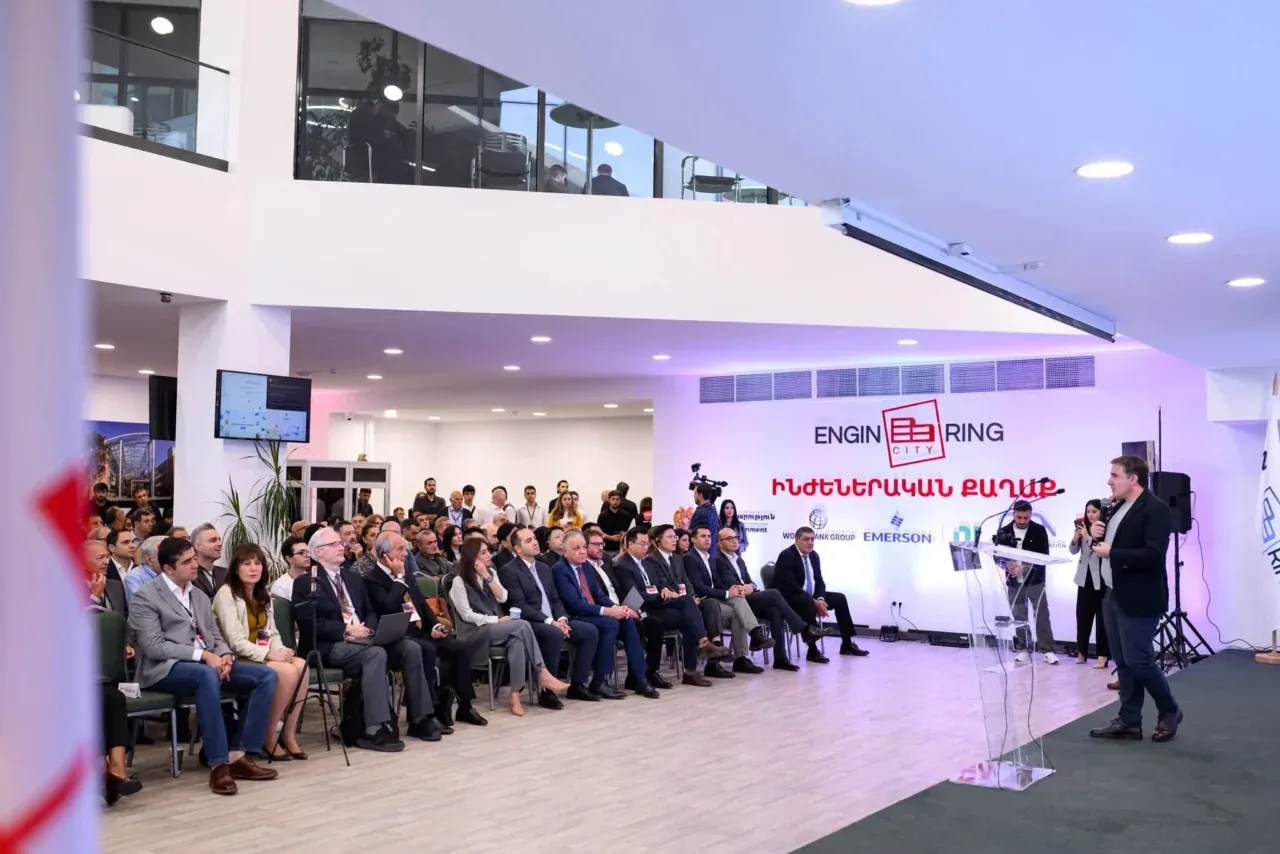
The 10th edition of Armenia Engineering Week 2026 has concluded in Armenia, bringing together engineering professionals, public and private sector representatives, research and educational institutions, international partners, and companies from Armenia and abroad. The event was held on October 2-4 in Yerevan and Vanadzor.
This year’s theme was “Physical AI: Engineering Intelligence for the Real World.” Over three days, discussions and demonstrations focused on the shift of artificial intelligence from digital environments into physical systems and on the development of innovative technology solutions in that field.
In his welcome remarks, Enterprise Incubator Foundation Director Bagrat Yengibaryan said engineering, high technologies, and artificial intelligence play an important role in Armenia’s technological development, the promotion of innovation, and the creation of new opportunities. He said Physical AI gives Armenia a chance to use its engineering and scientific potential, create new jobs, enter global markets, and position the country not only as a user of technology but also as a country capable of solving complex technological challenges.
The opening ceremony was followed by talks from international experts and thematic engineering panels. A key part of the first day was the engineering and high-tech exhibition, where Armenian companies presented innovative technologies and products. A special participant at the exhibition was the G1 humanoid robot, Jivan, which demonstrated how Physical AI can be applied in physical systems and create new opportunities for smart manufacturing.
Gurgen Mardoyan, Head of the Philip Morris PMI Science Research Center in Armenia, said the development of artificial intelligence should be accompanied by measurable results from its practical application. In his view, organizations are making major investments, but only a few are achieving real benefits, making it essential to rethink and improve processes through AI.
The second day of the program also included demonstrations, panel discussions, workshops, and professional tours. Participants visited the Science and Technology Museum, the Space Museum, and production facilities to see how engineering and technological solutions are turned into real products and practical applications.