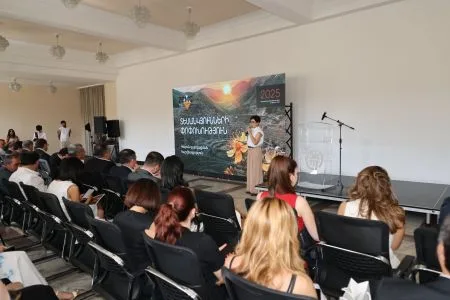
Zangezur Copper Molybdenum Combine has presented its fifth sustainability report for 2025, summarizing the company’s key performance indicators, changes in its governance system, and priorities for the period ahead.

One of the report’s main updates is an assessment carried out in line with the TNFD framework. ZCMC said it became the first company in Armenia to conduct such an assessment, reviewing the links between its operations and nature, as well as the related risks and opportunities.
In addition, the 2025 report includes a Double Materiality Assessment, or DMA, for the first time. The approach allows sustainability issues to be viewed both through the impact they may have on the company and through the impact the company itself has on the environment and society.
According to the company’s press service, ZCMC has worked with KPMG Armenia for a third consecutive year in preparing the report, while the external audit of the third report in the series was conducted by Grant Thornton Armenia. The document was prepared in accordance with GRI standards and guidance from the Sustainability Accounting Standards Board, or SASB.
The report was presented on September 15 at the National Polytechnic University of Armenia, with representatives of the professional community, government agencies, partners and other stakeholders in attendance. Opening remarks were delivered by ZCMC General Director Roman Khudoliy, National Polytechnic University of Armenia Rector Gor Vardanyan, and ZCMC Deputy General Director and Sustainability Director Armen Stepanyan.
Roman Khudoliy said sustainable development is a continuous journey shaped by changing international standards and by evolving expectations from society and investors. He said the company’s goal is to build a modern mining business that can compete globally while meeting higher standards in environmental protection, safety, social responsibility, corporate governance and transparency.
During the event, the National Polytechnic University of Armenia, ZCMC and the ZCMC Charitable Foundation signed a memorandum on institutional cooperation. Rector Gor Vardanyan said the university will soon present its own sustainability report, with support from the combine.
Participants at the presentation also discussed current and upcoming legislative requirements for sustainability reporting, as well as broader sustainability trends in Armenia’s private sector.
The report also shows that the company has developed a Climate Change Strategy for 2026-2040. It reflects ZCMC’s commitment to strengthening climate governance, aligning its operations with Armenia’s climate commitments under the Paris Agreement, and supporting the country’s transition to a low-carbon and climate-resilient economy.
The strategy sets out the company’s long-term climate ambitions, along with specific targets, implementation measures, governance mechanisms and areas of responsibility aimed at managing climate-related risks and opportunities effectively.
At the same time, the company continued improving the management and monitoring systems of the Artsvanik tailings storage facility in line with international best practice and GISTM requirements.
According to the report, the company’s total revenue in 2025 amounted to $723 mln, up 1.4% year on year. During the reporting period, ZCMC remained among Armenia’s largest taxpayers, ranking 3rd in the country. The source said the change was mainly linked to a lower level of royalty accruals compared with the exceptionally high figure recorded a year earlier.
Total payments to the state budget stood at about $73.5 mln, including profit tax of $34.7 mln and royalties of $38,86 mln. In 2025, the company produced 203,919 tons of copper concentrate and 15,548 tons of molybdenum concentrate.
ZCMC’s social investments totaled 18.2 mln, broadly remaining at the 2024 level. A significant share was directed to the enlarged communities of Kajaran and Kapan. The company’s direct contribution to Armenia’s gross domestic product is estimated at 2.5%, while headcount reached 4,828, up 3.7% from 2024.
As part of its commitment to responsible mining and environmental protection, the company continued phased land rehabilitation alongside its ongoing operations. Specifically, it rehabilitated 42,53 hectares of land, sowed 2 880 kg of seeds, and planted 4 209 trees and 340 shrubs.
The report also says environmental protection and biodiversity gained greater prominence on ZCMC’s agenda in 2025 as Armenia prepares to host the 17th Conference of the Parties to the UN Convention on Biological Diversity, COP17.



