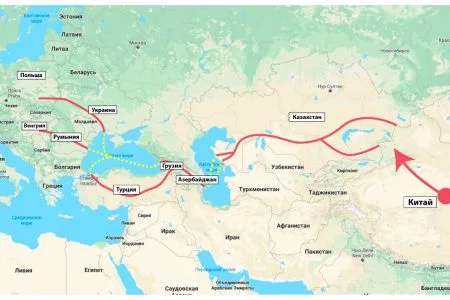
Participants at an international seminar in Warsaw discussed how to ensure the safe and uninterrupted movement of goods along the Trans-Caspian Transport Corridor. Representatives of Armenia’s State Revenue Committee attended the event, according to the SRC press service.
Armenia was represented by Mikael Khachatryan, customs attaché of the Republic of Armenia to the European Union and the World Customs Organization, and Tigran Mnatsakanyan, deputy head of the SRC department for customs service and control at land border checkpoints.
The seminar was organized by the European Commission, the German government and the German Agency for International Cooperation (GIZ), in cooperation with the Eastern Partnership program and Poland’s National Revenue Administration. Customs officials from 15 countries took part, including Armenia, Belgium, the Czech Republic, Georgia, Moldova, Poland, Romania, Turkey, Ukraine and five Central Asian states, along with representatives of international organizations such as EU TAXUD, ITC, UNECE and GIZ.
The event focused on sharing experience and developing practical solutions aimed at expanding customs cooperation and facilitating cargo movement along the Trans-Caspian Transport Corridor. Discussions covered international border control standards, interagency cooperation, customs data exchange, risk assessment and the use of ICT solutions.
Special attention was paid to the single-window principle in border control, joint inspections, and the harmonization of customs and transit procedures, including the eTIR system. Participants were also introduced to modern border control technologies and were able to see scanning equipment and mobile checkpoints in operation.
The program included a study visit to the Warsaw customs office. At the same time, participants identified the main bottlenecks along the Trans-Caspian Transport Corridor and discussed possible ways to address them.
Following the seminar, participants moved to drafting a Common Action Plan. They also agreed on the next steps and preparations for upcoming meetings.




