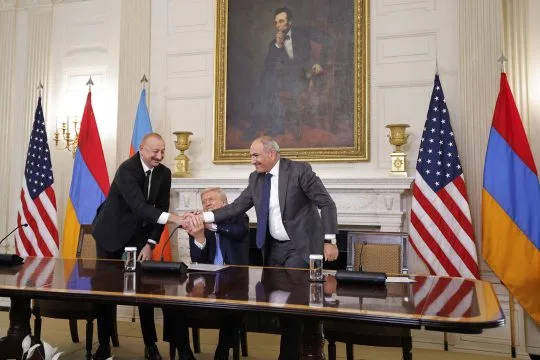
In an analytical article published by 1in.am, Hovhannes Mandakuni examines Prime Minister Nikol Pashinyan’s recent argument that long-term peace also needs an economic foundation. The logic, as described in the piece, is that Armenia, Azerbaijan, Georgia, Turkey and Iran should gain practical benefits from one another’s stability and prosperity.
The article says that if trade, transport routes, public revenues and wider welfare become tied to preserving peace, the countries of the region will have a shared incentive to avoid new shocks. Among the tools mentioned by Pashinyan are the opening of regional communications, the “Crossroads of Peace” initiative and TRIPP.
The author places this idea alongside Europe’s post-war experience. The analysis refers in particular to Robert Schuman’s 1950 proposal to place coal and steel production under joint management between France and West Germany, which led to the creation of the European Coal and Steel Community in 1951. The broader point is that durable peace usually requires not only political agreements but also everyday economic interests.
According to the article, open borders, railways and trade corridors give peace tangible value in the form of cargo flows, revenues, jobs, customs income and investment. When several countries benefit from the same system, the material cost of war rises and preserving peace becomes a shared economic interest.
The author argues that TRIPP’s political significance should be viewed through that lens. The piece says the Armenia–US framework agreement defines TRIPP as a project aimed at promoting regional communications, trade, peace and stability. At the same time, it stresses that implementation must remain fully under Armenia’s sovereignty and jurisdiction, including border control, customs procedures, security powers and law-enforcement authority.
In the author’s view, if stable trade begins through this route, Armenia’s strategic importance could change. The country’s stability would then become a direct interest for freight operators, investors, neighbouring states, the United States and broader regional economic networks.
The article also warns against excessive optimism about economic interdependence. It argues that interdependence contributes to security only when links are multilateral, routes are diversified, control remains sovereign and no single actor has an exclusive ability to shut the system down.
It specifically notes that excessive reliance on limited markets, individual gas pipelines, a single railway direction or one external partner does not create a reliable basis for stability. In times of crisis, such concentration can quickly turn into vulnerability.
From that perspective, the author says TRIPP’s strategic value should be measured by whether it gives Armenia more routes, broader markets and more diverse partners. If a new corridor merely replaces one dependency with another, the outcome will be limited. But if it links Armenia with the markets of Iran, Georgia, Turkey, Azerbaijan, Central Asia and Europe, the country’s geography could become a platform connecting several economic systems.
The article concludes that Pashinyan’s concept of a “peace economy” is an interesting political and economic experiment, but roads alone do not create peace. Peace becomes more durable when all sides have something to lose from closures and something to gain from keeping routes open.