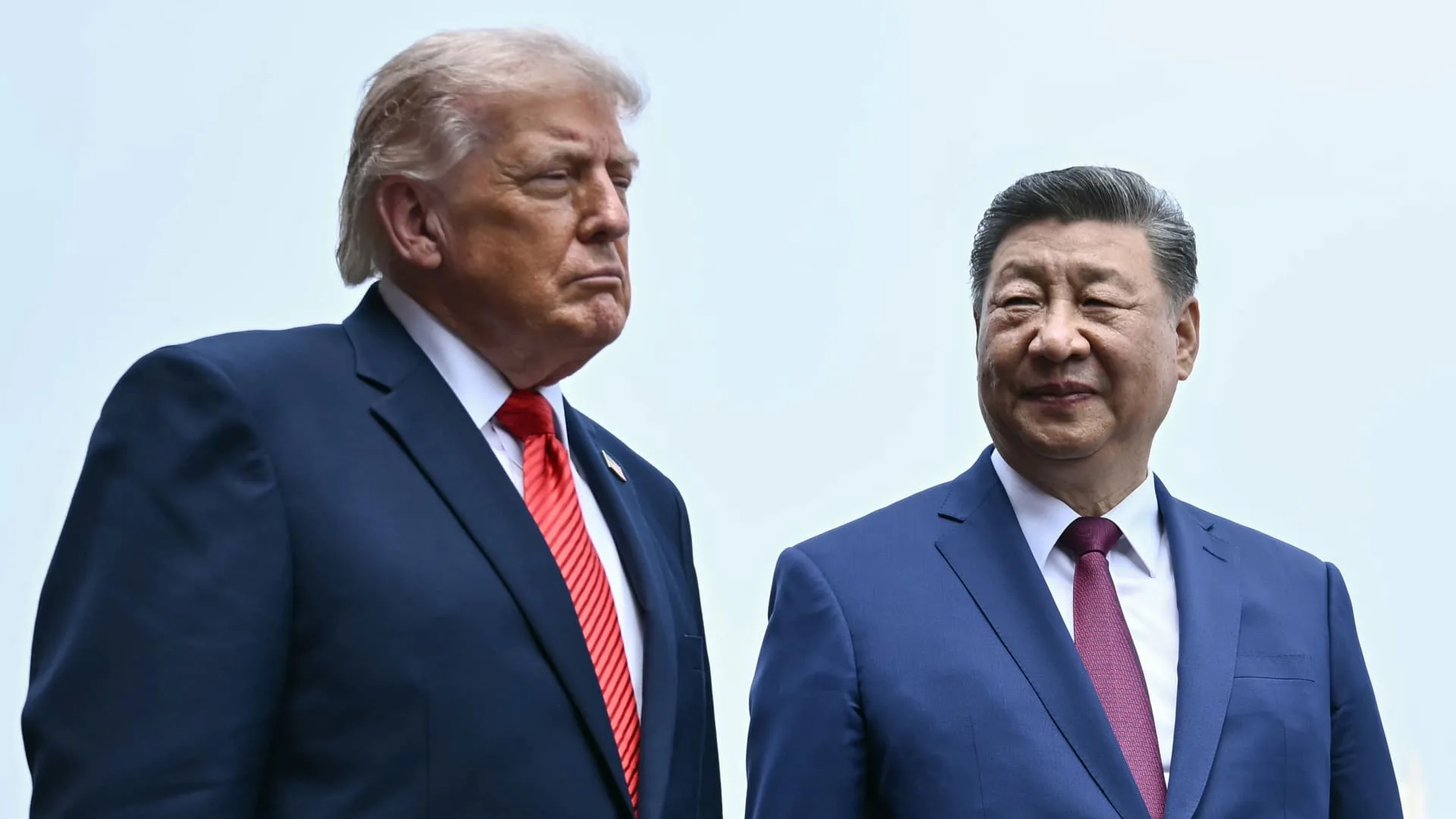
U.S. President Donald Trump and Chinese leader Xi Jinping are set to meet in Washington this week in an effort to shore up the fragile trade truce between the world’s two largest economies. But the talks are expected to be complicated by competition over artificial intelligence, shifting tariffs, Iran-related sanctions, export controls and long-running tensions over rare earths.
CNBC reports that, despite goodwill signals ahead of the summit, both sides have continued to trade accusations and retaliatory measures. Treasury Secretary Scott Bessent said on CNBC that the “great respect” between Trump and Xi helps the broader negotiation track, but he also acknowledged that China has not fully delivered on some commitments from the agreement reached nearly a year ago in Busan, South Korea.
Some analysts say Washington’s approach remains internally mixed. Claire Reade of the Center for Strategic and International Studies said Trump is setting the broad line on China while tougher actions continue at the margins.
Where trade stands
During last year’s sharp trade war, U.S. tariffs on Chinese imports climbed as high as 145%, while Beijing’s retaliatory duties reached 125%. Those rates were cut in May 2025 after negotiators struck a temporary deal in Switzerland, and the arrangement was extended in mid-August. Trump and Xi later reached a further understanding in Busan to scale back some of the back-and-forth trade restrictions.
Under that deal, China agreed to suspend export controls on rare earths and buy U.S. agricultural goods, while the United States reduced some tariffs and paused other retaliatory measures. The arrangement was designed to last one year and is due to expire on Nov. 10, one week after the U.S. election, unless it is extended.
Even so, tariff levels remain high on both sides. According to the Penn Wharton Budget Model at the University of Pennsylvania, the effective U.S. tariff rate on Chinese goods stood at 22.8% in July, the highest among major U.S. trading partners. The Congressional Research Service put the figure even higher, at roughly 36.5%, compared with Beijing’s 31% rate on U.S. goods.
U.S.-China goods trade fell nearly 30% in 2025, and the first seven months of 2026 showed a further decline, according to U.S. Census data. Still, China remains one of Washington’s most important economic partners, behind only Mexico and Canada. The U.S. goods trade deficit with China remains among the world’s largest at about $91.2 billion this year.
What the summit may deliver
Many analysts do not expect a major breakthrough. Bank of America Global Research said its base case is a one-year extension of the trade truce, which would preserve the current tariff framework and block new export controls. The bank’s analysts also said China could agree to additional purchases of U.S. goods, potentially including more Boeing aircraft.
After the meeting in Beijing, the two sides confirmed that China would buy 200 Boeing planes. Still, the same analysts expect only limited progress on other sensitive issues, including access to advanced semiconductors and any changes to existing export controls.


Ryan Hass of the Brookings Institution said both Trump and Xi appear to be aiming for modest gains while avoiding outright confrontation. In his view, that uneasy balance lets each leader show domestic audiences that the relationship with their top geopolitical rival is under control, while also buying time to reduce mutual dependencies.
Bessent also indicated that the current tariff truce is likely to remain in place. He said the issue was a central focus in weekend talks with Chinese Vice Premier He Lifeng.
The treasury secretary further suggested there has been movement on a proposed reciprocal $30 billion tariff reduction floated by Beijing earlier this month. He said U.S. Trade Representative Jamieson Greer has “operationalized” the idea as a “30-by-30 trade deal for non-critical goods.” Under that framework, the U.S. side would increase sales of agriculture, energy and medical devices, while China would ship more everyday consumer goods.
AI near the top of the agenda
Bessent has said artificial intelligence will be one of the leading topics in the Trump-Xi talks. The U.S. and China are seen as the two main competitors in a sector that is becoming increasingly central to the global economy.
Trump has tied AI leadership directly to U.S. economic strength and has pushed for rapid infrastructure buildout with minimal regulatory interference. At the same time, some U.S. AI executives have warned about the risks of advanced models developing too quickly. Trump had previously pushed back on those warnings, but on Monday he said the government “will rein things in if we have to,” hinting at a slightly more cautious tone.
Bessent also said he discussed with Chinese officials on Sunday the creation of a dialogue mechanism that would allow both countries to notify each other about AI-related incidents.
Iran sanctions in the background
U.S. sanctions policy toward Iran is also likely to weigh on Xi’s visit. Last month, Washington intensified economic pressure on Tehran by targeting its financial enablers, a move that immediately put attention on China as Iran’s top trading partner.
The Trump administration has said no country is exempt from potential sanctions, though it has not directly targeted Beijing so far. Bessent confirmed that the issue came up in weekend talks with Chinese officials, adding that quiet behind-the-scenes discussions are more effective than public confrontation and that Chinese financial authorities have been “very engaged in the process.”
Who will attend
As with the previous meeting in Beijing, a number of top U.S. business leaders are expected to attend the state dinner. According to a senior U.S. official, the guest list includes Amazon’s Jeff Bezos, Tesla and SpaceX’s Elon Musk, Google’s Sundar Pichai, Dell’s Michael Dell and Apple executive board chairman Tim Cook. CNBC had also previously reported planned attendance by JPMorgan Chase CEO Jamie Dimon, Citigroup chief Jane Fraser, Nvidia CEO Jensen Huang and OpenAI’s Sam Altman.
The report says Trump is preparing an elaborate welcome for the Chinese leader, including formal ceremonial events. Trump is also expected to greet Xi Jinping personally at Joint Base Andrews.



