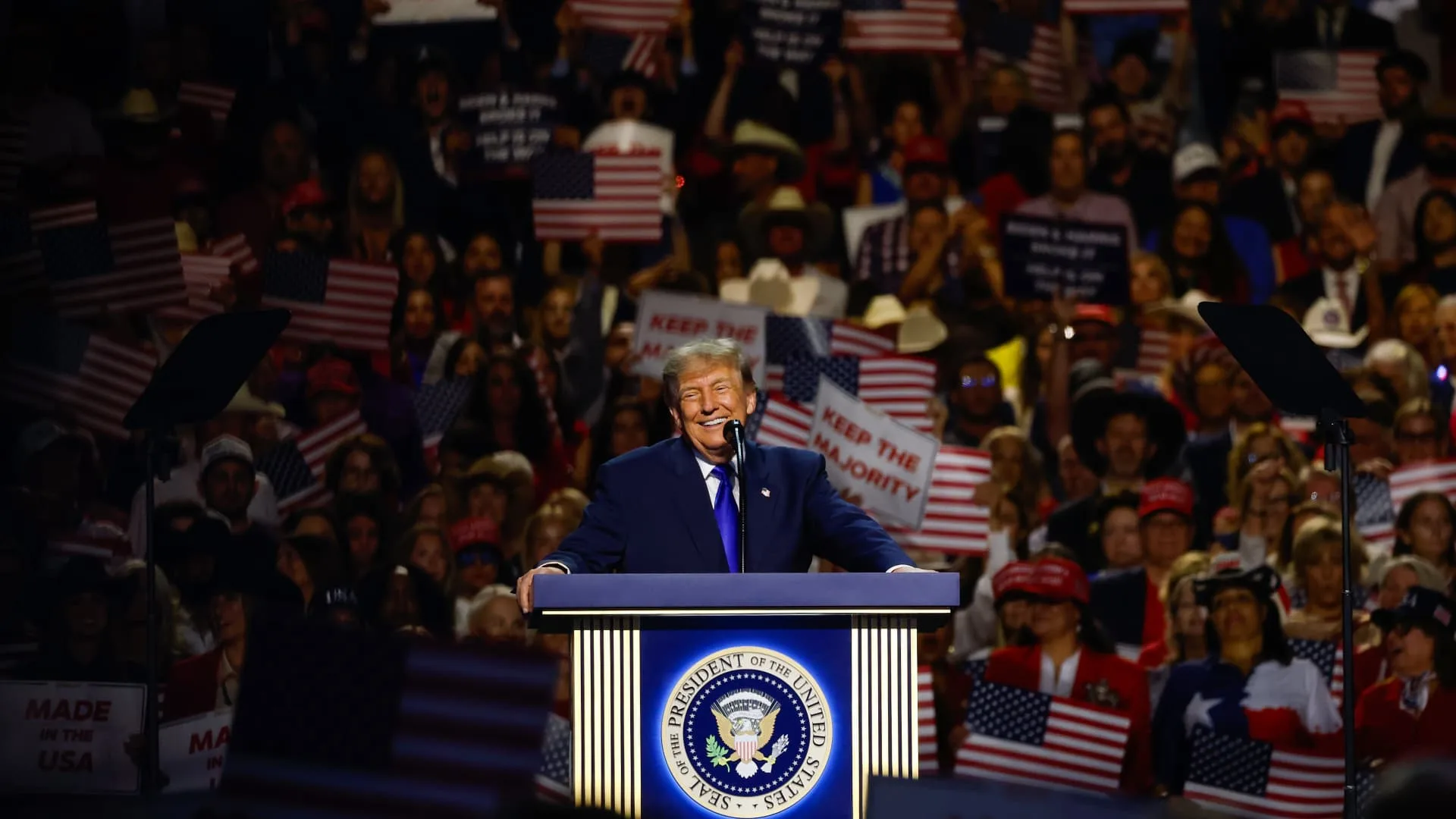
U.S. President Donald Trump said every adult American citizen would receive a $5,000 “dividend” if the Republican Party wins both the House of Representatives and the Senate in the upcoming midterm elections. He made the pledge at the GOP’s midterm convention in Dallas.
Trump told supporters that, because of the country’s economic “strength and success,” he would authorize the payment if Republicans take control of both chambers of Congress. He also urged voters to act as if he were personally on the ballot.
The U.S. midterm elections are due in early November. Current projections indicate that Democrats could win control of the House, a result that CNBC says would likely complicate Trump’s legislative agenda during his second term.


The fiscal burden of such a plan could be substantial. Estimates suggest the total cost of the proposed “Trump dividend” would exceed $1 trillion, raising questions about how it would be financed and what impact it could have on the federal budget.
CNBC notes that the potential payout is comparable to the $1.27 trillion the U.S. government has already spent on interest payments on the national debt so far in the fiscal year, as well as the $1.36 trillion committed to defense spending in 2026.
The U.S. budget deficit is approaching $1.8 trillion for the fiscal year to date. Between October and July, federal spending topped $6 trillion, leaving the deficit at roughly 5.8% of gross domestic product. At the same time, U.S. government borrowing costs have risen sharply in recent weeks amid concerns over sticky inflation, Treasury buybacks and elevated national debt. In the first quarter, debt stood at 122.6% of GDP.
Legal risks
The proposal may also run into legal obstacles. Under U.S. federal law, offering or making a payment to induce someone to vote, to withhold a vote, or to vote for or against a candidate is a criminal offense. Penalties can include a fine, up to one year in prison, or both, while a willful violation can bring up to two years’ imprisonment.
CNBC said it had contacted the White House for clarification on the legal implications of Trump’s proposal.
The report also points to a July finding by a bipartisan panel that tech billionaire Elon Musk likely broke state law by handing out $1 million checks to voters during the 2025 Wisconsin Supreme Court election. The Wisconsin Elections Commission referred two complaints to the Brown County district attorney’s office for a decision on whether Musk should face charges.
Trump has previously floated other direct-payment ideas that never materialized. Early in his second term, he backed a $5,000 “DOGE dividend,” which was supposed to distribute savings from cuts made by the now-defunct Department of Government Efficiency, then led by Musk. That plan was never implemented.
His proposed “tariff rebate,” a $2,000 payment to be funded by tariff revenue, also failed to materialize. The idea fell apart after the Supreme Court ruled against the legality of Trump’s tariff regime.
During the Covid-19 pandemic, Trump’s first administration and the Joe Biden administration spent trillions of dollars on direct household checks to support the economy. Some experts later argued that those payments may have contributed to the subsequent surge in inflation.



