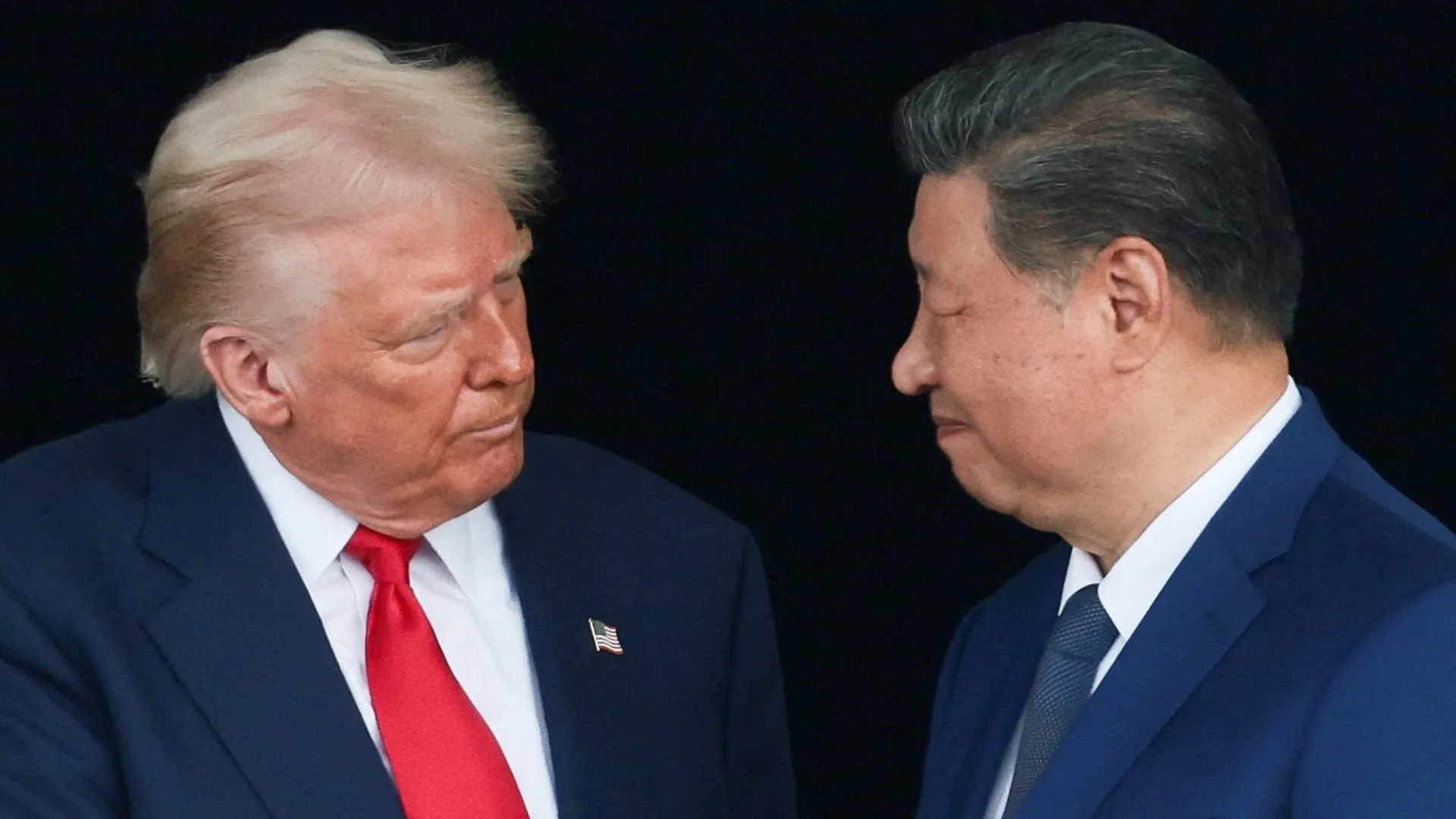
U.S. President Donald Trump is entering talks with Chinese President Xi Jinping at a time when Washington’s effort to isolate Beijing has become more difficult. CNBC reports that the shift reflects not only China’s expanding economic reach, but also growing strains between the U.S. and its traditional allies.
For years, Trump has sought to pressure China through tariffs, tighter access to advanced technology and efforts to persuade allies to cut their dependence on Beijing. Now, however, more countries are trying to preserve room to maneuver between Washington and Beijing rather than fully align with either side.
Analysts say the U.S. still holds major advantages through its alliance network and its control over critical technologies. But public confidence in Washington has weakened across several partner countries. Pew Research Center data released in June showed that the share of Canadians who see the U.S. as a reliable partner fell from 83% in 2022 to 35% in 2026. In Germany, the share of respondents who said Washington takes other countries’ interests into account in foreign policy decisions dropped from 60% in 2023 to 23%.
Ryan Hass, director of the John L. Thornton China Center at the Brookings Institution, said the U.S. still retains unmatched power globally, but turning that power into leverage requires a united front — and fewer countries are currently willing to follow Washington’s lead.


A changing global order
For decades, one of America’s biggest advantages over China was its broad network of allies and partners. When Washington imposed sanctions or technology restrictions, support from major European and Asian economies made those measures harder for Beijing to evade.
Lowy Institute data showed U.S. defense networks scored 81.4 out of 100 in 2025, compared with 18.9 for China. But experts argue Beijing does not need U.S. allies to switch sides to weaken that edge. It only needs them to become less willing to move in step with Washington.
CNBC says that since Trump returned to office, disputes over tariffs, defense spending and personal clashes have damaged U.S. relations with longstanding allies. Against that backdrop, Canada this month was invited to become the European Union’s first “associate member,” as Prime Minister Mark Carney’s government seeks deeper defense ties with Europe and less reliance on the U.S.
China, meanwhile, has tried to capitalize on that opening — not necessarily by persuading countries to choose Beijing over Washington, but by making the choice less binary. India is one example. It remains a U.S. security partner and a strategic competitor to China, yet it is also taking steps to stabilize relations with Beijing. Xi’s visit to India this month was his first in seven years, and bilateral trade reached a record $155.6 billion in 2025, according to Chinese data.
Economic pressure points
Washington’s main tools of pressure have been tariffs and export controls targeting China’s dependence on U.S. buyers, as well as its reliance on advanced semiconductors and manufacturing equipment. But Beijing has developed leverage of its own, particularly in rare earths.
Last year, China placed seven rare-earth elements under export controls, requiring companies to obtain government approval before shipping them abroad. According to the U.S. Geological Survey, China accounted for more than 70% of global rare-earth mining and more than 87% of refining and production in 2024.
That dependence has already had visible effects. Ford halted Explorer production in Chicago for a week because of magnet shortages, while Japanese and European auto suppliers also shut production lines as they waited for materials. In effect, the U.S. encountered the kind of vulnerability it had spent years trying to create for China.
That issue now hangs over the summit. The current trade truce expires on Nov. 10, and rare earths were again discussed in recent talks between Treasury Secretary Scott Bessent and Chinese Vice Premier He Lifeng. Bessent said the U.S. was open either to extending the current truce or to examining a broader deal.
At the same time, Washington still holds important cards. U.S. and allied firms control critical parts of the advanced semiconductor ecosystem, and American restrictions continue to limit China’s access to the most sophisticated chips and manufacturing tools. Trump has also allowed limited sales of Nvidia’s H200 AI chips to China while broader restrictions remain in place, making chip access another bargaining point.
Tests beyond trade
The bargaining dynamic is now extending beyond trade. A $14 billion U.S. arms package for Taiwan has been awaiting Trump’s approval for months. After meeting Xi in Beijing in May, Trump said he was holding the package in abeyance and called it a “very good negotiating chip.”
That has raised concerns among U.S. allies in Asia, who worry Washington could soften its position on Taiwan in exchange for economic concessions from Xi. Melanie Hart said Beijing’s objective goes beyond a single arms package: it is trying to convince Trump that a broader deal with Xi Jinping is taking shape, one that could require the U.S. to hold back support for Taiwan.
The article also points to Iran as another test case. The U.S. has spent decades trying to isolate Tehran, while Beijing has maintained economic and diplomatic ties, including frequent purchases of Iranian oil. Xi has offered to help mediate the conflict, but CNBC says neither Washington nor Tehran appears to be seeking an immediate off-ramp, limiting what China can achieve in the near term.
In CNBC’s assessment, the Trump-Xi summit will test whether frictions with U.S. allies have reduced Washington’s ability to turn economic and diplomatic pressure on China into practical leverage.




