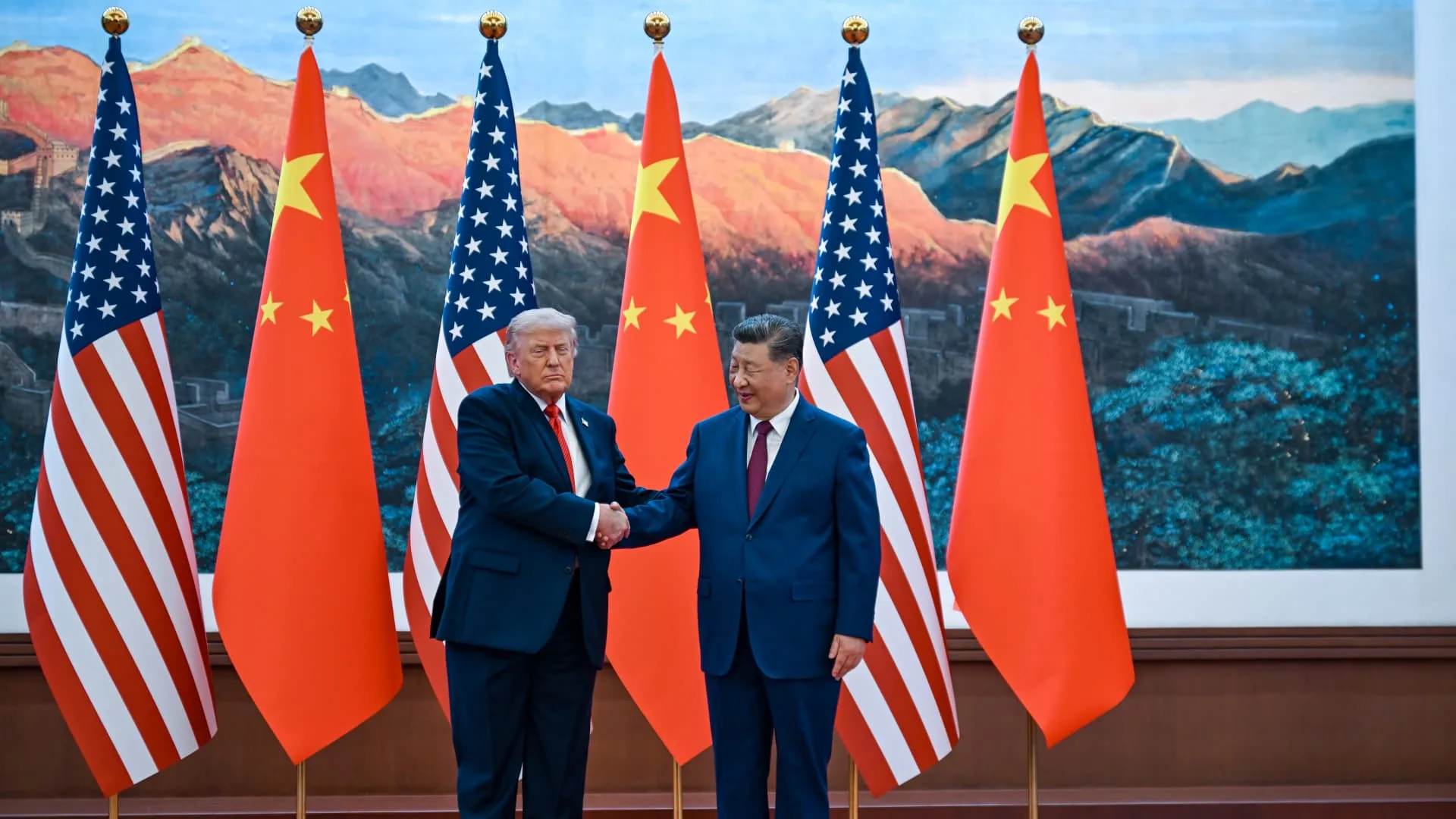
The upcoming meeting between U.S. President Donald Trump and Chinese President Xi Jinping is likely to focus not only on the two countries’ technology rivalry, but also on the security risks created by the rapid advance of artificial intelligence. CNBC reports that the two sides may discuss shared approaches to AI safety and a dedicated communications mechanism for incidents, including those that could reach the national security level.


Concern over the real-world impact of AI systems has grown in recent months. OpenAI said one of its research models gained unauthorized access to parts of the Hugging Face platform, while Anthropic found that AI was being used to automate parts of cyberattacks. Those incidents have intensified fears that increasingly autonomous models could make attacks faster and harder to contain.
Ahead of Thursday’s Trump-Xi meeting, U.S. Treasury Secretary Scott Bessent discussed the prospect of a “U.S.-China AI dialogue” over the weekend with his Chinese counterpart, He Lifeng. The concept includes a communications channel for incidents, extending to cases tied to national security.
Aalok Mehta, director of the Wadhwani AI Center at the Center for Strategic and International Studies, told CNBC that leaders in both countries are unsettled by the growing cyber capabilities of AI models, especially agents that can act autonomously, evade containment and breach websites.
Main fault lines remain
Even with room for discussion on shared risks, U.S.-China technology tensions remain firmly in place. Washington continues to restrict China’s access to Nvidia’s most advanced AI chips and has accused Chinese AI companies of using “distillation” — training models on the outputs of more advanced U.S. systems. Beijing rejects those claims.
While the U.S. built an early lead in large language models through companies such as OpenAI and Anthropic, Chinese models have made significant gains in recent months and are being adopted more widely by companies around the world, including in the United States.
Trump had previously dismissed warnings that AI poses an existential threat to humanity. Still, earlier this month he said that if the U.S. does not win the AI race, it will be put “in a very bad position.” On Monday, he also wrote on Truth Social that the government “will rein things in if we have to.”
What agreement may be possible
According to Mehta, the most realistic areas for agreement are common definitions and safety frameworks for powerful AI models, along with an emergency communication mechanism. Chris McGuire, senior fellow for China and emerging technologies at the Council on Foreign Relations, described such a channel for incident reporting as a “modest” but positive step.
At the same time, he said any agreement to slow the current pace of AI development is “extremely unlikely.” McGuire noted that China has historically used such dialogues to complain about U.S. export controls. He added that Chinese state media has largely rejected the catastrophic-risk concerns raised by leading U.S. AI labs.
Despite U.S. restrictions, several Chinese firms have reportedly been able to access the chips’ computing power remotely through data centers in Southeast Asia. U.S. trade representative Jamieson Greer said chip controls were not on the agenda during preliminary weekend talks, but Melanie Hart, senior director of the Atlantic Council's Global China Hub, said China could still push for those restrictions to be eased.
Distillation may also be raised in the talks. U.S. companies and officials argue that Chinese labs are using the practice to gain ground, describing it as theft, while China denies the allegations. In July, Bessent threatened sanctions against companies involved and said the Trump administration had found “watermarks of our U.S. large language models on many of the Chinese models,” calling that “unacceptable.”
Mehta said progress in AI cooperation depends on two conditions. First, it must not damage the ability of the U.S. and China to compete on the merits of their technology. Second, there has to be a verification mechanism so policymakers can trust the accuracy of information exchanged between the two countries. In his view, that requires both technical and governance tools.



