
Argentina’s oil sector is continuing to expand rapidly even as other parts of the economy remain under pressure from Javier Milei’s harsh austerity program. Official data show that oil production reached a record 902,920 barrels per day in July 2026, up almost 1% from June and 12% higher than a year earlier.
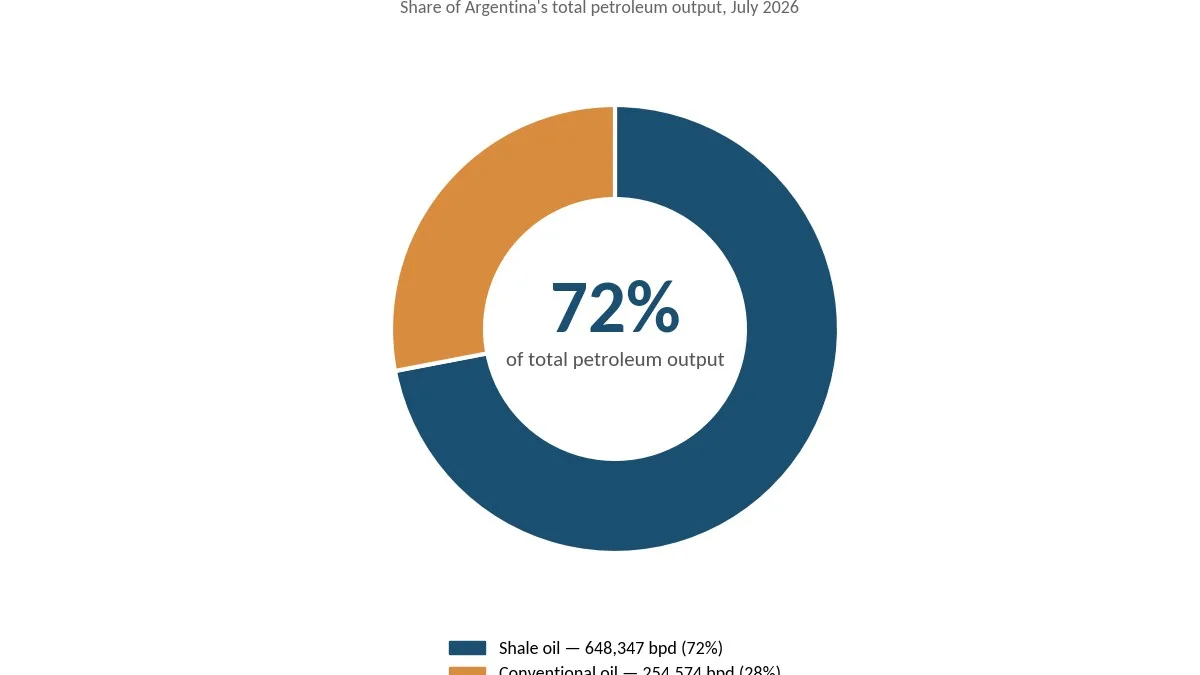
The main growth engine is the Vaca Muerta shale play in northern Patagonia, in Neuquén Province. Shale oil output climbed to 648,347 barrels per day in July, rising 1.2% month on month and 26% year on year. That lifted shale oil’s share of Argentina’s total crude production to a record 72%.
Natural gas production also remained strong, although the July figure edged lower. Total gas output averaged 5.6 billion cubic feet per day, down 0.5% from the previous month and 1.6% from a year earlier. Even so, gas production has increased 21% over the past five years, underscoring the sector’s longer-term expansion.
Shale gas production reached 3.9 billion cubic feet per day in July. That was nearly 1% below the June level but almost 4% above the figure recorded a year earlier. It was the second-highest monthly shale gas output on record, surpassed only by June 2026, when production hit 3.94 billion cubic feet per day. Shale gas now accounts for 70% of Argentina’s natural gas output, another record high.
At the same time, conventional oil production continues to decline. Government data show July 2026 conventional output at 254,574 barrels per day, down 2% from a month earlier and 13% lower than a year before. That suggests conventional production has fallen by about 50% over the past decade.
According to the report, Vaca Muerta is already the world’s second-most productive shale play after the Permian, though much of its potential remains undeveloped. Its geology — including thicker shale, richer organic content and higher reservoir pressure — helps wells maintain strong output for longer.
Investor interest is also supported by relatively low breakeven costs of $36 to $45 per barrel. As some mature U.S. shale plays approach their peak or move into decline, international drillers are increasingly looking abroad for new growth opportunities.
Against that backdrop, Continental Resources, founded by billionaire Harold Hamm, joined Phoenix Global Resources in bidding during a licensing round held by Neuquén province in August 2026. Continental later agreed to acquire a 50% stake in Phoenix Global Resources, forming an equal joint venture with Mercuria Energy Group, one of the world’s largest independent commodities traders.
Other major players are also stepping up activity in Vaca Muerta. Billionaire investor Peter Thiel recently acquired a 1% interest in Vista Energy worth around $76 million. Vista Energy is the second-largest oil producer in Vaca Muerta after national oil company YPF. Chevron, Shell and BP are also active in the formation.
Chevron has announced plans to invest $13.8 billion to develop its wholly owned El Trapial acreage in the northern part of Vaca Muerta. The project was filed under Javier Milei’s RIGI large-investment incentive regime. The framework applies to major projects above $200 million and offers 30-year guarantees of regulatory, tax and foreign-exchange stability, shielding investors from more burdensome future rules.
Chevron controls two blocks there: El Trapial-Curamched, a conventional oil operation, and El Trapial-Este, an unconventional concession. The company has disclosed few details so far, but early results are described as encouraging. Chevron plans to drill ultra-long horizontal wells of more than 3 kilometres to further develop Vaca Muerta’s resources.
Oil has already become Argentina’s second-largest export after soybeans. That is helping offset some of the economic strain created by Milei’s austerity policies, even as the country’s broader social and economic conditions remain difficult.



