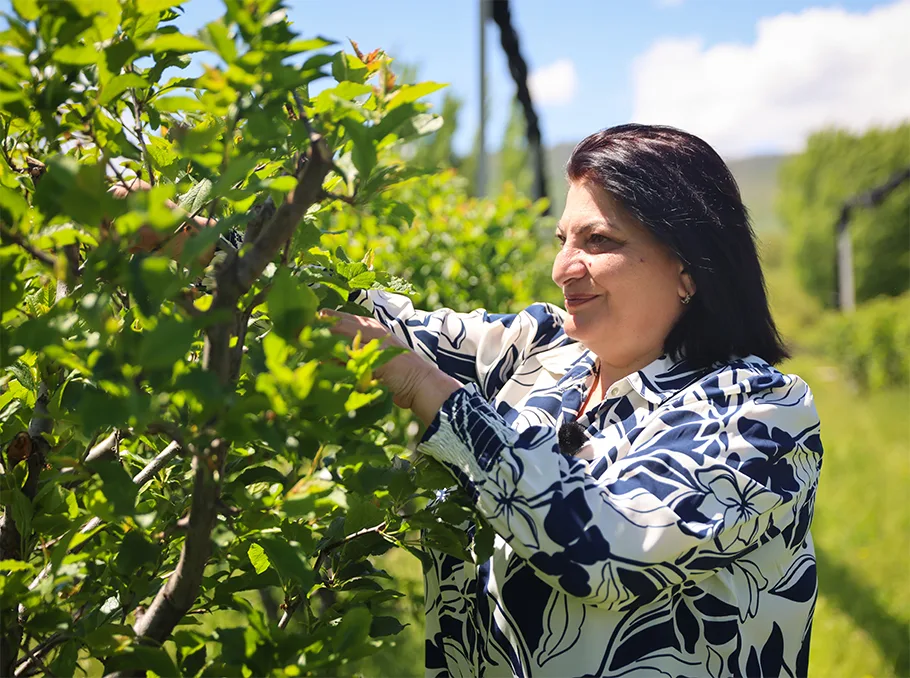
In Teghenik village in Armenia’s Kotayk region, Gohar Movsisyan has spent years turning rural routine into a business and a platform for creative work. In 2017, she founded Bari Farm, a company focused on organic agricultural production and processing.
The farm includes plum, apple and walnut orchards, a buckwheat field, and a vegetable garden with both traditional and non-traditional crops. Bari Farm entered the market with organic buckwheat and later gradually broadened its product range.

Movsisyan is a biology teacher by profession and has worked at a school for more than 35 years. She says working the land was never unfamiliar to her: she grew up in the village, watched her parents cultivate the soil, and later, while already teaching, continued tending the family’s small garden.
At some point, she says, she realized farming was more than a routine task for her. It was work she genuinely loved, especially because it allowed her to create something new. That realization became the starting point for Bari Farm.

The early years of the business were difficult. Several years ago, when the buckwheat field had ripened and harvest day had arrived, a severe hailstorm on July 25 destroyed the entire crop. Movsisyan says all the investment made in that field was wiped out in a single day, but setbacks like that did not force her to abandon the project.
Today, Bari Farm is no longer only about buckwheat. Over the years, the business has expanded to include organic plum, apple and walnut orchards, a vegetable garden, and oyster mushroom production. Movsisyan says she likes introducing new ideas to the farm and has worked to localize crops such as lemon balm, lavender, oregano, mint and kale alongside more familiar varieties.

Two years ago, with the support of AgriConcept, Bari Farm opened a small processing facility where it produces dried fruit and cider. Movsisyan says the work is rooted in a love for the land, the village and agriculture itself.
She notes that in the past, villagers largely produced the same goods, which made sales harder and limited room for growth. When she began thinking about organic agriculture, her family supported her, but many around her said it would not work in Teghenik.

Movsisyan speaks with particular care about her plum orchard of 300 trees, planted in a place where she had long dreamed of having a garden. The orchard was established according to organic principles and is equipped with drip irrigation and anti-hail netting. It stands 20-25 meters away from the intercommunity road, although the required buffer zone was at least 8-10 meters. Fertilization is done with locally prepared humus or compost, while treatments are made using the farm’s own infusions.
She says the orchard frequently faced frost problems in its early years, and many people advised her to remove the trees because yields were too low. She refused to give up, and now that the trees have matured and their resilience has increased, some of those difficulties have eased.


Before Bari Farm, Movsisyan and her husband ran a small bread production business. She recalls that repeating the same lavash recipe every day became exhausting over time, and that was when she understood she wanted to do work that demanded constant development and gave space to pursue bold ideas.
That is how, she says, they launched Bari Farm without a large sum of money or upfront investment — with a plot of land, seed, principles, commitment and one old tractor. She also notes that she can drive a tractor: she studied machinery at school and held a driving certificate.

She says none of this would have been possible without persistence, optimism and family support. In her view, agriculture is a difficult sector, and even more so for women, especially where access to machinery and the practical skills to operate it are limited.
Movsisyan has taken part in many events in Armenia and in European countries, and she has shared what she learned with fellow villagers. She says her background as a teacher has helped her pass knowledge on to others and make a difference in their lives.

Bari Farm also tries to follow a circular approach in agriculture. Movsisyan says nothing is thrown away on the farm. For example, cherry pits left over from making jam and dried fruit were turned into small heating pads that can be used both as children’s fine motor skill tools and, once warmed, as localized heat packs.
That idea became the basis for the “Baleni” box, which also includes tea made from cherry leaves, cherry jam and dried fruit. The farm says even by-products can be turned into added value.
Movsisyan also hosts visitors at Bari Farm through cooperation with local and international organizations, helping promote organic agriculture and healthy food culture. She also works with the National Agrarian University of Armenia, giving students an opportunity to complete practical training at her farm.

Sales are conducted mainly online, although guests visiting the farm also frequently make purchases. Movsisyan says it carries a certain symbolism for her when other farmers or international partners from different countries take Bari Farm products with them, allowing them to reach places such as Austria or the United States.
She stresses that production volumes are still small and the company is not considering exports yet. Still, the fact that the products end up in other countries and generate messages of thanks from abroad is, she says, of great value to the team.

According to Movsisyan, agriculture constantly brings new challenges — frost, hail and spoiled harvests. But those are also the moments, she says, when farmers learn, become stronger and find solutions.
The article was prepared and published within the framework of the “TsATK: educational programme for women’s progress and economic sustainability,” financed by AGFUND and implemented by the United Nations Population Fund (UNFPA). Mediamax bears responsibility for the content, which does not necessarily reflect the views of AGFUND and UNFPA.




