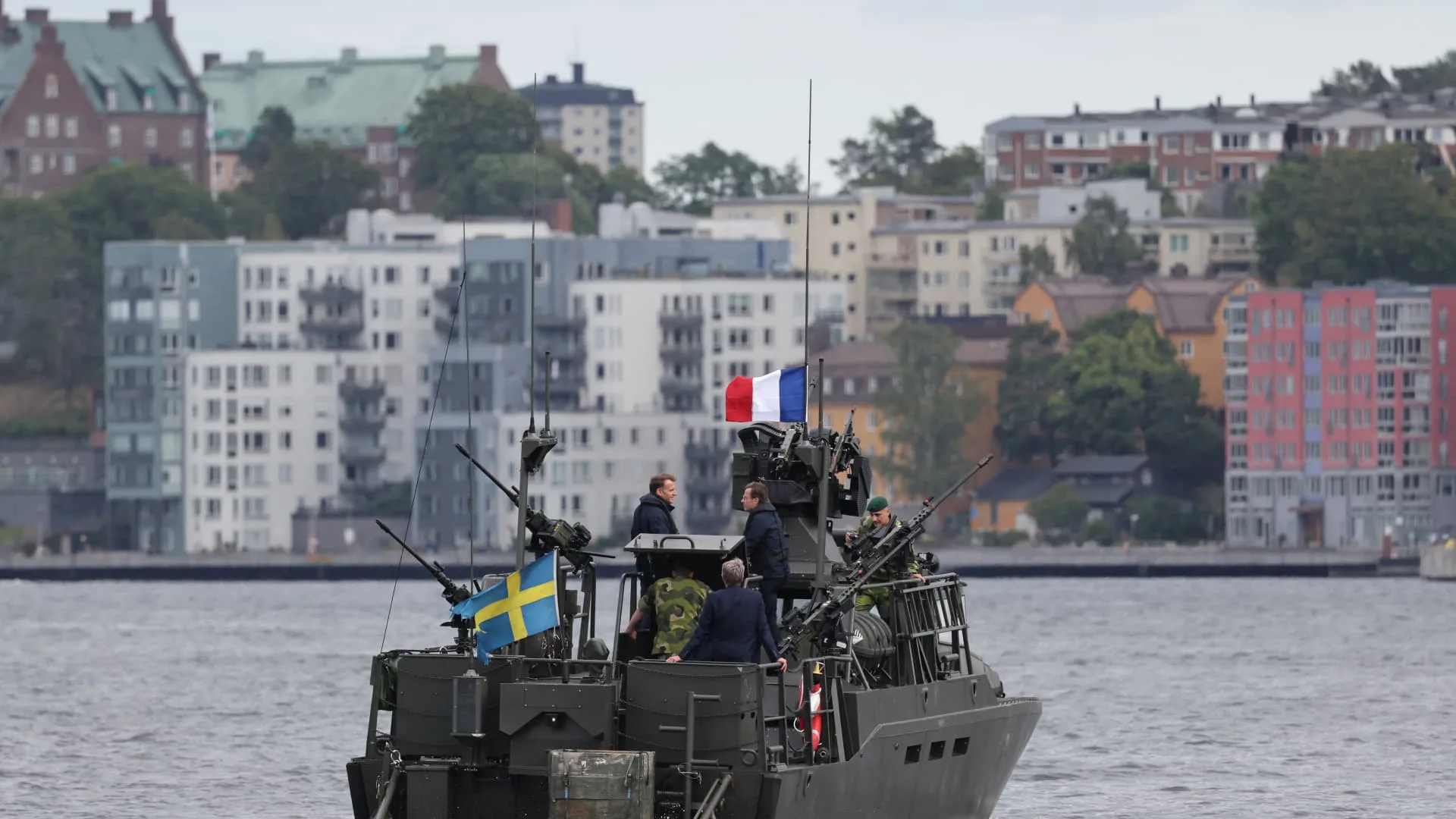
Swedes vote on Sunday, but whoever forms the next government will inherit more than a political challenge. The country is facing a difficult fiscal equation as structurally higher defense spending collides with rising demands on the welfare state and less room to fund both.
SEB Chief Economist Jens Magnusson told CNBC that election campaigns usually come with a long list of promises, but those pledges may face a “rather hard crash” once they meet post-election reality. In his view, Sweden cannot keep cutting taxes, raising spending and borrowing the difference indefinitely.
Most pre-election polls have shown Sweden’s center-left opposition parties, led by the Social Democrats, ahead, though that lead has narrowed as the Moderate Party government of Ulf Kristersson has regained support. The current government also relies on backing from the far-right Sweden Democrats, which the center-left has refused to work with, leaving the shape of any post-election coalition uncertain.
A new security environment comes at a cost
Sweden joined NATO in March 2024, ending more than two centuries of military non-alignment after Russia’s full-scale invasion of Ukraine. Last year, NATO members agreed to lift defense spending to 3.5% of GDP by 2035, plus another 1.5% for defense- and security-related needs.
According to the Stockholm International Peace Research Institute, Sweden’s military spending rose sharply between 2022 and 2025 as the country embarked on a major rearmament push. Even so, foreign policy has remained largely absent from the campaign. Political scientists say that is not because security matters less, but because there is limited disagreement among the main parties over Russia, NATO and continued support for Ukraine.
Jonas Tallberg, a political science professor at Stockholm University, said virtually all parties are signaling that voters will need to accept defense as a much larger part of the budget. The real debate, he argues, is not whether Sweden should invest in defense, but how that investment should be paid for.
That is where the core trade-off appears. Rising defense budgets, Tallberg said, have to come at the expense of something else, most often parts of the welfare state or foreign aid. Swedbank Chief Economist Mattias Persson likewise acknowledged a tension between defense and welfare spending, while stressing that policymakers see secure borders as a precondition for preserving the welfare model.
Russia, Donald Trump and economic uncertainty
While Russia remains the main driver of Sweden’s rearmament, U.S. President Donald Trump’s approach to NATO has added another layer of uncertainty. European governments are simultaneously building up their own deterrence against Russia and preparing for the possibility that they may need to shoulder more of the continent’s security burden themselves.
Tallberg said part of Sweden’s defense investment is aimed at deterring any potential Russian aggression, while another part is meant to strengthen the “European pillar of NATO” at a time when European allies are less certain about continued U.S. commitment to the alliance. Magnusson also cautioned against treating Donald Trump as the primary explanation for Sweden’s defense buildup. Russia’s invasion of Ukraine and Sweden’s subsequent NATO entry would have pushed spending higher anyway, he said, although pressure from Washington has clearly reinforced the shift.
Donald Trump’s trade policies are another source of uncertainty for Sweden’s small, export-dependent economy. Even so, both Magnusson and Persson said the impact so far has been less severe than first feared. Tallberg added that Donald Trump himself is unlikely to decide many votes on Sunday, because the major parties are broadly aligned on how Swedish foreign policy should be conducted.
Limited fiscal headroom
Sweden enters the election from a relatively strong fiscal position. Government debt stands at a low 35% in 2025 by international standards and is forecast to rise to 39% this year, while Swedish households’ disposable incomes have held up relatively well.
Still, both SEB and Swedbank say the next government will have far less room for unfunded reforms than in recent years. Magnusson said the government deployed around 80 billion Swedish kronor in unfunded reforms this year, alongside another 45 billion to 50 billion kronor in defense spending and support for Ukraine outside the normal fiscal framework.
That model has allowed Sweden to boost domestic spending, cut taxes and finance its security commitments at the same time. But Magnusson said it is not sustainable forever. He expects higher defense spending to remain a structural shift for at least the next five to 10 years, ultimately implying either higher taxes, lower spending elsewhere or more debt.
Persson also said Sweden can still afford, for now, to maintain its welfare state, raise defense spending and keep public finances sound. Over the next few years, however, he argued that defense spending needs to be brought back into the country’s normal budget process.
That fiscal constraint clashes with a campaign dominated by promises on health care, schools, migration, law and order, and household finances. Jan Teorell, a political science professor at Stockholm University, said foreign policy has historically played only a limited role in Swedish elections, and NATO membership has not fundamentally changed that. In his view, this campaign may be more of a welfare election than Sweden has seen for quite some time.
Economists also point to another paradox: household finances remain comparatively strong, yet the political debate is full of pledges aimed at easing pressure on voters’ wallets. Persson noted that in both Sweden and the U.S., households often believe inflation is much higher than it actually is.
Teorell also pointed to government measures introduced to cushion households from the economic fallout of the U.S.-Iran war and disruption around the Strait of Hormuz, suggesting those moves may have pushed purchasing power even higher up the political agenda. But as Magnusson put it, no matter which party is making the promises now, many of them are likely to be scaled back after the election.





