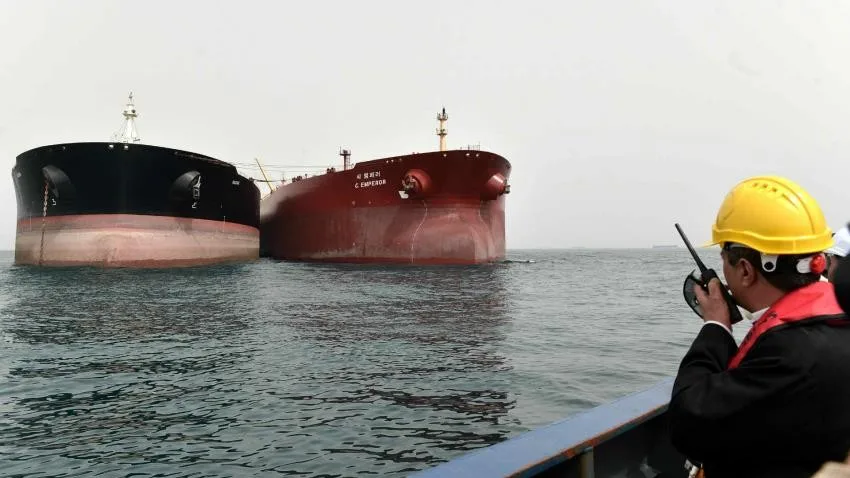

Standard Chartered analysts say the market floor for oil prices has moved higher as the US-Iran standoff persists and physical risks to Middle East exports intensify. Even after a pullback in prices, the bank argues that a sizeable geopolitical premium remains embedded in the market.
On Wednesday, Brent crude for November delivery was down 2.88% at 2:18 p.m. ET, trading at $105.6 per barrel, while October WTI futures fell 3.33% to $102.3. At the same time, the U.S. Federal Reserve raised interest rates by 25 basis points to a range of 3.75% to 4.00%, the first increase since 2023. Policymakers also signaled one more hike before year-end.
Higher rates would normally weigh on oil by slowing economic activity, strengthening the U.S. dollar and increasing the cost of holding inventories. But StanChart says the prolonged US-Iran deadlock and rising risks to regional exports should keep prices supported above a higher floor.
The bank notes that a planned diplomatic meeting between Iran and Gulf Arab states on commercial shipping through the Strait of Hormuz was postponed on Tuesday because of a lack of Arab consensus, reducing hopes for a near-term de-escalation.
Regional tensions have also risen because of new security developments. Last week, Iran-aligned Houthi forces in Yemen seized the strategic Red Sea port of Mocha and launched heavy drone and missile strikes on Saudi Arabia’s King Khalid Air Base. A subsequent drone strike from Iraq damaged a key pumping station on Saudi Arabia’s East-West oil pipeline near Riyadh and Medina.
Bahrain had already said it would boycott the forum, arguing that regional security cannot be preserved through a policy of appeasement, and cited the pipeline strike as evidence that Gulf infrastructure remains under threat. Oman then postponed the meeting after Saudi Arabia objected to the proposed wording, and the kingdom did not attend either.
Drone attacks have forced Saudi Arabia to shut its East-West crude pipeline, an important export alternative that bypasses Hormuz. StanChart says the damage materially increases near-term export risk, with the key bypass route to Yanbu likely to remain largely out of service for several weeks.
According to the bank’s estimates, Saudi Arabia has only around one week of crude stocks at its ports to sustain exports at current rates. If the outage lasts longer, the kingdom would have to rely more heavily on already constrained routes through Hormuz, putting a substantial share of export supply at risk.
At the same time, Houthi advances along Yemen’s Red Sea coast and around Bab el-Mandeb are increasing the risk to tanker transit through the Red Sea. That could add war-risk insurance, freight and rerouting costs. In StanChart’s view, the issue is not only potentially tighter crude availability, but also the higher cost and lower reliability of moving Gulf barrels to market.
The bank also argues that the disruption exposes a deeper weakness in assumed supply optionality. The East-West pipeline had been viewed as part of the solution to Hormuz risk because it allowed Saudi crude to reach the Red Sea without passing through the strait. Now that infrastructure itself has become vulnerable, while the alternative maritime route through the Red Sea and Bab el-Mandeb is also facing heightened geopolitical risk.
StanChart therefore expects the geopolitical premium to remain elevated as disruption risk now affects both Hormuz-linked flows and alternative export infrastructure. Oil prices, it says, may continue to see sharp corrections even when headlines appear more constructive.
In Europe’s natural gas market, prices have also retreated from recent highs but remain close to 2022 levels amid supply concerns ahead of winter. Dutch TFF gas futures fell from last week’s nearly four-year high of €82.84/MWh to €77.66/MWh on Wednesday. Even so, StanChart still sees the outlook for gas as bullish.
The bank cites Gas Infrastructure Europe (GIE) data showing that European gas storage is about 68% full, which is 16.3 percentage points below the five-year seasonal average. At the same time, LNG export flows from Qatar remain severely limited. Among EU countries, inventories are lowest in Germany at about 56% and in the Netherlands at about 52.5%. Germany’s Economy Minister Katherina Reiche recently expanded the autumn market tender for Long Term Options (LTOs), offering financial incentives to encourage traders to redirect gas supplies into the country.



