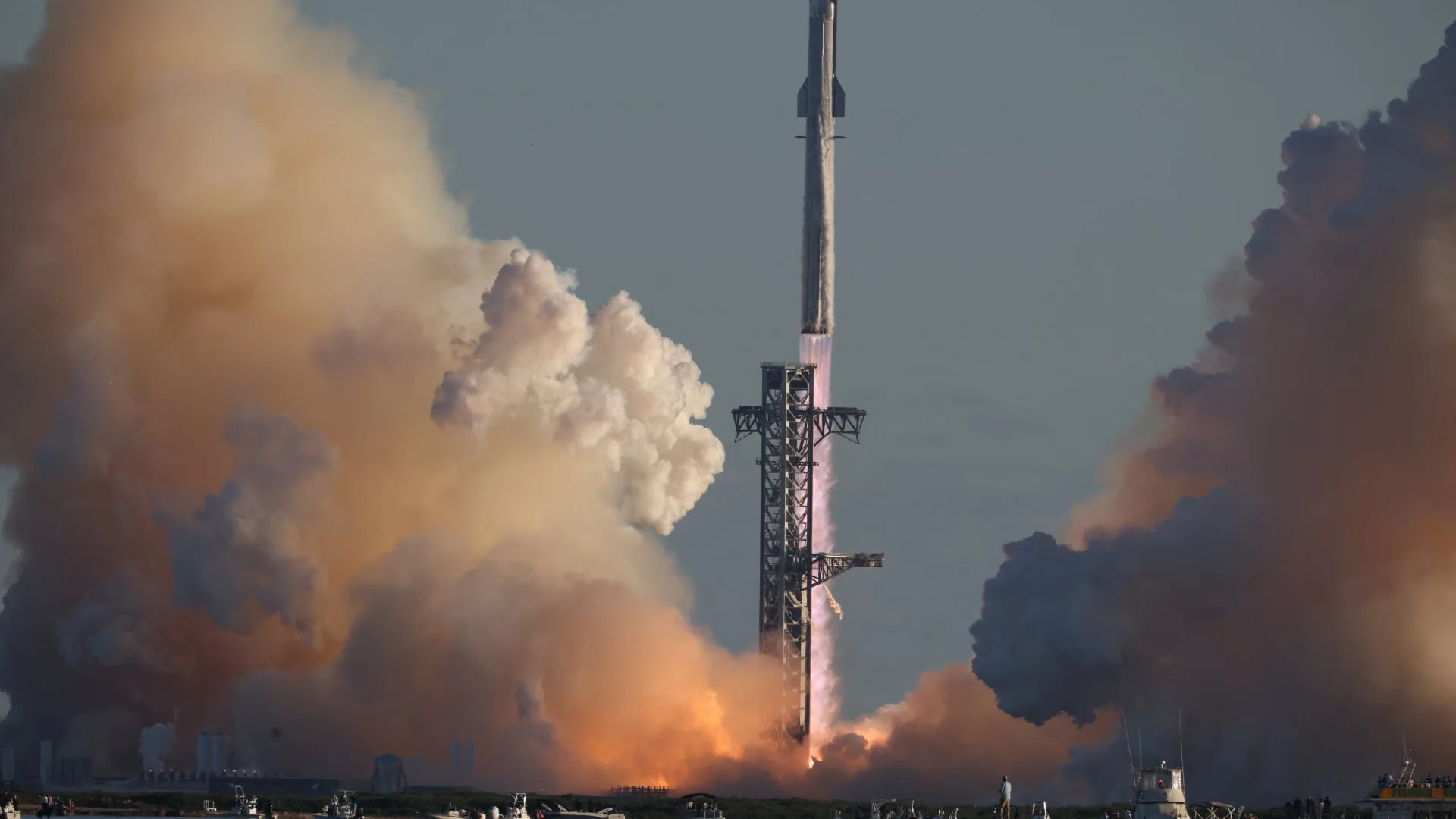

SpaceX on Friday carried out the 15th test flight of its massive Starship rocket, but failed to recover either stage. The vehicle lifted off from the company’s Starbase facility in South Texas at 4:47 p.m. local time, or 5:47 p.m. ET.
Test Flight 15 was the most ambitious Starship mission so far. Elon Musk’s company was attempting for the first time to catch and reuse both the booster and the upper stage, or spacecraft portion, of the rocket. The booster was not recovered and was instead diverted to splash down in the Gulf of Mexico, where it burst into flames.
Earlier the same day, SpaceX received authorization from the Federal Aviation Administration. Hours later, the FAA imposed a nationwide ground stop because of communication problems affecting multiple air traffic control centers, but an FAA spokesperson told CNBC that SpaceX’s license was not affected.
The upper stage continued into orbit after the failed booster recovery attempt. SpaceX expects the vehicle to circle the Earth a total of 14 times and, if the mission proceeds successfully, to return for a landing at Starbase on Saturday.
Starship is a critical program for SpaceX’s business plans. The company sees it as essential both for eventually sending cargo and people to the Moon and Mars and, in the near term, for expanding its Starlink satellite internet network. SpaceX says it already has more than 11,000 active satellites in low Earth orbit, and one Starship can carry up to 60 Starlink v3 satellites, about 20 times the capacity of earlier Falcon 9 rockets.
SpaceX deployed 26 v3 satellites on the previous Starship test flight and released another 26 during Friday’s mission. At the same time, the company is facing renewed criticism over restrictions on its Starshield service in Ukraine after Volodymyr Zelenskyy said limits were again imposed without warning, hurting the country’s ability to defend against Russia’s ongoing aerial attacks.