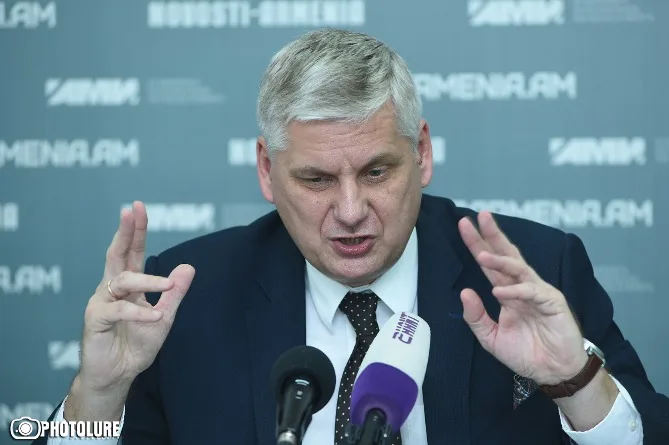

Political ties between Armenia and France are deepening rapidly, but the practical benefits for Yerevan remain limited so far, according to Sergey Markedonov, a lead researcher at the Institute of International Studies of MGIMO, who commented on Prime Minister Nikol Pashinyan’s visit to France on his Telegram channel.
Markedonov said the trip was another in a long series of visits by the Armenian prime minister to France. The previous one took place in March 2026, and from November 2023 through October 2025, Pashinyan visited France seven times in total, according to the analyst.
The formal reason for the latest visit was participation in an international summit on the strategic development of space. Markedonov noted that the development of national space capabilities is listed as a separate strategic goal in Armenia’s 2026–2031 government program. During that period, the country plans to acquire and put into operation at least three satellites — two for Earth observation and one telecommunications satellite.
At the same time, he described the visit as another step in strengthening close political interaction between Yerevan and Paris. At the Elysee Palace, Nikol Pashinyan held talks with French President Emmanuel Macron, with Armenia-France strategic cooperation among the main topics discussed.
Markedonov also recalled that during Macron’s state visit to Armenia in May 2026, the two sides signed a joint declaration on strategic partnership. Expanding bilateral cooperation with France is also included among the priorities of Armenia’s 2026–2031 government program.
Still, the analyst argued that the real scope of that partnership should be assessed carefully. In his view, a significant share of French military support for Armenia is provided on a commercial basis. The systems being supplied may be useful, he said, but do not by themselves alter the regional military balance.
He also stressed that France has not given Armenia military protection guarantees, and that the strategic partnership declaration signed in May is not comparable to NATO Article 5 or a bilateral mutual defense treaty. As additional constraints, he pointed to France’s geographic distance from Armenia and Armenia’s lack of sea access.
Markedonov said economic ties also lag well behind the level of political engagement. Citing French data, he noted that in 2025 France ranked only 14th among Armenia’s trading partners. In his assessment, this reflects a gap between the intensity of political relations and France’s relatively modest economic weight in Armenia.
He also urged caution in interpreting statements about the scale of French financial support. In May, Emmanuel Macron said the volume of activity by the Agence francaise de developpement (AFD) in Armenia had exceeded 800 million euros. But according to Markedonov, around 90% of that activity consists of loans that must be repaid, while about 10% is in grants. For that reason, he said, AFD activity should not be fully equated with non-repayable aid.
In a broader geopolitical context, the analyst referred to an interview given to Le Figaro by French journalist and political scientist of Armenian origin Tigrane Yegavian. Yegavian said, in his view, that the European Union does not intend to admit Armenia either in the medium term or in the long term, and linked the EU’s interest in Armenia to a new phase of confrontation with Russia.
In conclusion, Markedonov raised the question of what practical benefit Armenia is receiving from its current rapprochement with France.



