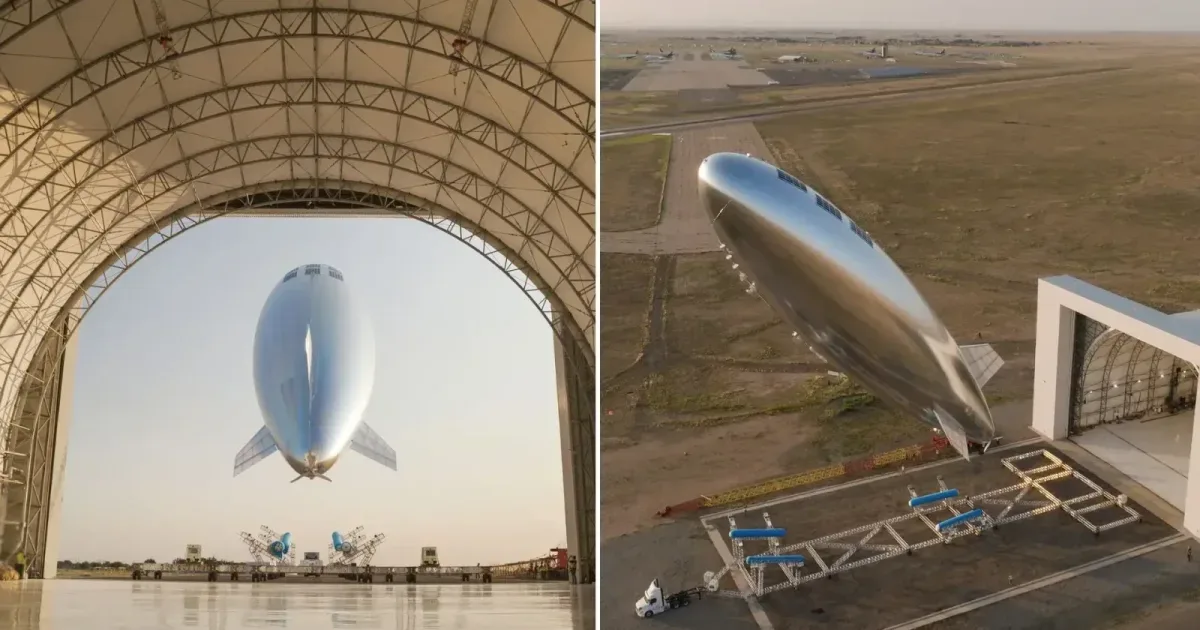

US company Sceye says its stratospheric platform has completed a record trans-Pacific flight, covering nearly 30,000 kilometres from New Mexico to Japan and back to the United States. According to Interesting Engineering, the flight was carried out as part of the Service Test 1 (ST1) mission.
The main objective was to test direct cellular connectivity with standard smartphones, along with on-platform computing and interaction with drones. The platform launched on August 9, 2026 and reached Japan 13 days later.
The tests were conducted jointly with Japanese telecom company SoftBank. Sceye demonstrated mobile broadband connectivity for conventional devices through SoftBank’s core network, meaning smartphones and other devices did not need any special hardware installed. For that purpose, the platform carried SceyeCELL, a system the company describes as a “cell tower in the sky”.
According to Sceye, one full-scale stratospheric platform could provide a coverage area comparable to roughly 500 ground towers. The flight also included tests of emergency calling, an alert system designed for large-scale emergencies, and communications with drones. The company sees these technologies as one possible route toward a three-dimensional communications network.
A separate line of testing focused on computing directly on the platform. A server was installed on the HAPS, allowing Sceye and SoftBank to process data before sending it to users. Average request processing time — from sending to response and back — was 68 milliseconds. The company said this represented more than a 40% reduction in latency compared with processing through internet cloud services.
Sceye said the test marked the first successful case in which a mobile core network and a web server for data processing were deployed simultaneously on a stratospheric platform. As a result, computations were performed directly on the HAPS and the processed data was then sent back to smartphones.
After the tests in Japan were completed, the platform returned to the United States, re-entering US airspace on September 4. On September 5, it reached the area around Sceye’s headquarters in Moriarty, New Mexico, where the company carried out additional tests before completing a planned landing.
Sceye believes the stratosphere could become an intermediate layer between ground infrastructure and satellites. In the company’s view, high-altitude HAPS could provide broad coverage with lower latency than orbital systems while avoiding the need to send equipment into space. For Sceye, ST1 was its first flight to Asia and an important step ahead of any potential commercial deployment of such platforms.



