A plenary session of the Federation Council, the upper house of the Russian parliament, in Moscow, Prime Minister Nikol Pashinian’s plans to formally apply for Armenia’s membership in the European Union will have severe economic consequences for the South Caucasus country, senior Russian lawmakers said on Tuesday.
Pashinian vowed on Monday to launch a “process” of making an EU membership bid in response to growing pressure from Russia unhappy with his pro-Western foreign policy. Kremlin spokesman Dmitry Peskov responded by saying that this will run counter to Armenia’s continued membership in the Eurasian Economic Union (EEU) which gives Armenian exporters tariff-free access to Russia, their main market. Two Russian lawmakers close to the Kremlin went farther, predicting an economic crisis in the country.
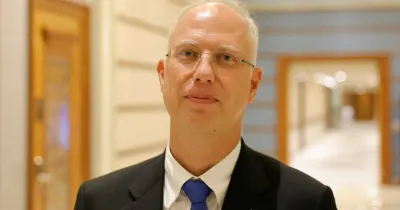
“Yerevan's intention to begin the process of applying for EU membership in the near future will lead, at the very least, to a crisis in the republic's economy,” Vladimir Dzhabarov, a senior member of Russia’s upper house of parliament, said in a social media post.
Dzhabarov claimed that the EU will never admit Armenia or make it prosperous otherwise and that it “needs Yerevan only for the standoff with Russia.”
“Ultimately, Armenia's current aspirations run counter to its entire history and geography. Moreover, they pose a real threat to the country's statehood,” he wrote.
Alexei Chepa, a senior member of the Russian lower house, the State Duma, issued a similar warning in comments to the official TASS news agency.
“They want to receive all the benefits from Russia and play along with the West,” Chepa said. “Let them do that. But then, of course, we will take away all the gifts we've given [this] country over the years. And it’s going to be very hard for Pashinian.”
Russia’s Foreign Intelligence Service (SVR) likewise claimed late last month that Armenia’s exit from the EEU would plunge the country into a “deep economic crisis” and destabilize its government.
Pashinian’s announcement followed persistent Russian demands for Yerevan to hold a referendum on joining the EU or remaining part of the Russian-led trade bloc. He remains reluctant to call such a vote despite planning to step up his EU membership efforts.
Moscow has threatened to take other punitive measures against Yerevan such as a sharp rise in the price of Russian natural gas supplied to Armenia, curbs on Russian tourists visiting the country and tougher requirements for hundreds of thousands of Armenian migrant workers in Russia.