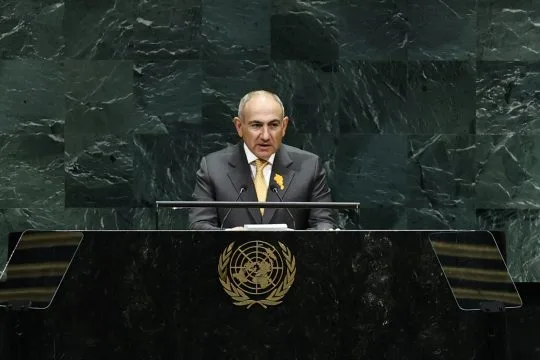
Armenian Prime Minister Nikol Pashinyan used his address to the 81st session of the UN General Assembly to focus heavily on regional transport links, logistics and infrastructure cooperation, presenting them as key economic outcomes of peace between Armenia and Azerbaijan.
Pashinyan said that after the August 8, 2025 peace summit at the White House, Armenia committed under the adopted declaration to work with the United States and mutually agreed third parties to define the implementation framework for the “Trump Route for International Peace and Prosperity” communication program, or TRIPP. He said the framework agreement on strategic cooperation for the project, signed between Armenia and the United States, will soon be submitted to the National Assembly of the Republic of Armenia for ratification.
According to the prime minister, work is now under way to establish “TRIPP development company” and sign a shareholders’ agreement. Under the initial structure, Armenia will hold a 26% stake and the United States 74%. The agreement also provides that if it is extended, the Republic of Armenia’s stake will rise to 49% in the 50th year without additional investment.
Pashinyan also linked TRIPP to the third point of the peace declaration signed the same day, which concerns the opening of communications between Armenia and Azerbaijan for domestic, bilateral and international transportation. He said the approach is based on respect for sovereignty, territorial integrity and jurisdiction, and includes unimpeded communication between the main part of the Republic of Azerbaijan and the Nakhchivan Autonomous Republic through the territory of the Republic of Armenia, with reciprocal benefits for Armenia.
He stressed that the project could be of historic importance for the Republic of Armenia. According to Pashinyan, for the first time since the early 1990s, Armenia will gain rail access to Azerbaijan and, through that route, also to Russia, Central Asia and China. He also said that after the August 8, 2025 peace summit, Azerbaijan opened its railway to Armenia, and Armenia now has a railway connection with Azerbaijan through the territory of Georgia.
In the prime minister’s assessment, TRIPP will make it possible to create a direct Armenia-Azerbaijan rail connection, as well as rail links between Armenia’s northern and southern regions through Azerbaijani territory and between the main part of Azerbaijan and the Nakhchivan Autonomous Republic through Armenian territory. He said Armenia plans in the near future to restore the Meghri and Yeraskh railway sections that existed in Soviet times and were later destroyed.
Pashinyan also pointed to a broader international effect. He said that alongside the reactivation of these rail routes, the reopening of the Armenia-Turkey railway is expected, and together with TRIPP this could become one of the most important developments in international logistics in recent decades. That would create a new rail connection linking China, Central Asia, Turkey and the European Union.
He added that restoring the railway connection between Armenia and the Nakhchivan Autonomous Republic of the Republic of Azerbaijan would also restore rail connectivity between the Persian Gulf and the Black Sea. In his words, this is why the project promises benefits for all countries in the region and could become one of the foundations of long-term stability and peace.
Pashinyan said that after roughly 35 years of conflict, discussions now go beyond an east-west railway and include pipelines, power transmission lines and roads. He said this could help turn not only the Republic of Armenia but the whole South Caucasus into a “Crossroads of Peace.”
In the political part of his speech, the prime minister said that in Armenia’s June 7, 2026 parliamentary election, most voters backed the peace agenda. At the same time, he said several issues remain unresolved in Armenia-Azerbaijan relations, including clarifying the fate of missing persons, cooperation on demining and the return of Armenians held in captivity in Azerbaijan.
According to Pashinyan, there have been no deaths or injuries resulting from exchanges of fire between Armenia and Azerbaijan over the past two and a half years, which he described as one of the most important results of recent cooperation.