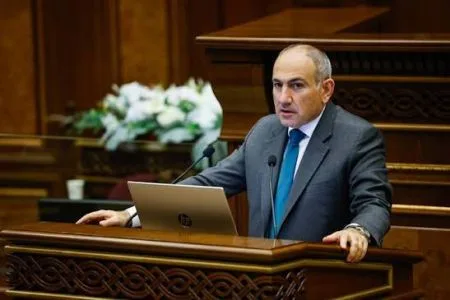


Gas in Armenia is not cheap, Prime Minister Nikol Pashinyan said on September 11, arguing that the price increase from the border to the end consumer is more pronounced in Armenia than in other countries.
Speaking to reporters, Pashinyan said Gazprom earns a large profit in Armenia. If gas tariffs are raised, he said, Armenia would respond “symmetrically” by reviewing where prices could be increased and possibly introducing proportionate charges for services that had previously been free.
“These issues should be discussed calmly and in a working atmosphere. But regardless of what happens, we will diversify our markets. If there is an opportunity to buy gas from a second, third or fourth source, we will take that path. If there is an opportunity under the TRIPP project to build a pipeline through Armenia and receive transit payments, we will take that path as well. We have a clear idea of what to do under any scenario,” Pashinyan said.
He added that there is no sector in which Armenia does not intend to pursue diversification, describing this as part of the authorities’ political decision to strengthen the country’s independence and statehood.
On April 4, Armenian parliament speaker Alen Simonyan warned that if Russia decided to raise the gas price for Armenia, the country could leave the CSTO and the EAEU. In response, Russian Federation Council Deputy Speaker Konstantin Kosachev called such comments inappropriate.
Kosachev also referred to remarks made by Russian President Vladimir Putin after talks with Pashinyan on April 1, when he said gas prices in Europe were above $600 per 1,000 cubic meters, while Russia was selling gas to Armenia at $177,5 per 1,000 cubic meters. Kosachev said Armenian politicians should take into account the scale of Russia’s support for Armenia rather than speculate about hypothetical price changes.



