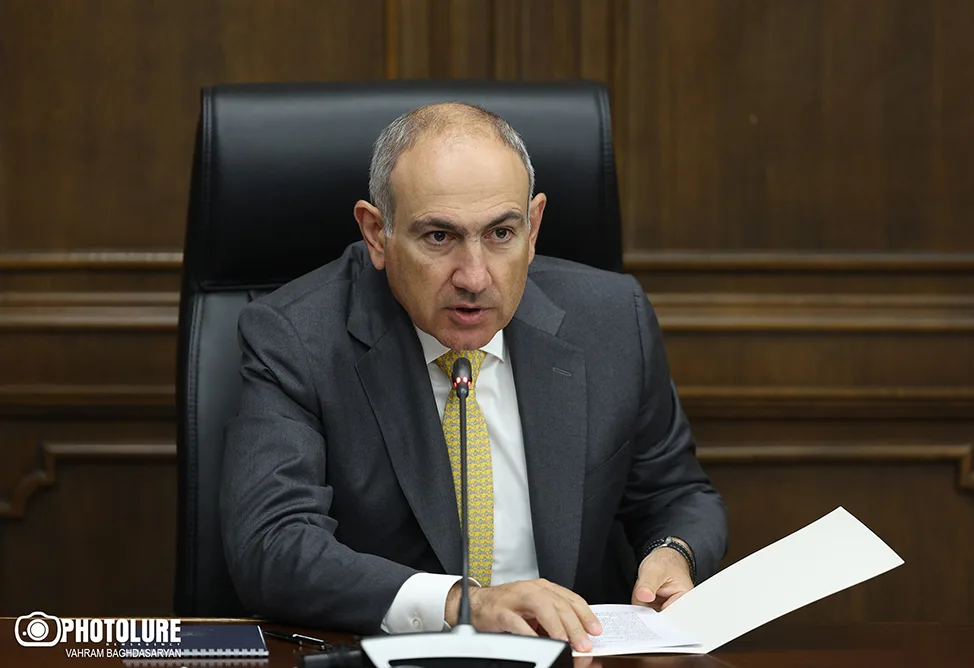
Armenian Prime Minister Nikol Pashinyan addressed the issue of possible changes in lending rates during a question-and-answer session in parliament, saying that Armenia’s steady sovereign rating improvement should also help bring some reduction in interest rates.

He referred to Central Bank of Armenia Governor Martin Galstyan’s remarks on September 15, when he said a rise in lending rates could not be ruled out after the CBA Board raised the refinancing rate by 0.25 percentage points to 6.75%. At the same time, the central bank chief stressed that a higher monetary policy rate does not automatically mean an immediate increase in bank lending rates.
Responding to lawmaker Hayk Farmanyan’s question about steps to contain the credit burden, Pashinyan said interest rates are shaped not only by domestic factors but also by external ones. He said global developments are also driving inflationary pressures, including the conflict between Russia and Ukraine and the situation in the Strait of Hormuz.
“We believe that the consistent improvement of Armenia’s sovereign rating should also lead to a certain decrease in interest rates. But we cannot ignore that global processes are unfolding in parallel and are causing inflationary pressures,” the prime minister said.
He added that the government periodically discusses such issues in a working format. “We are working in that direction,” Pashinyan said.
According to official statistics, the average rate on commercial banks’ credit transactions stood at 12.51% in July, down from 13.18% in June.
Sovereign ratings
In July 2026, Fitch Ratings affirmed Armenia’s long-term foreign-currency issuer default rating at “BB-” with a “Positive” outlook.
In the same month, Moody’s Ratings changed the outlook on Armenia’s sovereign rating from “stable” to “positive,” while affirming the long-term local- and foreign-currency issuer ratings at Ba3.
In August 2026, S&P Global Ratings affirmed the Republic of Armenia’s long- and short-term sovereign ratings at “BB-/B,” maintaining the “positive” outlook.
Inflation backdrop
According to Armstat, Armenia recorded 4.4% inflation in August 2026 compared with August 2025. Over the period, prices for food products and non-alcoholic beverages rose by 6.4% year-on-year, non-food prices increased by 2.4%, and service tariffs went up by 2.8%.
Armenia’s 2026 state budget assumes inflation at 3% (±1%). According to the Central Bank’s monetary policy report for the third quarter of the current year, inflation in Armenia is expected at 4.5-4.2% for full-year 2026, depending on the scenario (A-B).



