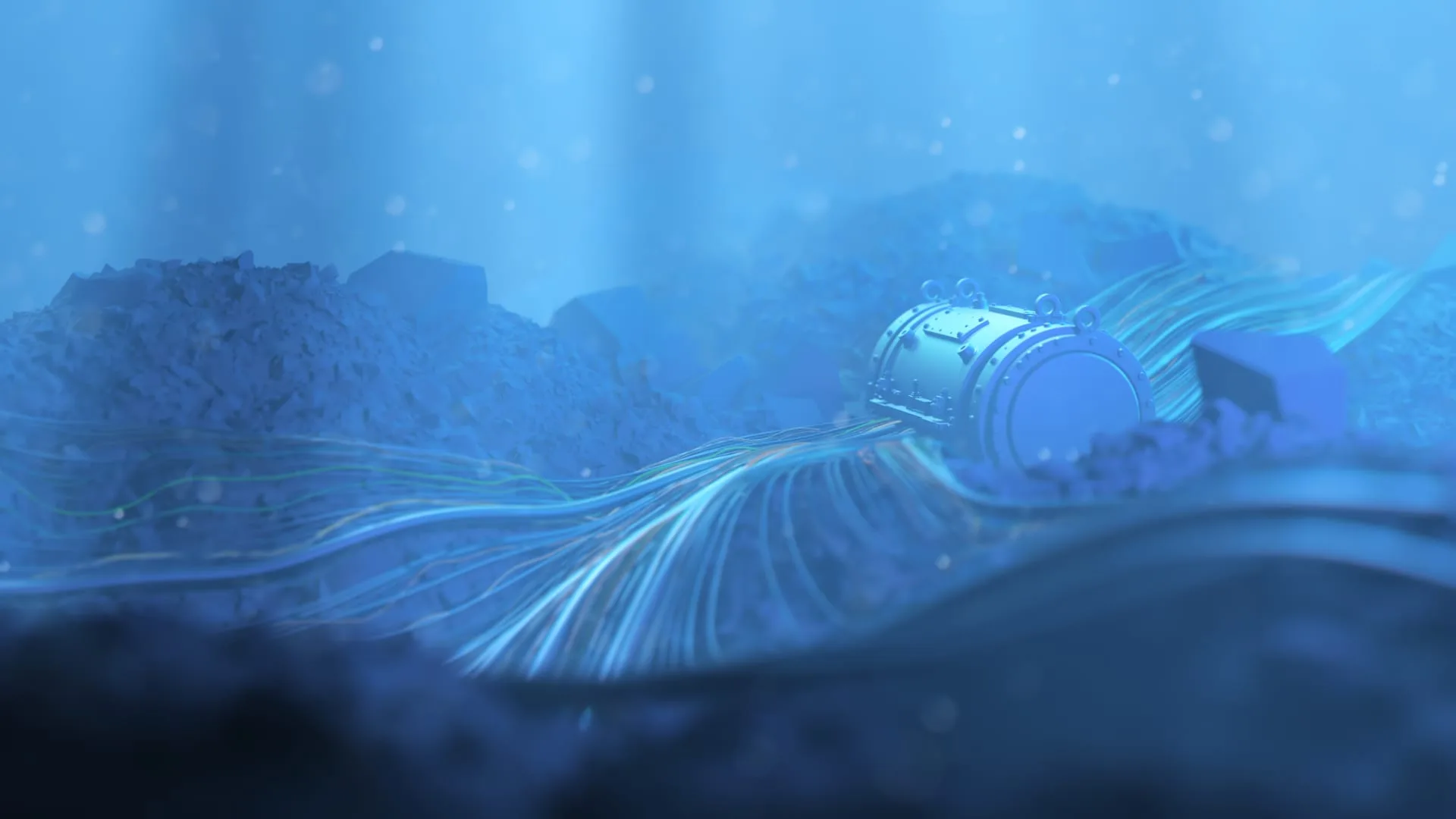
Critical underwater infrastructure that supports the global economy is becoming more vulnerable, and governments and private companies are trying to close a long-neglected security gap. CNBC reports that rising risks are creating a new market for subsea monitoring, communications and autonomous systems.
Katja Bego, senior research fellow at Chatham House, said the issue has moved up the agenda because the threat environment has changed. Growing concern over so-called hybrid warfare — including cyberattacks, energy sabotage, disinformation and economic pressure — is forcing governments to take the infrastructure running along the seabed much more seriously. “Our whole economy is built on top of this,” she told CNBC.
Attention has also intensified since the September 2022 explosions that ruptured the Nord Stream gas pipelines in the Baltic Sea. Investigators concluded that the pipelines, built to deliver natural gas from Russia to Germany, had been deliberately sabotaged. Bego said that incident, along with damage to subsea infrastructure in the Arctic and near Taiwan, exposed vulnerabilities that had received too little attention in the decades after the Cold War.
According to telecommunications research firm TeleGeography, more than 1.5 million kilometers of submarine communications cables were in service worldwide as of early 2026. Alongside them, a growing network of subsea power cables is linking electricity markets and transmitting power from offshore wind farms back to land.
Advances in artificial intelligence, autonomy and drones are opening up new approaches to underwater surveillance for governments and military alliances. Those tools range from autonomous underwater vehicles to sensors attached directly to subsea cables. Bego described the maritime environment as “the next logical domain.”
Defense companies are positioning for that shift as well. Italian shipbuilder Fincantieri said in July that it planned to acquire majority stakes in four companies for around 600 million euros ($689 million) to expand its capabilities in underwater and surface drones, marine surveying and subsea communications. CEO Pierroberto Folgiero previously told CNBC that underwater telecommunications are “the real enabler of this new ecosystem.”
Fincantieri is not alone. Large defense groups including France’s Thales already have businesses spanning sonar, anti-submarine warfare, mine detection and autonomous underwater systems. Bigger and smaller firms alike are trying to secure a role in the emerging market for operating beneath the ocean surface.


Germany-based defense-tech company Euroatlas is developing an autonomous underwater vehicle called GrayShark. Verineia Codrean, the company’s chief strategy and partnerships officer, said the vehicle can travel to an assigned area and carry out a mission without continuous human control. It is designed to avoid obstacles and follow predetermined instructions when it encounters something unexpected. While inspecting a pipeline, for example, it could identify a mine-like object, report it and wait for an operator to decide whether to investigate further.
Codrean said the future may involve fleets of autonomous vehicles constantly patrolling strategic areas of the seabed rather than warships trying to guard every mile of cable. In her view, covering the entire ocean is virtually impossible, and the challenge is one of scale: frigates, submarines and maritime patrol aircraft are too expensive and too scarce to maintain a continuous presence around cables, pipelines and other strategic assets.
The mission set is also expanding beyond infrastructure monitoring. Codrean pointed to the rise of so-called anti-autonomous underwater vehicle missions aimed at detecting, tracking and identifying autonomous and unmanned underwater vehicles operated by other countries. If NATO countries are building such systems, she said, then non-allies and adversaries are doing the same, making classification of friendly and non-friendly vehicles increasingly important.
Still, Codrean does not expect autonomous systems to replace conventional submarines and warships. Instead, she said navies are likely to combine crewed and autonomous platforms, making interoperability between them a key requirement.
Euroatlas is also developing a hydrogen fuel-cell version of GrayShark designed for up to 16 weeks underwater or 8,000 nautical miles, although the company has not yet demonstrated that endurance in underwater conditions. The company says it has signed more than 100 million euros in GrayShark contracts with unnamed European navies. Codrean said the vehicles are unarmed and intended for surveillance, detection and deterrence.
Despite rising investment and technological progress, the core problem remains unchanged: no one can realistically protect every mile of infrastructure on the seabed. Bego said nobody should pretend that a network stretching more than a million kilometers can be fully secured. Responsibility is also blurred. Much of the world’s subsea infrastructure is owned or operated by private companies, but deliberate interference or a wartime scenario increasingly pulls governments and militaries into the picture.
Governments, Bego said, are pushing for tougher security measures, from more intensive monitoring to sensors and deeper cable burial. Those steps can be costly, raising questions about who should pay and where private-sector responsibility ends. In her view, the likely outcome is not regulation alone but much closer cooperation between governments and infrastructure owners.
The investment opportunity is drawing interest from companies on both sides of the Atlantic, while Bego said Russia and China are also investing heavily in the underwater domain. At the same time, she cautioned that autonomous underwater systems are still far from the maturity seen in aerial drones used in Ukraine. Visibility is poor underwater, communications are difficult, and signals do not travel the same way they do through the air. For that reason, she said, the technology may help with deterrence and signaling, but it is not a cure-all for securing the seabed.



