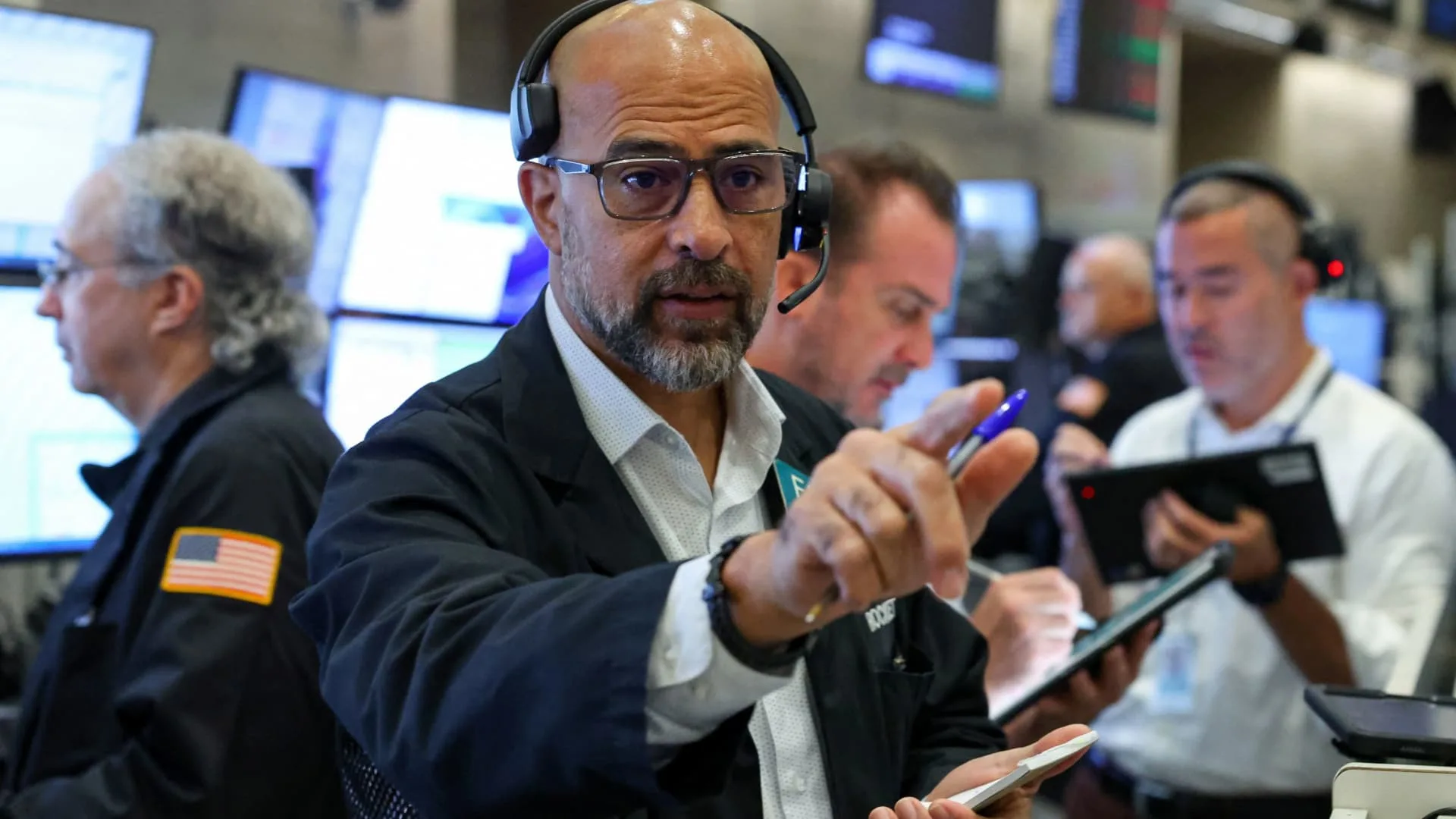
U.S. stocks traded mixed on Tuesday, with the Nasdaq Composite setting a fresh intraday record while the S&P 500 hovered near the flatline. The Dow Jones Industrial Average, by contrast, fell 270 points, or 0.5%.
The Nasdaq drew support in part from a roughly 4% rise in Sandisk after a bullish call from Rosenblatt. The tech-heavy index was up about 0.2% and earlier climbed to a new intraday high of 27,250.92. It was the benchmark’s first such record since June 1, 2026, coming a day after its first record close since June 2, 2026.


Investor sentiment remained tied to developments between the U.S. and Iran. Speaking at the United Nations General Assembly, President Donald Trump said he had a “big decision” to make on whether to pursue a deal with Iran or “annihilate” the country. He also said he believed an agreement could come right after the election because, in his words, “it doesn’t make sense for them not to.”
Oil prices were little changed after those remarks. Brent crude futures were up less than 1% at roughly $100 a barrel, while U.S. crude futures also traded less than 1% higher at around $96 a barrel. Earlier in the session, oil had moved lower after reports that Iran had offered to reopen the Strait of Hormuz within seven days. CNBC said it had not independently verified those reports. Saudi Arabia is also reportedly preparing to restart its East-West pipeline as soon as this week.
Tuesday’s trading followed a strong Wall Street session the day before, when the S&P 500 posted its best day since Aug. 4 and the Nasdaq logged its first record close since June. Falling oil prices had helped lift equities, while Treasury yields also pulled back.
Still, the yield on the 10-year U.S. Treasury edged higher on Tuesday to 4.974%. Tom Garretson, senior portfolio strategist of fixed income strategies at RBC Wealth Management, said markets may still be underestimating what a rate-hiking cycle could mean even in a higher-yield environment. He added that investors still appear too complacent about the possibility of the 10-year yield moving above 5% and the risk that the Federal Reserve could raise rates at least two more times, potentially pushing them back toward 5% by early 2027.
Traders are also looking ahead to this week’s Washington summit between Donald Trump and Xi Jinping. Artificial intelligence, the Iran war, tariffs and rare earth metals are expected to be among the main topics. Ahead of Xi’s U.S. visit, Treasury Secretary Scott Bessent met with Chinese Vice Premier He Lifeng.
Key corporate movers
Among individual stocks, Shopify jumped nearly 7% after announcing a partnership with Meta’s personal AI agent Muse. The tie-up will bring agentic checkout to merchants on the platform through Shop Pay. In a post on X, CEO Tobi Lutke said the move would give Shopify customers “an easy and delightful way to shop and check out with Muse.” The stock is now on pace for a two-day gain of more than 15%.

Capri Holdings advanced nearly 10% after a report said the luxury fashion group could become a buyout target. According to WWD, potential buyers have reviewed the financials of the parent company of Michael Kors, Jimmy Choo and Versace, though sources said any transaction is not expected in the near term. Even after Tuesday’s gain, Capri shares are still down more than 35% year to date.
Viking Therapeutics surged 31% after releasing new study results for its diabetes and obesity drug VK2735. After 21 weeks, patients lost between 16% and 19% of their body weight, putting the treatment in competition with therapies from Eli Lilly and Novo Nordisk. Separately, Roche reported progress with its experimental weight-loss drug enicepatide: patients with type 2 diabetes lost 15.5% of body weight over 48 weeks, while blood sugar levels also fell sharply. Shares of Lilly and Novo were each down about 1%.
Lennar rose more than 4% after Berkshire Hathaway disclosed a purchase of more than 2.7 million shares. Amgen gained more than 3% after positive phase 3 results for dazodalibep, aimed at treating moderate-to-severe Sjögren's disease in adults. Grab Holdings jumped more than 7% after CEO Anthony Tan disclosed that he had recently bought 10.4 million shares.
In premarket trading, investors also watched Alibaba, Quest Diagnostics, Labcorp Holdings and Vicor. Alibaba rose more than 3% after CEO Eddie Wu said at the Apsara Conference that Alibaba Cloud plans to operate more than 20 gigawatts of data centers globally by 2032, and after he introduced the Zhenwu V900 chip. Quest Diagnostics and Labcorp Holdings each dropped more than 5% after the Centers for Medicare & Medicaid Services said Medicare had been paying 16% more for laboratory services than private payors and would align most payments with private-sector rates. Vicor rallied 9% after forecasting sequential revenue growth of more than 20% in the third quarter, up from prior guidance of nearly 10%.
In Europe, equities initially traded lower before the Stoxx 600 turned positive and rose 0.2% after reports that Iran had offered to reopen the Strait of Hormuz within seven days if the U.S. takes steps toward de-escalation. The report, attributed to Kyodo, was not independently confirmed by CNBC. Elsewhere, Kingfisher jumped 8.6% after upgrading its full-year adjusted profit before tax guidance in its half-year results, while Ericsson fell 3.5% after Morgan Stanley downgraded the stock and cut its price target.
A separate macro focus was the state of U.K. public finances. Data from the Office for National Statistics showed U.K. public sector net borrowing rose by around a fifth year on year in August 2026 to £18.3 billion ($24.5 billion). Economists polled by Reuters had expected a £15.5 billion deficit. Public debt remained just below £3 trillion, though it fell by 1.3 percentage points as a share of GDP to 93.8%.



