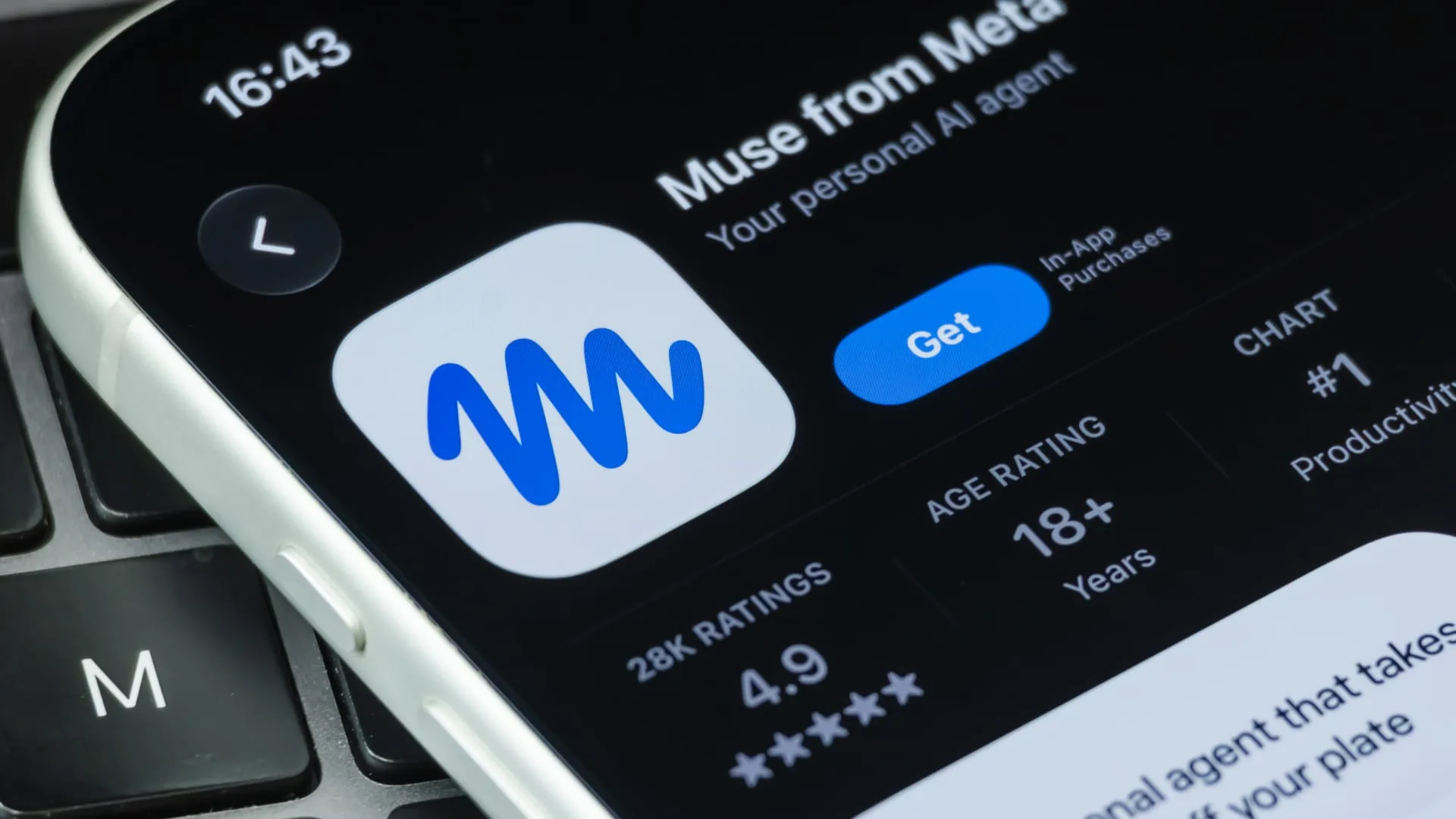
Meta Platforms CEO Mark Zuckerberg is due to speak on Wednesday evening at the company’s annual Meta Connect developer conference, with the tech sector and Wall Street closely focused on Muse. CNBC reports that Meta’s new personal AI agent, built on the company’s proprietary Muse Spark model, has already climbed to the top of app rankings, while Meta shares have gained more than 20% since the launch earlier this month.
The article compares the early reaction to Muse with the wave of enthusiasm that greeted ChatGPT when it brought generative AI to a mass audience in late 2022. For investors, CNBC says the central question is whether Meta can turn the product into a meaningful new revenue stream. The report adds that Muse could be integrated more deeply into Meta’s Family of Apps ecosystem and could also strengthen the company’s smart glasses lineup.
CNBC also notes that Meta recently agreed to an approximately $18 billion settlement related to the youth social media addiction case brought by state attorneys general. Some analysts have viewed that as a clearing event that could allow the company to accelerate new AI product launches. In CNBC’s assessment, Muse fits that narrative as one of the most significant rollouts so far.
Analyst optimism has already shown up in price targets. According to CNBC, the latest increase came from KeyBanc, which raised its target on Meta shares to $900 from $780, implying roughly another 20% upside from current levels. KeyBanc’s main argument is that consumer AI is entering a stronger growth phase and that Meta is well positioned to monetize its large AI investments to drive further revenue and earnings expansion.
The report also highlights that Meta trades at a forward P/E of 22.6, only modestly above the S&P 500’s 19.5 multiple. CNBC argues that if Meta can clearly demonstrate how it plans to monetize Muse and its broader AI strategy, the market may be willing to assign the stock a higher valuation.
CNBC presents Muse as an example of agentic AI, distinguishing it from standard generative AI tools. In the article’s framing, generative AI is largely reactive and follows a question-and-answer pattern, while agentic AI can not only interpret a prompt but also use connected services and approved tools to complete multistep tasks autonomously.
To illustrate the difference, the article uses a dinner reservation example. In CNBC’s description, a standard chatbot still requires the user to choose a restaurant, move to an external link or make a call, and then complete the booking process. With Muse, the report says, the user only needed to submit the prompt and choose the restaurant, after which the agent completed the reservation on its own using previously stored contact details and an OpenTable connector that had already been set up.
CNBC also links Muse’s potential edge to the type of data Meta controls. The article says Facebook, Instagram and the broader Family of Apps give the company a deep view into how people behave online, including comments, interactions and communication across different media formats. In the authors’ view, that may help Muse better understand user context and the nuances of natural communication.
In conclusion, CNBC says the race in agentic AI is still open, but Meta has now established itself as one of the leading contenders for the consumer market. Investor attention is now shifting to Meta Connect announcements and to what further steps the company will outline for monetizing its AI investments.





