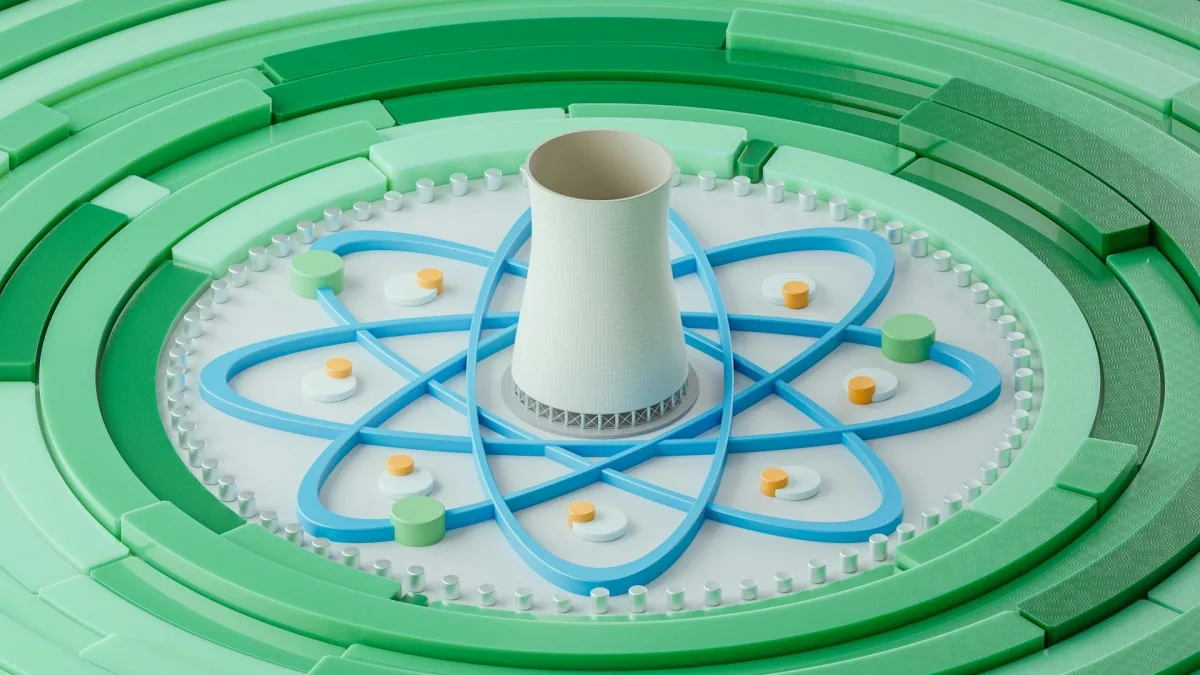

The long-term outlook for nuclear energy has been revised higher again. In a new report, the International Atomic Energy Agency (IAEA) said global nuclear power generation capacity could fully triple by 2060.
The agency expects a meaningful share of that expansion to come from small modular reactors, or SMRs, whose commercial rollout has been delayed for years by regulatory hurdles, funding gaps, and nuclear fuel supply chain constraints.
Under the IAEA’s high-growth scenario, SMRs would account for 28% of all new nuclear capacity added by 2060. That is above the agency’s previous high-case estimate of 24%. In its low-growth scenario, SMRs are now seen making up 23% of new capacity, versus just 5% in the earlier forecast.
The report also points to especially strong adoption in North America, where about 60% of new nuclear capacity could come from SMRs. In South-Eastern Asia, as well as in Latin America and the Caribbean, the share is projected at 40% in both the high- and low-growth scenarios.
At the same time, debate over the economics of the technology remains unresolved. The article cites IEEFA director of resource planning analysis David Schlissel, who argues that the real-world experience of the first SMRs already built or under construction has yet to prove that they are truly cost-competitive.
While the United States, the United Kingdom, China, and Russia have all invested heavily in SMR development, only Russia and China currently have operational, grid-connected units. In the United States, one SMR design has been approved, with commercial deployment expected in 2028.
Momentum is also becoming visible on the ground in the United States. This week, the U.S. Nuclear Regulatory Commission fast-tracked a construction plan for two proposed SMRs at the Palisades Energy Center in Michigan. The site has been cleared to begin early work before a Limited Work Authorization is issued. Together, the two reactors are expected to produce 680 megawatts of electricity.
The report also links rising interest in SMRs to the fast-growing power needs of artificial intelligence. With a single hyperscale AI data center able to consume as much electricity as 50,000 homes, technology companies are increasingly looking for scalable, baseload, low-emissions power sources, including next-generation nuclear systems.



