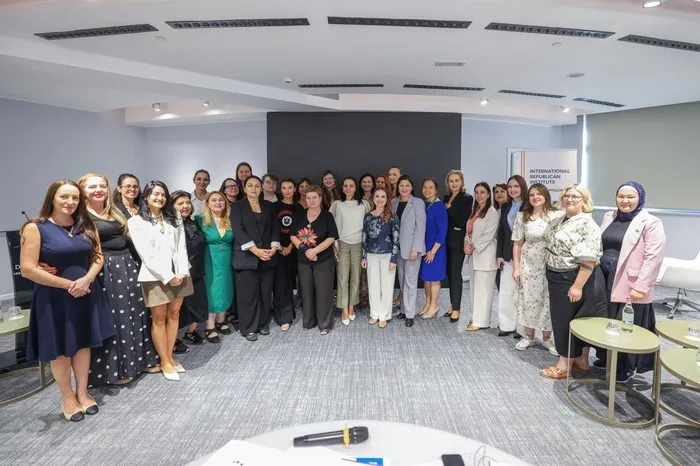
Lilit Makunts, Chief of Staff to the Prime Minister of Armenia, attended the closing ceremony of the two-day WDN (Women’s Democracy Network) Europe-Eurasia regional summit in Yerevan focused on “Women, Peace and Security.”


In her remarks, Makunts said peace cannot be treated as the responsibility of a single agency or one part of the state. She argued that the “Women, Peace and Security” agenda requires coordinated action across the entire public system — from foreign policy and justice to security, economic and social policy, as well as cooperation between institutions and citizens.
According to Makunts, the agenda is closely tied to Armenia’s government priorities on peace, democratic governance and the development of state institutions. She said peace must be felt in people’s daily lives through greater security, economic opportunity and confidence in the future, and that women must have a meaningful and substantive role in shaping that future.
Makunts said Armenia has made important progress in recent years in women’s representation in state and political decision-making. In particular, following the latest parliamentary elections, women account for more than 35% of deputies in the National Assembly of Armenia.
Turning to economic security, she said lasting peace is stronger when people have a real stake in preserving it. In that context, Makunts highlighted women’s access to jobs, entrepreneurship, financial resources, education and professional development, saying economic independence strengthens individual resilience, supports families and communities, and broadens participation in public life.
She added that developments in recent years globally and across the region have demonstrated women’s central role not only in building peace, but also in maintaining state governance and social resilience during crises. Makunts also stressed that peacebuilding does not end with agreements, as it is followed by long phases of implementation, reconciliation, cooperation, economic ties and restoration between societies.
The summit, which opened on September 15, brought together women leaders, parliamentarians, policymakers, civil society representatives, experts and specialists from 13 countries. Over two days, participants held discussions across five thematic tracks: reconciliation and community peacebuilding, defense and security sector reforms, socio-economic empowerment and recovering economies, networking, youth and civic resilience, and legislative support for peace.



