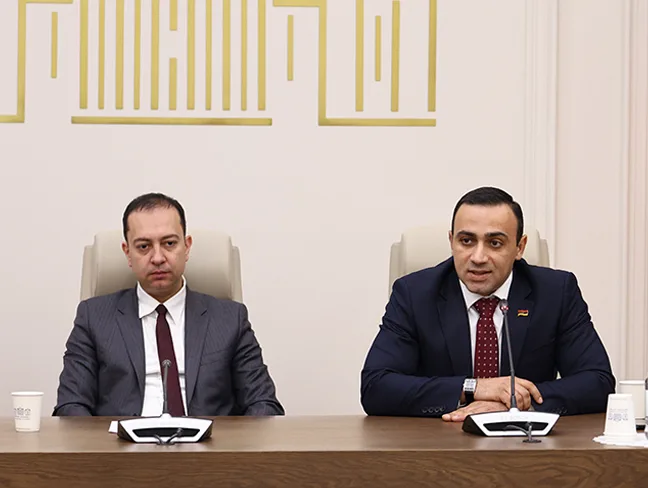


At a briefing in the National Assembly, lawmakers from the Civil Contract faction defended a new legislative package that would nearly double the salaries of ministers and senior officials. They argued that the proposal has been mischaracterized in public debate.
Citing remarks reported by Factor.am, Taron Chakhoyan asked why a professional earning 20 million drams would come to Armenia to serve as a minister for a salary of 1 million drams. In his view, the public sector is struggling to compete with the private sector, leading to an outflow of qualified personnel.
Chakhoyan said the planned changes are not limited to top officials and would affect about 20,000 employees across the public sector. He added that raises for first-class and senior specialists, following the logic of the pay hierarchy, have also prompted a revision of rates for division and department heads, deputy ministers and ministers.
Lawmaker Eduard Aghajanyan, for his part, pointed to international practice and argued that there is an inverse relationship between higher official pay and corruption levels. According to him, adequate remuneration lowers incentives to seek illicit income and helps improve the quality of public services.
As reported by Panorama.am, Aghajanyan said there is a negative correlation worldwide between highly paid public officials and the level of corruption in countries. He argued that states with low salaries for officials tend to have higher corruption levels.
He cited Singapore as an example, saying there are countries where the head of state receives a salary of $300,000. In Aghajanyan’s view, the benchmark should be zero tolerance for any manifestation of corruption, and if studying such countries shows that pay is a key factor, then salaries should be increased.
He added that the issue is not simply raising wages, but setting competitive compensation in the public sector within the context of the country’s overall economy. That, he said, would help attract highly qualified professionals and ultimately improve the quality of public services.
Arguing for the increase, Chakhoyan also said pensions have been raised three times since 2017, while the salaries of public officials have not grown at the same pace.
The government-backed legislative package has triggered debate. The planned changes would add more than 25 billion drams in annual spending to the state budget, prompting public questions over whether such costs are justified given existing social problems.



