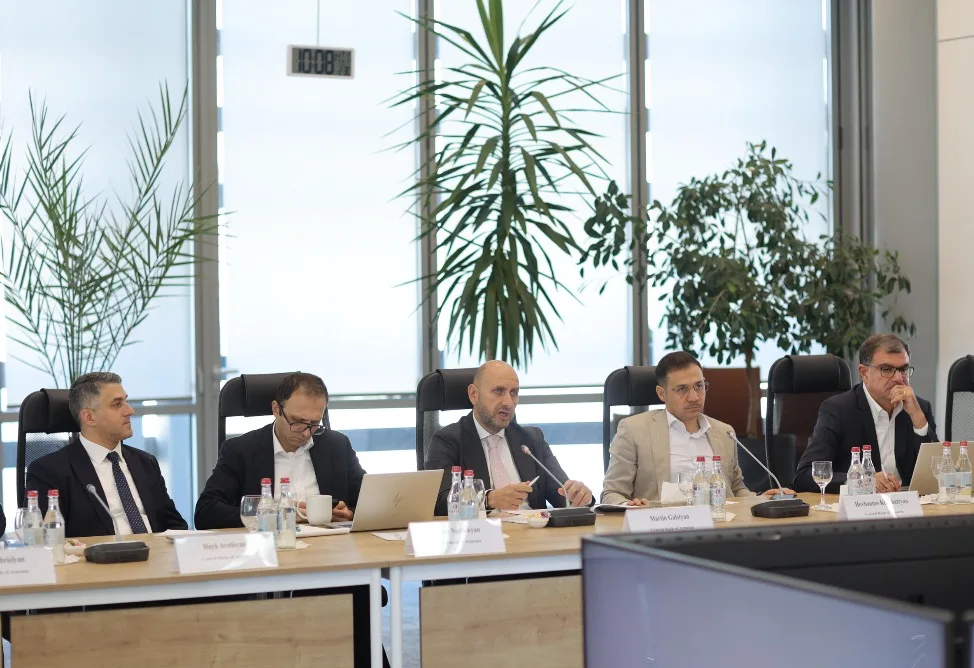

Central Bank of Armenia Governor Martin Galstyan used a kickoff meeting with an IMF mission delegation to review recent macroeconomic developments, the country’s economic outlook and the main risks facing the economy. The IMF mission in Armenia is headed by Alexander Tieman.
According to the regulator’s press service, the talks also covered monetary and foreign exchange policy, trends in international reserves and developments in the financial sector.
The sides also discussed progress on structural benchmarks under the IMF-supported reserve program. Those issues included the enhanced banking resolution framework, the payments system, identification of climate risks, risk management and capital market development.
Deputy Central Bank governors Armen Nurbekyan and Hovhannes Khachatryan also took part in the meeting.
About the IMF reserve program
On December 1, 2025, the IMF Executive Board approved a new 36-month Stand-By Arrangement (SBA) for Armenia worth SDR 128.8 million. That equals 100% of Armenia’s IMF quota, or about $175 million. The program is intended to help the authorities preserve macroeconomic stability, advance structural reforms and provide insurance amid uncertainty.
Following approval, Armenia immediately gained access to an amount equivalent to SDR 18.4 million, or about $25 million. On June 10, 2026, the country gained access to another SDR 18.4 million, or about $25.1 million, bringing total access to SDR 36.8 million, or about $50.2 million. The remaining amount will be made available in equal tranches subject to semiannual reviews. Armenia’s authorities have said they intend to treat the arrangement as precautionary.
About bank resolution
On July 3, 2026, Armenia’s National Assembly passed in the second and final reading the law “On Bank Resolution” along with a number of related laws. The need for the legislation stemmed from recommendations by the World Bank and the IMF presented in 2018 under the Financial Sector Assessment Program for Armenia (FSAP).
The law proposes introducing a bank resolution regime instead of liquidation, with exclusive authority for its use assigned to the Central Bank of Armenia. Key tools include the sale of a bank, a bridge bank mechanism, separation of troubled assets and other measures aimed at stabilizing a bank without liquidating it.
A Resolution Fund will be created to finance the process. It will be funded through one-off, periodic and additional contributions from commercial banks. The target level is set at no less than 0.5% of the banking system’s total liabilities, to be reached within 10 years after the law enters into force.



