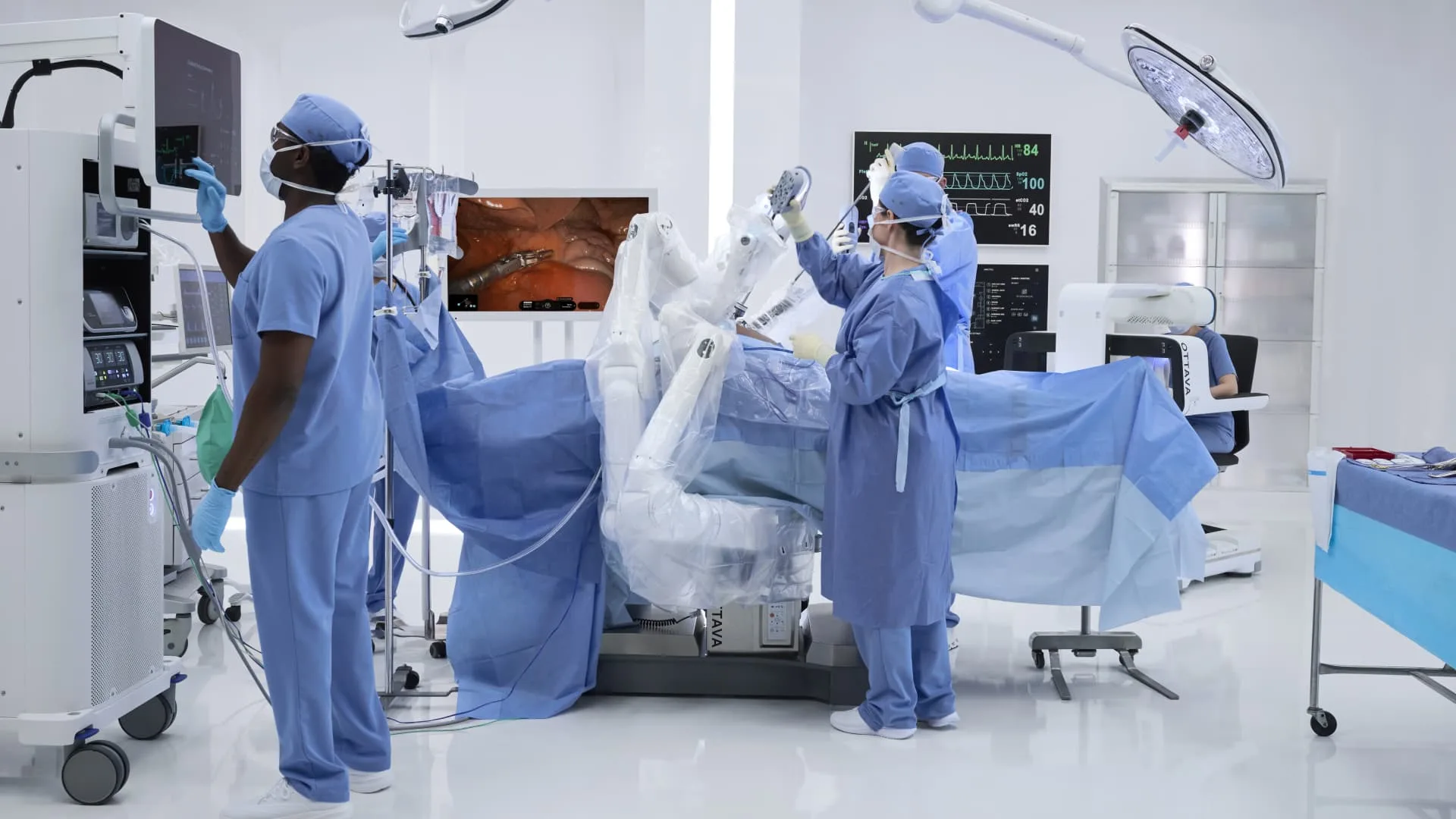
Johnson & Johnson is making a serious push into robotic general surgery after winning FDA clearance this summer for its new Ottava system. Management has made clear that the financial payoff is unlikely to be immediate, but it sees the platform as a potentially important long-term growth engine for the company’s MedTech business.
Ottava is currently cleared for 10 general surgery procedures, including gallbladder and spleen removal, gastric bypass, certain hernia repairs and a procedure used to treat severe acid reflux. Johnson & Johnson expects to broaden that footprint over time, with additional hernia indications as well as future expansion into urology and gynecology.
The company argues that Ottava’s design is its biggest competitive differentiator. Its robotic arms fold directly into the operating table, a configuration that Johnson & Johnson says allows the system to use 30% to 50% less space than traditional robotic platforms. Management believes that smaller footprint could appeal to hospitals looking to expand robotic surgery programs without renovating operating rooms or adding infrastructure.
J&J is also leaning on its deep presence inside operating rooms. Through Ethicon, the company has long supplied sutures, stapling products, energy devices and other surgical tools. That installed commercial presence could help Ottava gain traction with hospitals already using J&J products, and could also create bundling opportunities, as Duke University surgery associate professor Dr. Jacob Greenberg told CNBC.
Surgery is already the largest part of J&J’s MedTech segment. In the first six months of the year, the surgery business generated $5.16 billion in revenue, up 4.3% from a year earlier and equal to roughly 30% of total MedTech sales. The company’s other core MedTech priorities are cardiovascular and vision, while its orthopedics business — whose separation or sale was announced in October 2025 — is being divested over an expected 18- to 24-month period so the division can focus on higher-growth, higher-margin markets.
The market opportunity is sizeable. Precedence Research estimates that the U.S. surgical robotics market could grow from about $4.4 billion in 2025 to $18.75 billion by 2035. Globally, the market is projected to expand from $14.45 billion in 2026 to roughly $50.29 billion by 2035. Demand is being driven in part by patient preference for fewer and smaller incisions. According to UCSF Health, less than a quarter of surgeries in the U.S. are currently performed robotically, suggesting there is still room for broader adoption.
Still, Johnson & Johnson is entering a field where Intuitive Surgical remains the dominant player. The Sunnyvale, California-based company first won FDA clearance for its da Vinci system in 1997, then received authorization to perform surgery in 2000, helping it become the industry standard. The platform is now in its fifth generation, with da Vinci 5 cleared by the FDA in 2024. Intuitive says more than 20 million patients have been treated using da Vinci since launch, and total da Vinci procedures rose 18% in 2025 to more than 3.1 million.
As of the end of June, Intuitive had 11,710 da Vinci systems installed globally, up 12% from a year earlier. Of those, 6,615 were in the U.S. and 5,095 were outside the country. The company placed another 468 systems in the second quarter alone, with nearly 60% of them in the U.S. Its position is reinforced by several financing models, including outright purchases, fixed-payment plans and usage-based agreements.
Intuitive’s business model also extends beyond selling the robot itself. Much of its revenue comes from the instruments and accessories used during procedures. FactSet estimates those recurring sales will account for roughly 60% of Intuitive’s projected $11.76 billion in revenue this year, while system sales make up about 25% and the remainder comes from service revenue. That creates an added challenge for new entrants, since surgeon familiarity and a broad service network matter as much as the machine.
Competition is not limited to Intuitive. Medtronic’s Hugo system received FDA clearance in December 2025, initially for urologic procedures, with plans to expand into general surgery and gynecology in the U.S. Hugo has already been marketed in Europe for several years. CEO Geoff Martha said Medtronic expects Hugo to surpass 50,000 completed procedures by the end of the fiscal year and to have 250 units installed by year-end.
Some analysts remain cautious on Ottava’s outlook. There is skepticism on Wall Street about how large a role the system will ultimately play in robotic soft-tissue surgery. Oppenheimer analysts said in August that U.S. competition remains a “non-factor” for Intuitive for now, while also pointing to workflow and sterilization concerns around Ottava and limited production capacity in 2026 and 2027. Even so, they did not rule out meaningful progress, estimating that J&J could capture 15% of the U.S. market by 2030, versus 75% for Intuitive and 10% for others.
Johnson & Johnson itself says commercialization will be phased. The company plans to start with a select group of hospitals before expanding instruments, indications and geographies as the platform scales. It is also pursuing regulatory registrations in Western Europe and Japan. Pricing details have not yet been disclosed, while Intuitive told CNBC that the average selling price for purchased da Vinci systems was $1.59 million in the second quarter.
For Johnson & Johnson, Ottava is more than a product launch: management sees it as one of the company’s most significant MedTech innovations of the decade. For investors, the central question is how quickly the group can turn that technology into a meaningful revenue stream and a credible share of a fast-expanding market.





