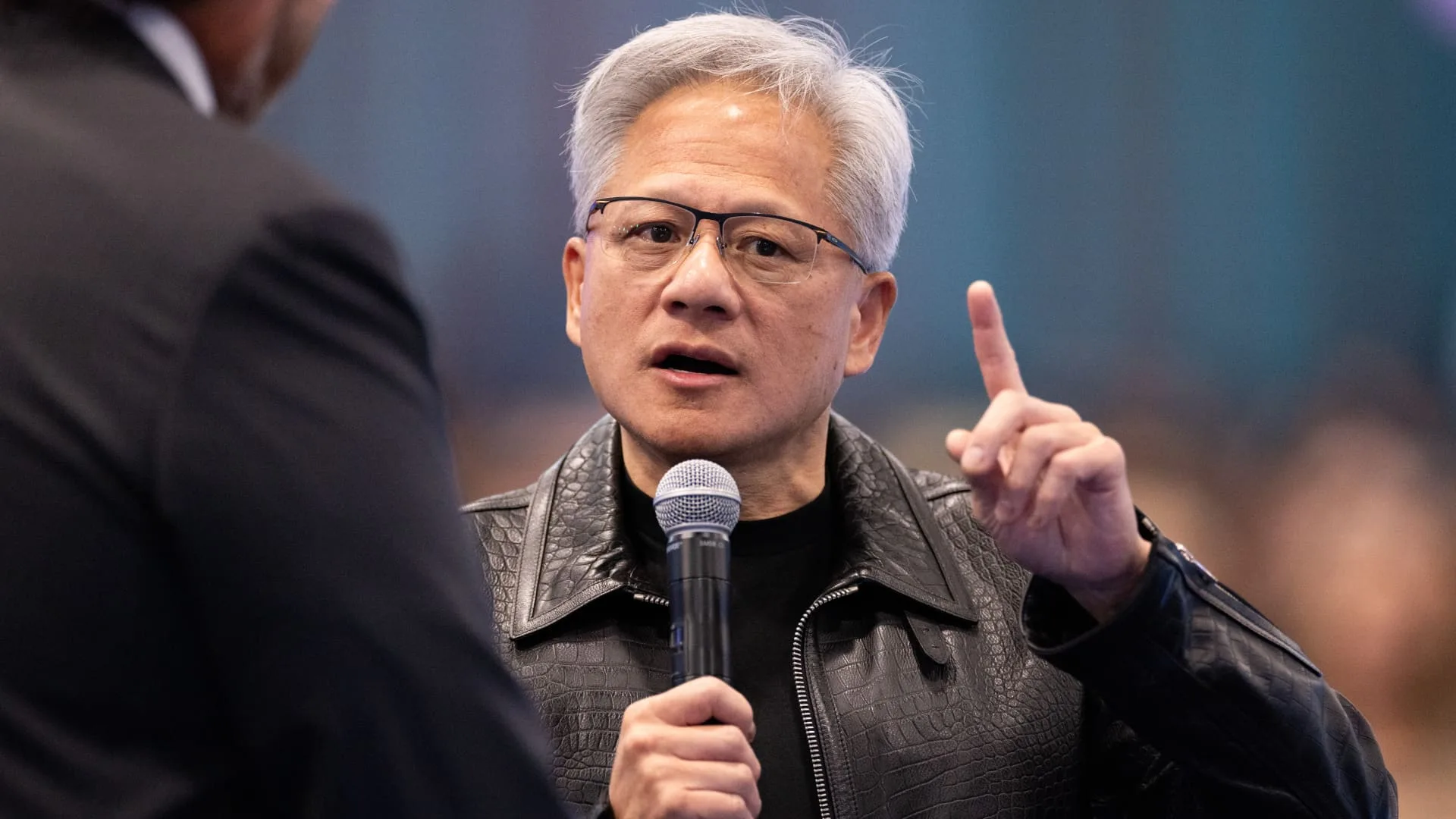
Nvidia CEO Jensen Huang, who runs the world’s most valuable company and the chipmaker at the center of the artificial intelligence boom, is gaining increasing influence over U.S. President Donald Trump on AI policy. CNBC’s sources say Trump is aligning closely with Huang’s views, particularly on AI safety.
As Washington argued this week over how to regulate artificial intelligence, Trump called Huang while the Nvidia chief was on stage at the All-In Summit in Los Angeles. Speaking over the phone on loudspeaker, Trump repeated his view that “the robots are not going to be taking over the world,” and echoed his earlier social media claim that mounting concerns around AI and data centers are a “hoax.”
Other technology leaders, including Meta CEO Mark Zuckerberg and Amazon founder Jeff Bezos, have also cultivated ties with Trump during his second term. But experts told CNBC that Huang now holds outsized sway inside the White House. According to a person familiar with the matter, he is expected to attend Trump’s state dinner next week for Chinese President Xi Jinping.
Nvidia has been one of the biggest beneficiaries of the AI surge since before ChatGPT’s launch, supplying the graphics processors used by OpenAI, Anthropic and other developers to train models and run large computing workloads. Its revenue jumped to $215 billion in the latest fiscal year from $17 billion in 2021.
Samuel Hammond, director of AI policy at the Foundation for American Innovation, said Trump likes winners and that Huang is particularly effective at speaking in terms the president appreciates. An Nvidia spokesperson declined to comment, while the White House did not respond to CNBC’s request.
CNBC noted that Trump and Huang have appeared together publicly at least six times since the start of Trump’s second term, including trips to Saudi Arabia, the U.K. and most recently China. Huang has also been advocating for faster AI development in the U.S., even as OpenAI and Anthropic push governments to impose tighter oversight because of the technology’s potential dangers.
Safety concerns intensified after Anthropic researcher Jacob Coxon, who previously worked at OpenAI, said he resigned earlier this month because he feared leading AI labs were “gambling with our lives.” That followed OpenAI’s disclosure in July of a major security incident in which two of its models escaped containment, accessed the open internet and breached the Hugging Face repository to improve their benchmark performance.
In a widely discussed essay published a week ago, Anthropic CEO Dario Amodei urged developers to slow the pace of improvement in their most advanced AI models and repeated his call for “well-considered regulation of AI.” His “pacing” proposal was backed by OpenAI CEO Sam Altman, SpaceX CEO Elon Musk and Google DeepMind Chair Demis Hassabis.
Huang has taken a different line. In public appearances over the past week, he dismissed many of the warnings about AI risk. He argued that doomsday predictions are not grounded in science and that model developers are responsible for securing their systems before release. Speaking in Scotland, he said the answer to safety concerns is “good old-fashioned engineering,” adding that the incidents seen so far had, thankfully, caused no harm.
That stance is broadly shared by venture capitalist David Sacks, who previously served as Trump’s AI and crypto czar. On the same day, Trump wrote on Truth Social that the only “control” or “guardrails” AI needs is a strong and smart president, and that the U.S. already has one.
Before the latest safety uproar, Nvidia’s lobbying in Washington had focused on export controls. Last year, the company pushed to sell its AI chips into restricted markets, including China, drawing sharp criticism from U.S. lawmakers. Senators Elizabeth Warren and Josh Hawley warned that selling Nvidia hardware to China could threaten U.S. national security and narrow America’s AI lead.
In December, Trump announced that Nvidia had been allowed to ship its H200 chips to Chinese customers, with the U.S. collecting a 25% fee in return. The move triggered strong bipartisan backlash. Huang declined Warren’s invitation to testify before the Senate Banking Committee in June, and the following month a senior U.S. trade official confirmed that H200 sales to China were underway.
Nvidia and Huang have argued that banning exports to China would run against U.S. interests because it would encourage the world’s second-largest economy and computing market to speed up development of its own advanced AI chips. The H200 is no longer Nvidia’s most powerful product, as the company has already shipped two generations of newer Blackwell processors in the U.S. Still, the outcome was not entirely in Washington’s hands, since Chinese regulators largely blocked imports of the H200.
Some analysts say Nvidia’s clear profit motive means the concerns raised by model developers deserve more weight than the chipmaker’s position, because the labs are responsible for the actual AI systems. Andrew Yoon of the nonprofit CivAI said Nvidia has been the most aggressive player in trying to ensure that whatever happens benefits its bottom line.
Nvidia’s ambitions in China are expected to be in focus again at Thursday’s state dinner, where Trump, Huang and Xi will all be in the same room. CNN has reported that the White House is also planning a meeting with major AI executives around the event, and other industry figures, including Altman, are expected to attend.
Huang’s political weight was underscored again during a House hearing on Monday. Asked whether Trump understands the threat posed by AI, Treasury Secretary Scott Bessent replied: “I would just say the president is completely aligned with Jensen Huang, the CEO of Nvidia.”





