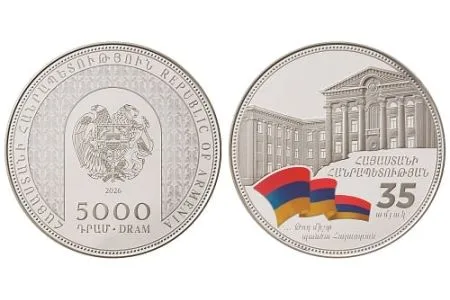
The Central Bank of Armenia on September 14 put into circulation a silver commemorative coin titled “35th Anniversary of the Republic of Armenia.” According to the regulator, the coin has a face value of 5,000 drams and is made of .925 silver.
The coin’s sketches were designed by Eduard Kurginyan. It was struck at the Lithuanian Mint. The coin weighs 168.1 grams, has a diameter of 63 mm, proof quality, and a smooth, numbered edge. The issue is limited to 300 pieces.
The obverse features the coat of arms of Armenia in the center, with the denomination “5000 drams” shown below it. The design is framed with an Armenian ornament.
The reverse depicts the National Assembly building (architect M. Grigoryan, 1950), a stylized tricolor, the inscription “35th Anniversary of the REPUBLIC OF ARMENIA,” and lines from the national anthem of the Republic of Armenia, “Our Homeland” — “...Let Armenia always be glorified.” The lyrics were written by M. Nalbandyan and the music by B. Kanachyan.

The Central Bank said commemorative coins are minted from precious metals to present the country’s national, international, historical, cultural, spiritual and other values to the public, to immortalize them in metal, and to meet demand in the numismatic market.
While commemorative coins, like all coins, carry a face value and are legally a means of payment, that nominal value is far below their production cost. The cost includes the value of the precious metal used as well as minting and other expenses. As a result, such coins are regarded primarily as collectibles rather than as instruments for everyday circulation.
The regulator also noted that the selling price of commemorative coins is set by the Central Bank of Armenia. These issues are released in strictly limited mintages and are not reissued. Numismatists, collectors and other buyers can purchase Armenia’s commemorative coins at the Central Bank’s “Numismat” store.
The statement further notes that Armenia’s Third Republic began on September 21, 1991. The state symbols — the flag, coat of arms and anthem of the Republic of Armenia — were established, state awards were instituted, and on November 22, 1993, the national currency, the dram, was introduced into circulation. In the Central Bank’s wording, the formation of an independent democratic state helped preserve and strengthen national identity and traditions, while also increasing the role of the Armenian Apostolic Holy Church in public life.
The source says one of the most important achievements of the independence period was the creation of a national army as a defender of Armenian statehood. Today, Armenia is a member of the United Nations, the Commonwealth of Independent States, the Council of Europe, the World Trade Organization, the Eurasian Economic Union and other international organizations.



