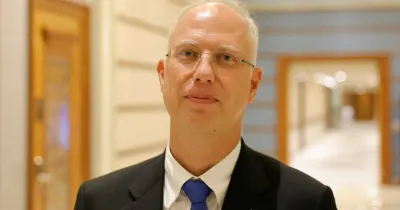
YEREVAN, September 1. /ARKA/. Armenia's aspiration to the EU is a legitimate right of the country and its people, but it creates difficulties in remaining in the EAEU and threatens to nullify the republic's advantages in the EAEU market and disrupt established trade chains. This was stated by Russian President Vladimir Putin during a meeting with Armenian Prime Minister Nikol Pashinyan in Bishkek.
“Over more than 10 years of participation in Eurasian integration processes, Armenia's GDP has nearly tripled: in 2015 it was $10.6 billion, and by the end of 2025 it is projected to be $29.2 billion according to our statistics. The export of the union country has increased tenfold. Today, about 36% of external trade turnover falls on the market of the union,” he said.
In this context, the Russian leader emphasized that the choice of the country's further political and economic course must be clearly expressed by the Armenian people.
“But at the same time, as we said, it is important to approach this objectively based on realities and take appropriate steps. I repeat once again, we will respect any choice made by the Armenian people. How Armenia decides is how it will be,” he said.
Putin asked Armenia to determine its position on this issue as soon as possible, adding: “We need to adjust our trade and economic policy in connection with these possible decisions.”
“The sooner we determine, the better, because we also need to understand how to develop relations with Armenia, primarily in economic terms. Some issues, such as regulation of agricultural products, various technical norms and standards, do not coincide at all in the EAEU and the EU,” he said.
In his response, Pashinyan stated that it is important for Armenia to have alternatives.
“This does not mean that we are dissatisfied with the EAEU. Despite the fact that there are many working issues in the EAEU, we always discuss them. Both strategic and tactical issues are considered a legitimate goal to have alternatives for the state, for the country. This process is not against Russia, nor against the EAEU. Because we highly value our relations with the Russian Federation. We hope that these relations are important for the Russian Federation as well. I want to confirm that I personally and our government treat these relations with great care, and I hope you do too,” he said.
The Armenian Prime Minister also noted that there will come a time when a very specific choice will need to be made.
“Our position is that at this moment the time has not yet ripened. Right now we have no alternative. When it is created (if it will be), then we will make a choice through a referendum or without it. There are also such options,” he explained.
In response, Putin stated: “I agree that the people should always have a choice. Just do it this way, and we will close the topic. That’s all. The simplest thing is to address the people and ask them what they want. This way or that way? And that’s it.”
Armenia-EU: main points
On March 26, 2025, the Armenian parliament approved a law to begin the process of joining the European Union. On April 4, the document was signed by the president.
On December 2, 2025, in Brussels, the parties approved the strategic agenda for the Armenia-EU partnership. In Yerevan, it was stated that this concerns support for the country's sovereignty, territorial integrity, democratic reforms, and economic stability.
Prime Minister Nikol Pashinyan emphasized that Armenia is moving towards EU standards but still maintains membership in the EAEU. According to him, if it becomes impossible to combine both directions, a further choice will be made together with the citizens of the country.
On May 4, 2026, a summit of the European Political Community was held in Yerevan. It was attended by representatives of EU countries, other European countries, and international organizations. The main topic of the summit was formulated as “Building the Future: Unity and Stability in Europe.”