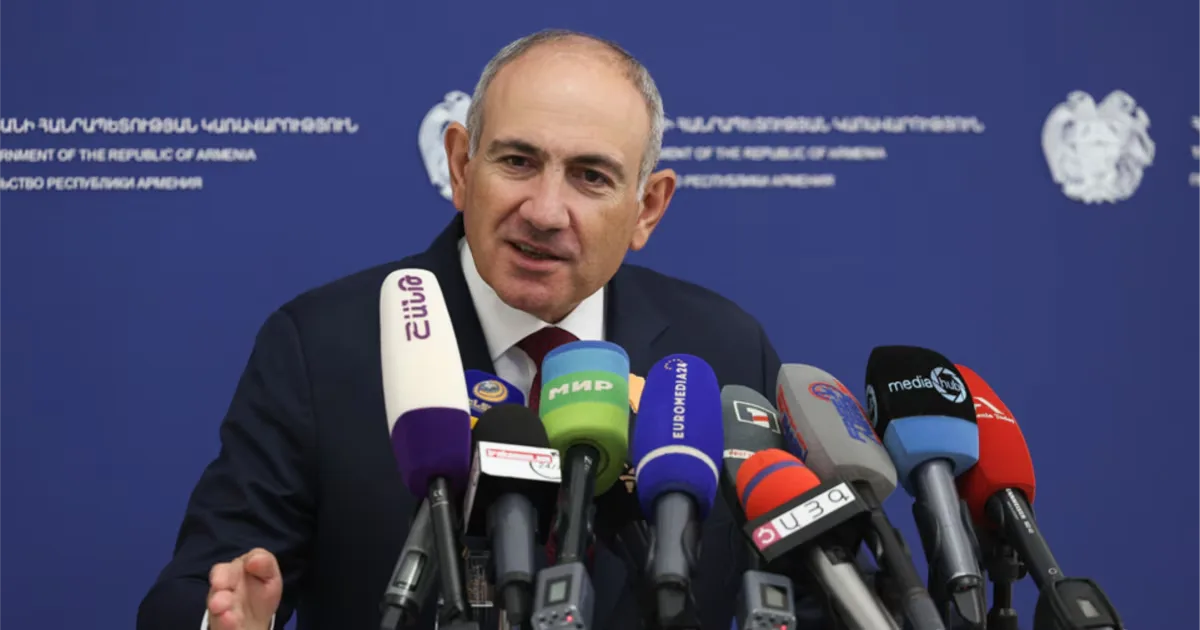

Armenia will keep diversifying its natural gas supplies regardless of whether that leads to higher prices, Prime Minister Nikol Pashinian said on September 11, as tensions with Russia continue.
Speaking to reporters after a cabinet meeting, Pashinian said the policy is a firm political choice. If Armenia gets a chance to import gas from a second source, it will do so, he said, and it would also pursue a third source if that option becomes available.
Pashinian said one possible avenue could be a gas pipeline crossing Armenian territory that could be linked to the Trump Route for International Peace and Prosperity (TRIPP). The U.S.-backed project is designed to connect Azerbaijan with its western Nakhichevan exclave via southern Armenia. According to the prime minister, such a route could also bring transit fee revenue to Armenia.
He said the government has a plan for all potential scenarios, including the impact on consumers if the price of Russian gas rises.
As Armenia moves to deepen political and economic ties with the West, especially the European Union, Moscow has repeatedly warned of possible economic fallout. That has included the prospect of ending the heavily discounted terms under which gas is supplied to Armenia.
Russia has already banned virtually all agricultural imports from Armenia. President Vladimir Putin has urged Yerevan to decide “as soon as possible” whether it wants to remain in the Russian-led Eurasian Economic Union or seek membership in the EU. Putin and Pashinian discussed the issue during their latest talks in Bishkek on the sidelines of a Shanghai Cooperation Organization summit and agreed to meet again in Moscow “in the near future.”
In a letter sent to the Armenian government in May, Russian Energy Minister Sergei Tsivilev said Armenia’s efforts to join the European Union “do not correspond to the nature of the partnership between the governments and economic entities of our countries.” He said Moscow could therefore suspend or cancel a 2013 agreement that exempts Russian natural gas and some other goods imported by Armenia from Russian export duties.
Russia supplies around 2 billion cubic meters of natural gas to Armenia each year via Georgia at a border price of $177.50 per 1,000 cubic meters. Those deliveries account for more than 80 percent of Armenia’s annual gas imports.
Pashinian also said Gazprom Armenia, the Russian-owned operator of Armenia’s gas distribution network, is a profit-making company. He argued that despite the discounted border price, the tariffs paid by end users in Armenia cannot be considered low compared with other countries.
In July, Armenia’s Public Services Regulatory Commission capped the retail price of Russian gas for household consumers at up to 148 drams (40 U.S. cents) per cubic meter through the end of 2026.
Pashinian added that if Russia raises gas prices, the Armenian government would consider “what other prices we could raise or whether services that are currently provided free of charge could be made subject to fees.” He did not provide further details.
According to the prime minister, Armenia’s political decision is to strengthen its independence and statehood, while the remaining issues can be addressed through situation-specific responses.
At the same time, Yerevan is seeking to increase gas supplies from Iran. In July, Territorial Administration and Infrastructure Minister Davit Khudatian said Armenia wanted to significantly boost Iranian gas imports, and that the two countries had agreed to form a joint task force to examine ways of expanding energy ties.
Armenia imported less than 500 million cubic meters of Iranian gas in 2025.



