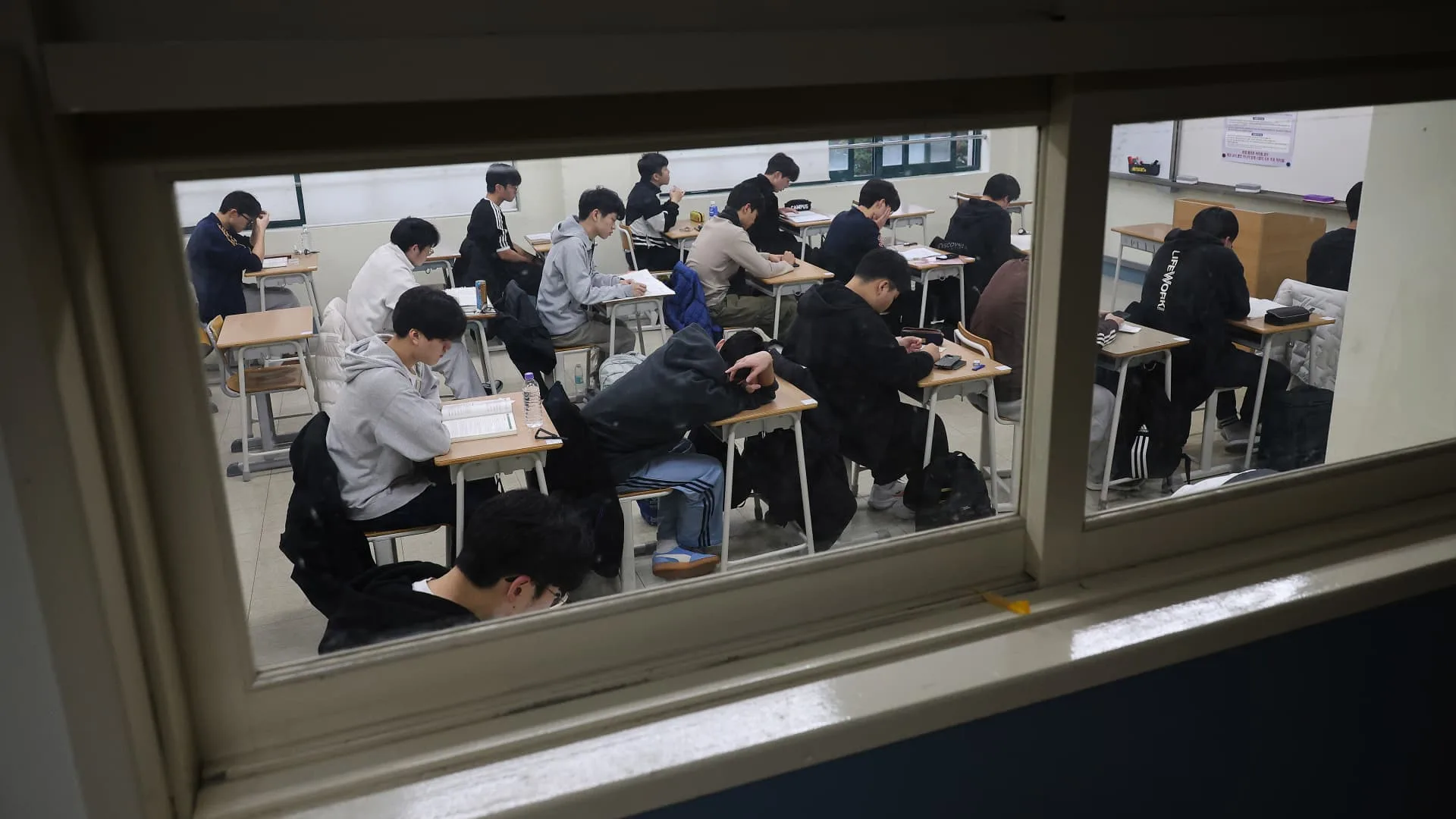
South Korea’s leading tech companies, Samsung Electronics and SK Hynix, are using joint university programs to recruit future talent long before graduation. These schemes, known in the country’s higher-education system as “contract departments,” offer students financial support and, in some cases, a clearly defined path into employment.
According to CNBC, demand for those programs is rising. Data from Seoul-based Jongro Academy showed that the number of applicants to contract departments tied to large companies jumped by more than 38% from a year earlier. The increase covers not only programs linked to Samsung Electronics and SK Hynix, but also courses connected to Hyundai Motor and LG Uplus.
Applications to Samsung Electronics contract departments rose 6.5% for the 2026 academic year, while those for SK Hynix-linked programs climbed 12.7%. Overall, Samsung Electronics contract courses attracted 13.44 applicants for every seat, while SK Hynix contract department courses had 9.14 applicants competing for each available place.
Jung Chae-rin, a second-year student in Sogang University’s Department of System Semiconductor Engineering, which was established in partnership with SK Hynix, told CNBC that the program guarantees employment at SK Hynix after graduation. She said every admitted student automatically receives an SK Hynix scholarship, and students who meet the required academic conditions are also assured a job.
Jung Chae-rin said she receives a study incentive allowance of around 300,000 every month, while her tuition is fully covered by the scholarship. Additional scholarships are also available for strong grades and project awards. To keep the scholarship, students must maintain a GPA of 2.3, and a 2.7 GPA is required for employment with SK Hynix. Students who drop out must repay the support they received. The company also said graduates are required to work at SK Hynix for a period equal to the duration of the financial support they received.
Samsung Electronics follows a slightly different model. Kim Tae-rin, a third-year student in the Department of Intelligent Software at Sungkyunkwan University, where a five-year integrated bachelor’s and master’s program was created with Samsung Electronics, told CNBC that tuition is covered for the first three years if students meet certain requirements, including minimum grades. From the second half of the third year, students can enter a separate Samsung hiring process. She described it as a “minimum procedure,” but said students must pass it before employment is confirmed. Only those who clear that stage continue receiving full tuition support for the rest of the five-year program.
The SKKU course only started in 2024, and its first cohort has yet to graduate. The university did not explain what happens to students who do not pass the Samsung hiring process. Sogang University also did not respond to CNBC’s request for comment.
Students said the value of these programs goes beyond financial aid. Samsung offers SKKU scholars “various experiential opportunities,” including participation in Samsung Electronics internship programs, visits to overseas research centers and attendance at international academic conferences. Kim Tae-rin said students have already visited a Samsung overseas branch and the company’s Suwon site, while meetings with company representatives are held regularly.
Jung Chae-rin said she toured the SK Hynix headquarters last year and attended a forum held on site. One of her most memorable first-year classes, she said, involved weekly lectures by SK Hynix employees, executives or professors from SK Hynix University on the technology and business areas they oversee. She also had the chance to present solutions to real industry problems directly to SK Hynix executives and receive live feedback.
The companies are also influencing what is taught. Samsung Electronics told CNBC it gives universities input on relevant courses and curricula, but did not specify how deeply staff are involved. SK Hynix said it also partly participates in curriculum design and review. The company added that there are currently no formal internships or hands-on field experiences, though such measures are being considered for the future.


The trend shows that for South Korea’s chip giants, recruitment no longer starts after university. In the middle of the AI boom, the race for top talent is increasingly beginning inside these contract departments.



