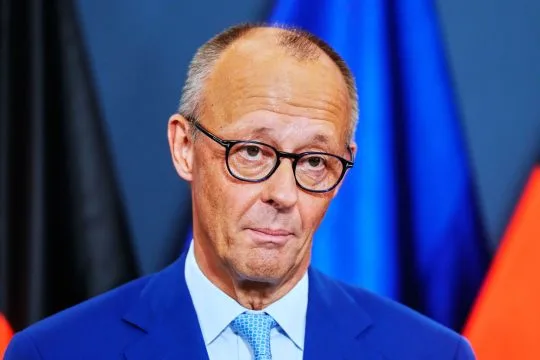
Election results in two German states have created fresh problems for Chancellor Friedrich Merz and highlighted the weakening of the country’s traditional political centre. In Mecklenburg-Western Pomerania, his Christian Democratic Union won about 5%, one of its weakest postwar showings.
In the same vote, AfD (Alternative for Germany) took around 38%, while the SPD won about 35%. Merz described the outcome in a single word: “disaster.” The CDU’s decline stands out even more against the party’s historical role. Under Konrad Adenauer, it became a main pillar of postwar West Germany’s orientation; under Helmut Kohl, it led the country through reunification; and during Angela Merkel’s years, it remained the dominant force in Germany’s political centre for an extended period.
The trend of recent weeks suggests this is not an isolated setback. Two weeks earlier, AfD posted a record result in Saxony-Anhalt, while in Berlin the Left Party came first. Against that backdrop, the Christian Democrats continue to lose ground, and voters are moving away from the political centre that shaped Germany’s agenda for decades.
This realignment is not only about party competition. German industry is dealing with expensive energy, weak investment activity and the high cost of technological transformation. In the eastern states, those pressures are compounded by inequalities that were never fully resolved after reunification. Although Germany reunified in 1990, the economic gap between east and west has not completely disappeared and still affects living conditions, opportunity and political choice.
AfD has been able to turn that dissatisfaction into durable electoral support. That gives Germany’s internal political shift a broader European dimension, because Germany is the European Union’s largest economy, one of Ukraine’s main European backers and a central player in the continent’s defence rearmament.
At the same time, Friedrich Merz’s government is trying to reshape the pension system, tax policy, the labour market and public spending. In these conditions, the chancellor’s domestic weakness could limit not only the scope for reform at home but also Germany’s influence in Europe.
AfD is also advocating a different foreign policy line: reducing support for Ukraine, restoring relations with Russia and bringing Russian energy supplies back to the German market. As a result, the party’s rise is already affecting not only domestic politics but also European security, relations with Russia, and the EU’s economic and energy policy.
Germany’s main parties still refuse to form a coalition with AfD. But each new victory for the party makes government formation more difficult and further narrows the room for the traditional centre. The Mecklenburg-Western Pomerania vote showed that Germany’s old political balance is weakening, with consequences that are likely to be felt across Europe’s economy and politics.