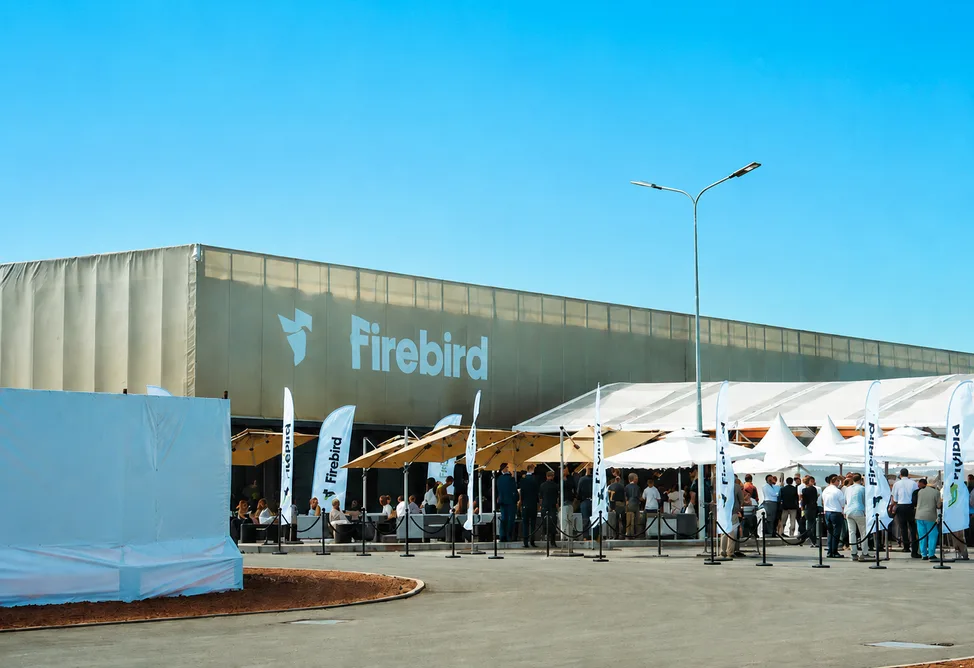
The launch of Firebird’s NVIDIA-based AI facility in Hrazdan sparked debate in Armenia over whether the project’s future expansion could put added pressure on the country’s water resources. Materials reviewed by ARKA, along with information provided by the company and Armenia’s Ministry of Environment, indicate that the operating site does not have постоянное water consumption for technological cooling.

The first phase is designed for up to 15 MW of computing capacity, while Firebird has previously said it aims to scale the infrastructure to 300 MW. The company clarified that 15 MW refers to the peak capacity of the computing cluster, while 18 MW is the maximum possible power use of the entire complex, including engineering and support infrastructure. The first phase includes 6144 NVIDIA B200 GPUs.
Where the nearly 2 million liters a day estimate came from
A figure of about 500,000 US gallons, or roughly 1.89 million liters of water per day, has circulated publicly in connection with Firebird. Eurasianet cited that estimate in November 2025 in relation to a then-discussed 100 MW data center. However, the publication did not identify a source or methodology for the water calculation. The link in that paragraph referred to electricity demand, not water use, so the figure cannot be treated as a confirmed measure of Firebird’s actual water consumption.
ARKA notes that standard estimates for data-center water use cannot simply be applied to the Hrazdan site, because the outcome depends not only on scale but also on the cooling system, local climate and operating conditions.
Why data centers use water
High-performance GPUs used to train and run AI models generate large amounts of heat that must be removed continuously. But liquid cooling does not automatically mean a constant draw of water.
If water or another coolant circulates in a closed loop between the cooled components, distribution units and heat exchangers, the fluid is reused rather than continuously consumed. Large ongoing water demand usually appears in systems that rely on cooling towers or other evaporative cooling equipment.
Based on public technical information and the company’s comments, Firebird uses dry external heat rejection, which sharply reduces direct water use.
What system Firebird uses
Firebird told ARKA that the operating site uses Vertiv FIZ125 and LVZ090 units with closed cooling systems. According to the company, the data center does not use evaporative or adiabatic cooling even during the hottest periods. The heat-transfer fluid circulates inside a sealed system and releases heat through radiators cooled by fans using ambient air only.
NVIDIA had previously said Vertiv supplied Firebird with a cooling architecture combining chilled water technology, the iCOM CWM control system and the Vertiv TrimCooler solution for external heat rejection. In Vertiv’s catalog, the CoolLoop Trim Cooler is described as a fully dry solution that does not require a constant water supply for external cooling. At high outdoor temperatures, compressors using R1234ze refrigerant handle peak loads.
The company compares the basic operating principle to a car radiator, while stressing that the actual setup is a far more complex industrial system. In simplified terms, the coolant absorbs heat from the processors, transfers it to the external cooler and then returns to the loop after being cooled.
Why Hrazdan was chosen
Firebird said one reason for choosing Hrazdan as the site for the AI facility was the local climate. According to the company, the city’s maximum air temperature over the past ten years has not exceeded 36.5°C, allowing dry cooling to be used even on hot days.
Firebird also said there is currently no water-supply infrastructure at the operating site. That infrastructure will eventually be needed for employees’ domestic and sanitary needs.
What is inside the closed loop
The company said the closed system contains about 250 tonnes of glycol-based coolant imported from Europe. It circulates within the sealed loop and is not consumed during cooling. Scheduled replacement is expected roughly once every 5–8 years.
That means the fluid serves as a heat-transfer medium rather than a continuously supplied and consumed resource, unlike systems that use evaporative cooling towers.
Does that mean no water is used at all?
No. Even a data center with dry external cooling may still use limited amounts of water for the initial filling of the system, maintenance and compensation for possible losses. Water may also be needed for staff needs, cleaning and fire-safety infrastructure.
Arevik Hovsepyan, president of the scientific and environmental NGO Country Water Partnership Armenia, said, citing company representatives, that about ten truckloads of water were used for the system’s initial flushing. In her view, that is not a significant volume, and once the loop is filled, additional liquid may not be needed for about 5–6 years.
There is also an indirect water footprint
Direct on-site water use is only part of a data center’s overall water footprint. There is also an indirect component linked to electricity generation. Some power plants use water for cooling, while hydropower reservoirs lose part of their water through evaporation.
According to Firebird’s expansion project documents, the plan includes major energy infrastructure supplied from sources linked to the Hrazdan HPP and Hrazdan TPP. Natural gas will not be used at the site itself. Still, the available materials are not sufficient to calculate the AI facility’s indirect water footprint from electricity supply with precision.
What Armenia’s Ministry of Environment says
Armenia’s Ministry of Environment told ARKA that Firebird AI CJSC is not registered in the state water cadastre as a water user and has not applied for a water-use permit. At the same time, the project’s expansion is going through an environmental impact assessment process.
On August 7, the company submitted a report on the expansion of the AI data center in Hrazdan. According to the revised EIA document, another 30 hectares are planned next to the existing 5.813-hectare site, bringing the total complex area to about 35.8 hectares. The design предусматривает a chiller system with a closed water-glycol loop for technical facilities. The report says no permanent water consumption is expected for cooling, and the system would need filling roughly once every eight years.
How much water the expanded complex will need
Even without permanent technological water use for cooling, the expanded facility will still require water for non-technological purposes. Project documents estimate peak domestic water use during operation at 25 cubic meters per day.
Firebird also told ARKA it plans to keep the dry-cooling approach as it scales AI infrastructure to 300 MW. Even so, the environmental review of the expansion is still underway, and a fuller assessment of the project’s broader water impact will require more data.



