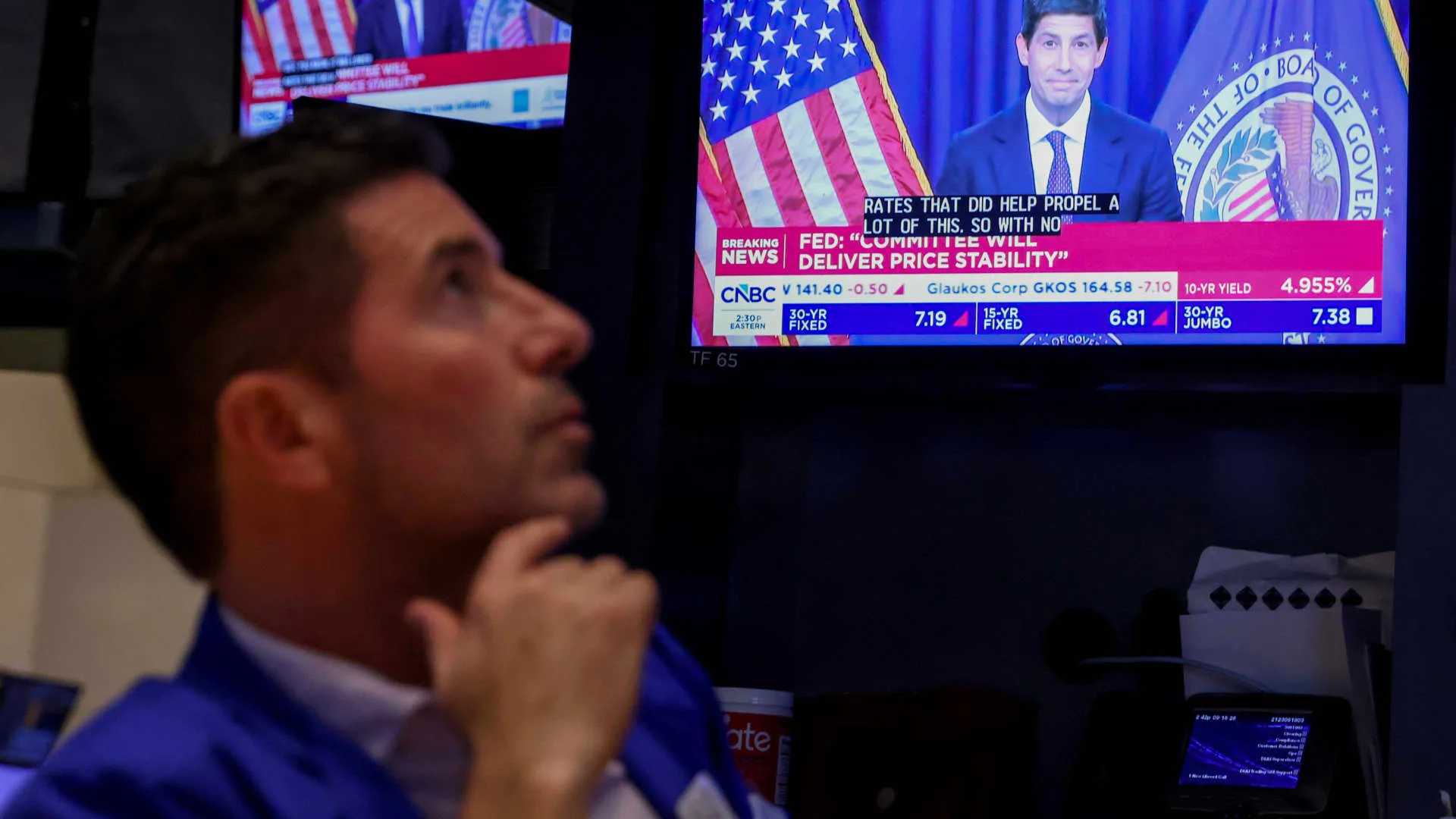


U.S. stocks ended the Sept. 16 session lower after the Federal Reserve raised interest rates for the first time in three years and Chair Kevin Warsh stressed that inflation pressures have not meaningfully eased.
The Dow Jones Industrial Average fell 631.21 points, or 1.21%, to close at 51,461.90. The S&P 500 dropped 0.45% to 7,551.81, while the Nasdaq Composite slipped 0.01% to 25,978.42. All three indexes had traded higher earlier in the day before reversing course after the Fed decision and Warsh’s press conference.
In a unanimous 12-0 vote, the Federal Open Market Committee raised its key rate by 25 basis points, taking the target range to 3.75%-4%. It was the central bank’s first increase since July 2023. Policymakers also signaled that another rate hike could come before year-end.
At his press conference, Kevin Warsh said inflation remains too high and that this summer’s readings do not show a meaningful improvement in underlying trends. Following those remarks, the yield on the 10-year U.S. Treasury moved back above 5%, a level investors viewed as a major psychological threshold.
Art Hogan, chief market strategist at B. Riley Wealth, said the Fed’s move was broadly in line with expectations, but Warsh’s more hawkish tone could mean elevated yields will remain in place for longer. In his view, both the bond-market reaction and the prospect of higher-for-longer inflation may act as near-term headwinds for equities.
Large bank stocks came under particular pressure after the decision. Shares of Bank of America and Wells Fargo each fell nearly 3%, while American Express and Goldman Sachs dropped about 4%. Separately, the State Street SPDR S&P Bank ETF (KBE) lost 2.6%, putting it on track for its weakest day since Feb. 27. JPMorgan Chase declined 1.5%, while Citigroup, Goldman Sachs, Wells Fargo and Bank of America all fell more than 3%.
Energy prices added to concerns about the economic outlook. U.S. diesel prices hit $6 per gallon on Friday for the first time, amid ongoing supply constraints linked to the wars in Ukraine and Iran. Crude oil, meanwhile, remained above $100 a barrel.
The transportation sector also posted sharp losses. The Dow Jones Transportation Average fell more than 2%, underperforming the broader market. J.B. Hunt was the biggest drag after management warned that third-quarter earnings are expected to decline 5% to 10% sequentially because of higher driver, fuel and transport costs. CFO Brad Delco said the company has seen some of the most extreme and abnormal swings in fuel prices on record. According to AAA, average diesel prices have recently reached $6.31. J.B. Hunt shares were down more than 13% in afternoon trading, while C.H. Robinson Worldwide, Old Dominion Freight and Werner Enterprises also moved lower.
In currency markets, the dollar index rose 0.6% to 100.21, its highest level since July 31. That move was also tied to Warsh’s warning that inflation risks remain persistent.
At the same time, some company-specific news helped cushion losses in technology. Intel shares gained 4% after a report said the company was in talks with South Korea’s SK Hynix to build semiconductors in the U.S. That helped limit a deeper decline in the Nasdaq.
Among broader market views, Citi global equity strategist David Groman said stocks often wobble at the start of a rate-hiking cycle but tend to recover over the following 6 to 12 months. In his assessment, the next phase for markets will depend heavily on whether economic growth stays resilient and inflation begins to ease.
Pereon Wealth CEO Michael Tanney said the Fed’s move restores confidence and credibility in the central bank’s approach. He also said upcoming midterm elections could influence the timing of future decisions, though another 25 basis-point increase before the end of the year remains possible if market data support it.



