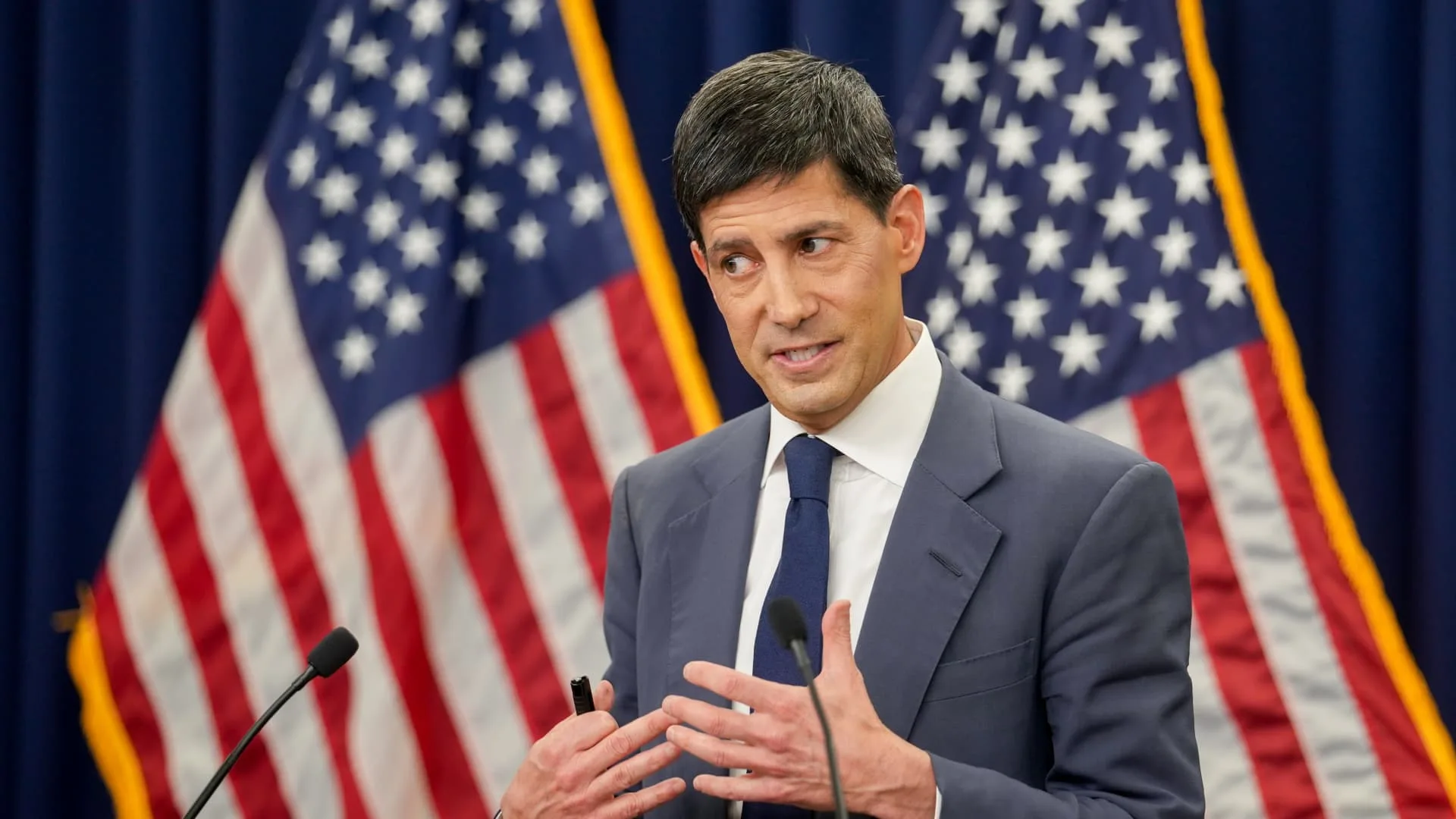


Federal Reserve Chair Kevin Warsh enters this week facing two linked challenges: whether to back a likely rate increase and whether he can assemble enough support for that move inside the committee. Markets have largely priced in a quarter-percentage-point hike in Wednesday’s decision, but the size of the backing among the 12 voting members of the Federal Open Market Committee remains uncertain.
CNBC notes that the FOMC voted 9-3 in July to leave rates unchanged. That makes this week’s two-day meeting an important test of how deep the divide remains between officials who see inflation as temporary and those who worry recent price pressures could become more entrenched.
The Fed funds target range currently stands at 3.50% to 3.75%. According to CME Group’s FedWatch tool, futures traders as of Monday afternoon were assigning better than a 92% probability to a rate increase this week and more than a 75% chance of another move in December. Those expectations strengthened after another rise in fuel prices and last week’s August inflation report, which showed that prices continued to climb.
Even so, the case is not straightforward. Many economists argue that this year’s inflation pickup has been driven mainly by one-off factors, including tariffs and an energy supply shock stemming from the Iran war, both of which have uncertain implications for the longer-term inflation path. Goldman Sachs economist David Mericle wrote in a client note that the economic argument for raising the funds rate is weak and that the overshoot above the Fed’s 2% target can be traced to temporary factors. Still, the bank shifted its call and now expects a hike, largely because it believes market expectations will push the Fed to act.
The vote count itself is complicated. In July, three dissenters backed a rate increase: Dallas Fed President Lorie Logan, Cleveland Fed President Beth Hammack and Minneapolis Fed President Neel Kashkari. If their views have not changed, at least four additional members would need to move from the hold camp to the hike camp for a tightening decision to pass.
One of the most closely watched officials is Governor Christopher Waller. In remarks on Sept. 3, he favored another hold, while stressing that incoming data should confirm that disinflation is continuing. His argument was mainly for patience: waiting one more meeting carries little cost, and a 25-basis-point increase right now would not by itself bring the consumer price index back to 2%.
August CPI showed headline inflation at 3.4%, while the core measure, which excludes food and sharply rising energy costs, came in at 2.4%, down 0.1 percentage point from July. Waller is not the only policymaker urging caution. New York Fed President John Williams told CNBC less than two weeks ago that a wait-and-see approach appeared sensible, and earlier in the summer he said he believed inflation had peaked.
Governor Michael Barr has taken a more balanced position, warning that temporary inflation could become more deeply rooted while saying he would be open to a hike rather than fully committed to one.
Who could form the majority
Markets broadly expect Kevin Warsh to be in the camp favoring a hike, given his remarks at Jackson Hole. Governor Lisa Cook said in early August that she was “prepared to act” against inflation. By contrast, Philadelphia Fed President Anna Paulson and Chicago Fed President Austan Goolsbee have argued for a more patient approach.
That leaves Vice Chair Philip Jefferson, former Chair Jerome Powell, who has kept a notably low profile since stepping down, and Michelle Bowman, who said little about monetary policy over the summer. Her last relevant comments came in May, when she also warned against tightening unnecessarily.
Analysts also point to a broader wildcard: if Warsh strongly presses the case for a hike, undecided members may move to his side in order to present a more united front to the public and the President. JPMorgan Asset Management chief global strategist David Kelly said that if a majority forms around a hike, the final vote may not look especially close in retrospect, and dissents could shrink to two, one or even none.
After the decision, market attention will turn to the Fed’s updated dot plot, which anonymously reflects the rate expectations of all 19 meeting participants. Warsh did not submit his dot in the June update. Investors will be watching for how much support there is for two hikes this year, what the committee’s outlook is for 2027, and what the first projections for 2029 show.
Mericle said that a 10-8 split in favor of one hike, assuming no Warsh dot, could suggest some participants are ambivalent even about the first move and do not want to push market expectations higher. At the same time, he sees a risk that a majority could align behind two hikes if more participants interpret higher oil prices, AI demand and this week’s move as the start of a broader tightening cycle.
If the committee remains closely divided, attention will quickly shift to Warsh’s Wednesday afternoon press conference and how he explains the FOMC’s thinking. Former New York Fed President Bill Dudley said the Fed needs to make clear how it is assessing the economy. In his view, if Warsh follows his earlier rhetoric with action, he could repair the credibility problem Dudley believes was created during the chair’s first two press conferences.



