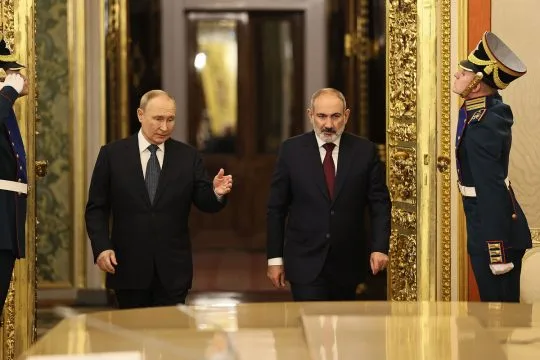
For Armenia, gas supply diversification is increasingly becoming not just an economic issue but a strategic one. The latest debate follows Prime Minister Nikol Pashinyan’s statement that the country will seek to diversify supply sources regardless of whether Russian gas becomes more expensive. The underlying idea is that the price of fuel may influence purchasing decisions, but it should not determine Armenia’s foreign policy course.
The issue gained momentum after Vladimir Putin said in April that Russia sells gas to Armenia at $177.5 per 1,000 cubic meters, while the same volume in Europe can cost more than $600. The message behind that comparison was clear: a geopolitical choice may carry an economic price. Yerevan’s current response is that gas pricing can shape where Armenia buys from, but it should not dictate the country’s political choices.
At the same time, diversification cannot be achieved through political declarations alone. It requires alternative suppliers, delivery routes, and the practical ability to bring gas into Armenia, store it, and distribute it to consumers.
Armenia currently consumes about 2.7 billion cubic meters of imported gas a year. In 2025, roughly 2.23 billion cubic meters came from Russia and around 476 million cubic meters from Iran. That means the foundation of an alternative already exists. Iranian gas is supplied under a “gas for electricity” arrangement, under which Armenia sends Iran 3 kilowatt-hours of electricity for every cubic meter of gas. The current agreement has been extended until 2030.
A key point is that the Armenia-Iran gas pipeline has far more capacity than is currently being used. The International Energy Agency has estimated its annual capacity at about 2.3 billion cubic meters. Armenia’s government said this summer that the pipeline has spare capacity and that it is already discussing an expansion of the “gas for electricity” program with Tehran. If talks over Russian gas become more difficult, the Iranian route could become the first practical alternative rather than a theoretical one.
The completion of the third Armenia-Iran high-voltage transmission line is also important. The greater Armenia’s ability to export electricity to Iran, the greater the volume of gas it may be able to receive in return under the existing swap-style arrangement.
Another possible option is swap supply via Georgia. In international gas trade, the same physical molecules do not have to travel all the way to the end buyer. Gas can be fed into an interconnected system at one point and an equivalent volume received at another. That means Armenia could look not only at building new pipelines, but also at creating commercial and swap mechanisms using regional networks that already exist.
Turkmenistan is of particular interest, as it is one of the countries with the world’s largest gas reserves. Yerevan has already publicly expressed interest in expanding gas cooperation with Ashgabat. There is also a regional precedent: Turkmenistan has supplied gas to northeastern Iran, while Iran has delivered equivalent volumes to Azerbaijan from its northwestern border. In theory, a similar model could work for Armenia, with Turkmen gas entering northern Iran and Tehran supplying Armenia with equivalent additional volumes through the existing Armenia-Iran pipeline.
That is not yet a ready-made deal. It would require political agreement, clarity on pricing and transit, an assessment of sanctions risks, and technical solutions. Even so, the existence of such options strengthens Armenia’s negotiating position.
The article’s central argument is that Armenia’s dependence is not only about buying Russian gas. It is also about the fact that the entire gas transport system is under Russian control. “Gazprom Armenia”, a wholly owned subsidiary of “Gazprom”, not only sells gas on the domestic market but also handles transportation, storage, and distribution. The same system includes the Abovyan underground gas storage facility and the Armenian section of the Armenia-Iran pipeline.
Under those conditions, the arrival of new suppliers would still not amount to full system diversification. If gas entry, transit, storage, and internal distribution are all concentrated in the hands of one vertically integrated monopoly, then supplier diversification alone does not remove strategic dependence.
The article compares this problem with Europe’s experience after 2022, when cheap Russian gas, especially in Germany, had long been treated as an economically rational choice. The war showed the opposite: once political relations collapsed, the economic advantage turned into a strategic vulnerability. For Armenia, the main lesson is not that it must abandon Russian gas, but that it needs to build the capacity to choose.
If Russian gas remains the most competitive option, Armenia can continue buying it. If Iranian gas or Turkmen gas supplied through a swap mechanism proves more advantageous, the market should be able to accommodate those options as well. In that sense, the goal of diversification is not simply to replace one supplier with another, but to build a system in which no single source can turn into a political ultimatum.
As a result, the next stage of debate in Armenia, the article argues, should focus not only on the $177.5 price, but also on the future structure of the country’s gas transport system, third-party access to infrastructure, storage capacity, full use of the Armenia-Iran pipeline, and the mechanisms needed to join regional swap markets.
In this reading, energy sovereignty does not mean producing all gas domestically. It means having enough sources, routes, and contracts so that none of them can dictate Armenia’s political choices.