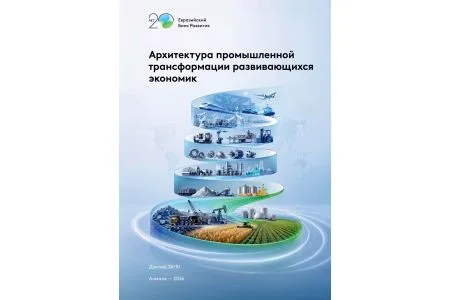


The Eurasian Development Bank (EDB) has released a new analytical report, “Architecture of Industrial Transformation of Developing Economies,” outlining how developing countries can move into the high-income category and remain there sustainably.
The report argues that simply increasing investment and importing modern equipment is not enough. In the bank’s view, the critical step is turning external technologies into domestic production capabilities, engineering skills, supplier networks, standards and innovation capacity.
According to the report, 64% of economic growth episodes over the past 50 years were linked to manufacturing, while one industrial job supports another 2.2 jobs in related sectors on average. It also says industry accounts for 53% of global R&D activity and that industrial companies hold nearly 60% of green patents worldwide.
EDB proposes a three-stage architecture for industrial transformation: investment → technology infusion → innovation. The first stage focuses on building a basic production foundation, including reliable energy, transport, water, industrial sites, quality infrastructure and vocational skills. The second stage brings separate industries together into an industrial platform by developing suppliers, engineering capabilities, deeper processing, standards and project finance. The third stage adds applied R&D, pilot lines, intellectual property and commercialization of home-grown solutions.
The report stresses that the state and the private sector have distinct but complementary roles. Governments are expected to build conditions in energy, transport, water, logistics, industrial sites, standards, workforce training and risk-sharing mechanisms. Private companies, meanwhile, test the commercial viability of projects through investment and competition. State support, the authors say, should be tied to co-financing and measurable results.
EDB also highlights the scale of the challenge. Today, 108 economies with around 6 billion people fall into the middle-income group, but only 34 economies have moved from that category into the high-income group since 1990. The bank says that underlines how difficult it is to shift from growth driven by capital accumulation, urbanization, commodity advantages and borrowed technology to growth based on productivity and domestic technological capability.
For the Eurasian region, the report translates that framework into a practical opportunity set. Russia and Belarus are seen as capable of developing more complex segments such as equipment, components, engineering, standards and selected technological niches. Kazakhstan and Uzbekistan can connect their resource and energy base and rising demand more deeply with chemicals, higher value-added metallurgy, electrical engineering and machinery manufacturing. Armenia, Kyrgyzstan and Tajikistan can strengthen regional chains through specialized component, service and niche production.
A scenario estimate from an earlier EDB study suggests that developing four interconnected sectors — chemicals, machinery manufacturing, higher value-added metallurgy and food processing — could generate more than $510 billion in additional annual output at 2019 prices. The bank says this is not a GDP forecast or a guaranteed outcome, but an estimate of potential that includes export expansion, partial substitution of critical imports and spillover effects in related sectors.
The authors add that industrial transformation is not only about building new factories. Physical infrastructure — energy, transport, logistics, warehousing, water and industrial sites — must be developed alongside soft infrastructure such as standards, certification, metrology, vocational and engineering education, applied science and supplier development programs. Priority areas, the report says, should pass tests of market demand, resources and competencies, technological proximity, infrastructure readiness and financial feasibility.
EDB assigns a special role to multilateral development banks, saying they should turn industrial strategy into a financeable project pipeline by preparing complex projects, reducing early-stage risks, providing long-term financing, mobilizing private capital and linking national initiatives into regional production chains.
As of the end of June 2026, EDB’s cumulative portfolio included 348 projects with total investment of $22.1 billion, according to the bank. Most of that portfolio is concentrated in projects with an integration effect in transport infrastructure, digital systems, green energy, agriculture, industry and machinery manufacturing. Under its 2022–2026 Strategy, EDB is also implementing three megaprojects: the Central Asia Water and Energy Complex, the Eurasian Transport Framework and the Eurasian Commodity Distribution Network.



