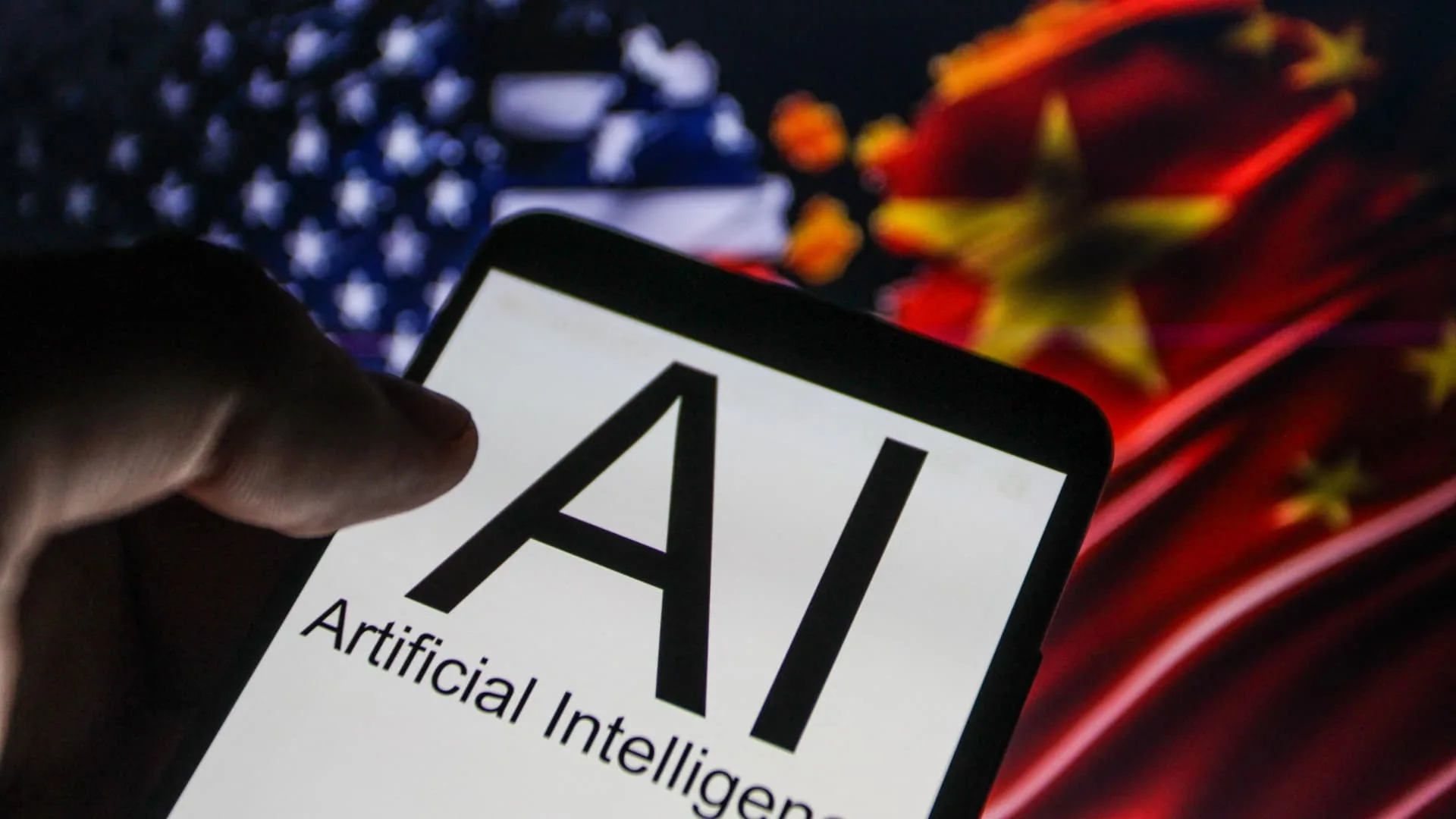
In the U.S.-China race for artificial intelligence leadership, “distillation” has become one of the most contested concepts. Broadly, the term refers to training one AI model using the outputs or answers of a more advanced model. Critics argue that this can let a weaker lab build a competitive product by leveraging a system that may have cost millions or billions of dollars to develop.
U.S. companies and Washington have argued that Chinese labs used this approach to narrow the gap with American rivals, describing the practice as theft. But a growing number of industry voices are questioning whether China’s AI progress can really be explained mainly — or entirely — by distillation.


Cohere CEO Aidan Gomez told CNBC that not all of China’s gains should be attributed to that technique. Gomez, a co-author of the 2017 paper “Attention Is All You Need,” described Chinese AI models as “world class” and said the lead held by top U.S. labs is “evaporating very quickly.”
He said claims that Chinese companies are merely copying, distilling and cheating are true to some extent, but do not tell the whole story. According to Gomez, the newest Chinese models outperform the best U.S. systems on some benchmarks and capability axes. In his view, copying can help close a gap, but it cannot by itself produce a superior model.
Conflicting views on China’s AI rise
That assessment diverges somewhat from the public stance of U.S. AI companies and policymakers. Anthropic, the maker of Claude, has repeatedly said Chinese labs have used distillation and has characterized it as theft. This month, Anthropic’s head of threat intelligence, Jacob Klein, told CNBC there is “an entire illicit ecosystem” trying to gain access to Claude and other models.
In a report released this month, Anthropic said companies including Alibaba, Moonshot and DeepSeek — among China’s leading AI labs — attempted to use “illicit distillation” to train their own models.
The U.S. government has also issued warnings. Earlier this month, the Cybersecurity and Infrastructure Security Agency said Chinese AI companies are “conducting systematic extraction of proprietary functionalities and capabilities of U.S. AI companies’ models through industrial-scale knowledge distillation campaigns,” arguing that this is central to their development strategy rather than merely a supplement.
Doubts over distillation’s importance
At the same time, more experts are questioning how decisive distillation really is. Former senior White House AI policy adviser Sriram Krishnan said Thursday that services such as ChatGPT and Claude themselves “came out of distilling human content,” referring to the fact that those models were trained on information available on the internet.
Krishnan said the idea of distillation has always been a core part of how computer science works. In his view, even if Chinese labs are using the method, it remains unclear how much it is actually contributing to their ability to push models forward. That is broadly in line with Gomez’s argument.

The Chinese government has rejected the allegations. A spokesperson for China’s Ministry of Commerce said U.S. claims that Chinese companies are using “industrial-scale” distillation are “groundless and legally unsound.”
CNBC also pointed to another factor behind China’s progress: technology restrictions. Even as China faces limits on access to cutting-edge chips, including products from Nvidia, it has accelerated development of its domestic semiconductor industry. Most experts agree Chinese semiconductors still do not match the performance of U.S. chips, but the country has used a range of technical workarounds to make them usable.
Neil Shah, a partner at Counterpoint Research, told CNBC that chip restrictions forced Chinese developers to build “leaner, smarter architectures” and achieve more with less compute. Dismissing that simply as imitation may suit restrictive policymaking, he said, but it misreads the competitive landscape.
The report ultimately raises a broader question: are Western policymakers underestimating China’s technical capabilities in AI? Gomez’s answer was unequivocal: “Absolutely.” In his view, the market is still adjusting to the reality that China is no longer just copying, but is innovating in its own right.





