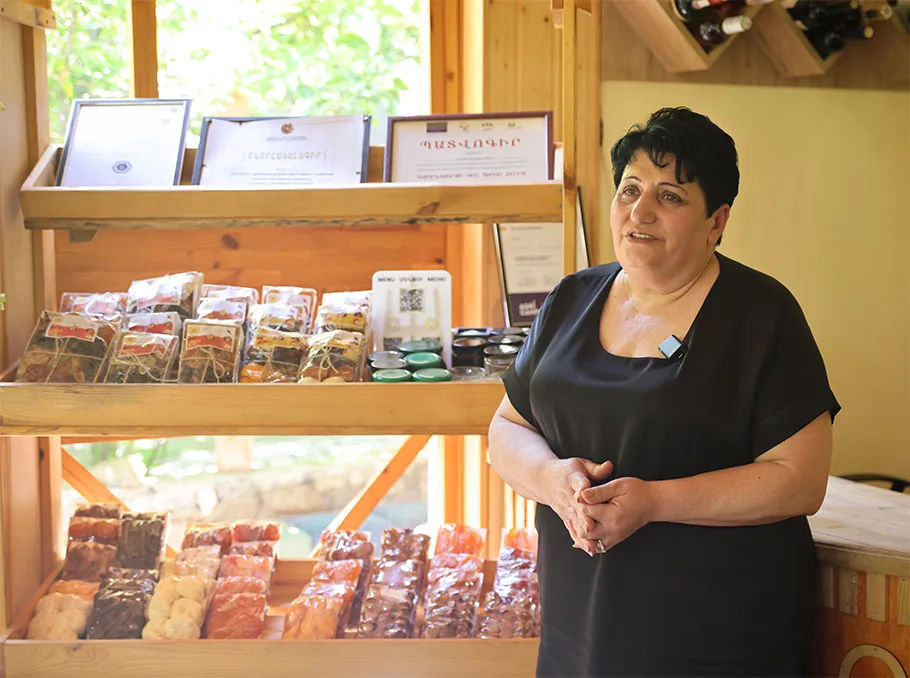
Chir’s House in the village of Byurakan in Armenia’s Aragatsotn region began as a small family-run dried fruit workshop and has gradually expanded into an agricultural cooperative and a rural hospitality venue. Founder Tsovik Ohanyan says the business was built with the support of her husband and three children, who helped turn what was once a dump site into a production area, greenhouse and garden.

Photo: Mediamax
Ohanyan is a trained electrical technician and worked as a technologist at the Sirius factory from 1985 to 1993. She says the idea to launch the dried fruit business came in 2015, when small growers in the village struggled to sell harvests of 10, 100 or 200 kilograms. Her family decided to open a workshop that would buy fruit not only from their own farm, but also from small producers in neighboring villages.

Photo: Mediamax
In 2016, the family business was reorganized into the Byur-Akn agricultural cooperative. According to Ohanyan, the format made it easier to bring in other women from the village, pool investment and continue operating on a more sustainable basis. The cooperative has 5 founding members, only one of whom is a man. Other members later joined and began selling fruit from their orchards through the workshop.

Photo: Mediamax
The workshop also stands out for its production model. Obsidian stones are used in the drying process to provide heat and improve ventilation. Ohanyan says the facility was designed by her youngest daughter. The business produces dried fruit in two ways: with sulfur treatment and in a natural “grandmother’s method” format involving only washing, cleaning and drying. It uses both solar and electric drying methods. The workshop usually accepts between 1 and 100 kilograms of fruit, but she stresses that product quality depends on high-quality raw material.

Photo: Mediamax
The business has also faced setbacks, including spoiled tons of plums, but Ohanyan says failures are part of learning. In her view, entrepreneurship is not just about calculation. Since the first days of production, Chir’s House has given away around 300-400 kilograms of dried fruit every year, a practice she says returns in the form of goodwill, new customers and more guests.
Over time, a hospitality component developed alongside production. Visitors coming to Byurakan for the Observatory, Herouni station, Amberd and Aragats began asking what else they could see in the village itself. At first, guests were hosted in very simple conditions, but the family later built its first rural-style pavilion and gradually upgraded the site. After an info tour held on May 18-19, 2018, the venue took the name Chir’s House, while visitors also popularized the Armenian version, “Chri tun.”

Photo: Mediamax
The project’s sourcing footprint has widened as well, with fruit now coming from different parts of Armenia. Chir’s House also joined an Armenian organic program and won a competitive project for an organic strawberry greenhouse, which has been running for 8 years. It later added organic dried strawberries, oyster mushroom production and beekeeping under organic standards. Ohanyan says the entire area is maintained without toxic chemicals.

Photo: Mediamax
Today, Chir’s House sells packaged dried fruit, sweet sujukh, teas and oyster mushrooms. Its products are stocked in some supermarkets in Armenia, while sales are also made on-site and online. Ohanyan says the business makes dried fruit only from strawberries grown on its own land, while other fruits are reserved for treating guests. Visitors are always offered dried fruit and a signature product called “Dream Sujukh.”
The founder says family support, especially her husband’s day-to-day help, has been vital to the business. She adds that what she enjoys most is hosting people and telling them the story of the land, the trees and the garden. In her view, that personal story and direct human connection are what bring people to Chir’s House.

Photo: Mediamax
Ohanyan also encourages women to value their own strength and keep learning at any age. She says self-confidence is often limited when a business starts, but experience helps entrepreneurs assess risks more accurately, understand their strengths and weaknesses and keep a business alive. “I learn every day,” she says.

Photo: Mediamax