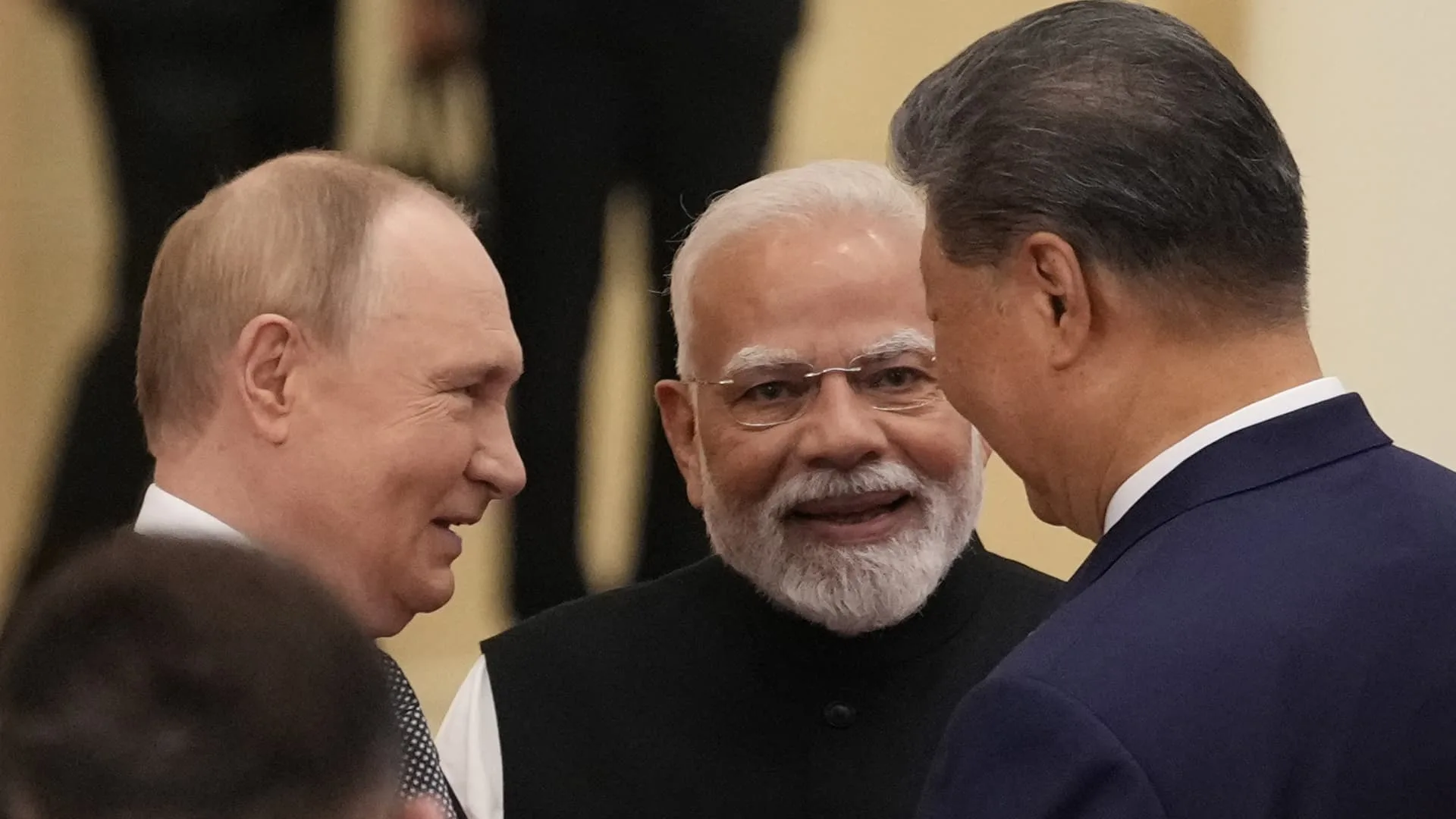
The BRICS summit taking place in New Delhi this weekend is highlighting how U.S. tariffs, sanctions and the worsening conflict in the Middle East are reshaping the economic calculations of the group’s members. India is hosting the gathering, and Chinese President Xi Jinping, Russian President Vladimir Putin and Iranian President Masoud Pezeshkian are expected to attend alongside Prime Minister Narendra Modi.
CNBC says the meeting comes amid a highly complex geopolitical backdrop. The U.S. and Israel are at war with Iran, Washington is still pushing Moscow toward a deal to end the war in Ukraine, and U.S. President Donald Trump’s trade policies have disrupted ties with both allies and rivals. Against that background, the summit is drawing attention to whether some BRICS members now have stronger incentives to deepen cooperation in trade, energy and payments.
At the same time, the report stresses that Trump’s policies are not the sole reason these countries are talking more closely. India and Russia have maintained close ties for decades, while the cautious thaw between India and China began before the latest round of U.S. trade tensions. Still, tariffs, sanctions and other forms of economic pressure from Washington have become an additional factor in their strategic calculations.
A delicate balance for India
Xi Jinping’s trip will be his first visit to India since 2019. It marks another step in a cautious improvement in ties after deadly clashes along the countries’ disputed Himalayan border in 2020.
Modi and Xi have tried to stabilize relations by restoring flights, visas and high-level contacts. But tensions remain over the border dispute, India’s large trade deficit with Beijing and the two countries’ broader strategic rivalry across Asia.
The U.S. has also spent years deepening its relationship with India. The country is a member of the Quad alongside the United States, Japan and Australia. Yet New Delhi has long pursued strategic autonomy, keeping ties with Russia and Iran, improving relations with China and still expanding cooperation with Washington.
Chatham House senior research fellow for South Asia Chietigj Bajpaee said recent strains with the Trump administration have pushed New Delhi to reinvest in other relationships. In his view, a Modi-Xi meeting is likely to advance the ongoing reset in bilateral ties and help build confidence, especially after an August meeting between the Chinese foreign minister and India’s national security adviser made notable progress on their long-running border dispute.
Russia’s motives are different. Western sanctions over the war in Ukraine have made partners outside Europe and the U.S. even more important for Moscow. China has become a critical economic partner, while India is a major buyer of Russian oil. CNBC notes that, for Putin, deeper economic links with China and India provide an important buffer against sanctions and a chance to show that Russia still retains relationships with some of the world’s largest economies.


Tariffs, sanctions and payment systems
Trump has made tariffs a central tool of his economic and foreign policy agenda, while Washington continues to use sanctions and other economic measures against Russia and Iran. For BRICS members, that has sharpened the focus on alternative channels for trade and payments.
The group has discussed expanding trade in local currencies and developing alternative cross-border payment mechanisms. According to Bajpaee, India has tried to steer BRICS away from a broader de-dollarization drive and instead emphasize national currencies and digital payments as a way to lower the cost of cross-border trade.
Russia has increasingly conducted trade outside the dollar system, although the Kremlin said this week that Moscow was not seeking outright “de-dollarisation.” Trump has previously described BRICS as an “attack on the dollar” and threatened tariffs on members if they tried to undermine the U.S. currency. Even so, the bloc remains divided over how far it wants to go in reducing dependence on the dollar, which still dominates global reserves and international transactions.
An expanded but divided grouping
BRICS has moved well beyond its original five members — Brazil, Russia, India, China and South Africa. It now also includes countries such as Iran, Egypt, Ethiopia, the United Arab Emirates and Indonesia. That expansion has increased the grouping’s economic and geopolitical weight, but it has also made consensus harder to achieve.
Quincy Institute Global South program director Sarang Shidore described BRICS as a “dysfunctional family.” Speaking to CNBC, he said the group’s differences are most visible on security issues, pointing to the fact that Iran and the United Arab Emirates are both members despite being on opposing sides of the war in the Middle East.
Shidore said BRICS is a “pragmatic club for limited purposes,” with members focused mainly on development, trade and reform of global institutions rather than building an ideological bloc against the United States. Bajpaee similarly argued that India wants BRICS to promote a non-Western worldview without becoming explicitly anti-Western, even as some members push the group in a more geopolitical direction.
The report notes that India’s desire for deeper ties with the U.S. illustrates the overlapping relationships that complicate the idea of BRICS as an emerging anti-U.S. alliance. Other members, including the United Arab Emirates, also maintain important ties with Washington while diversifying their economic relationships. The United Arab Emirates recently pledged to invest $46 billion in Germany across a range of sectors, and Xi Jinping is due to travel to the United States later this month.
Bajpaee said members still see value in BRICS despite differing visions for its role. He noted that a Modi-Xi meeting at the 2024 summit helped set the India-China reset in motion. Now, as Xi, Putin and Modi meet again in New Delhi, the key question is whether U.S. tariffs, sanctions and other economic pressure will turn this summit into a catalyst for another shift.



