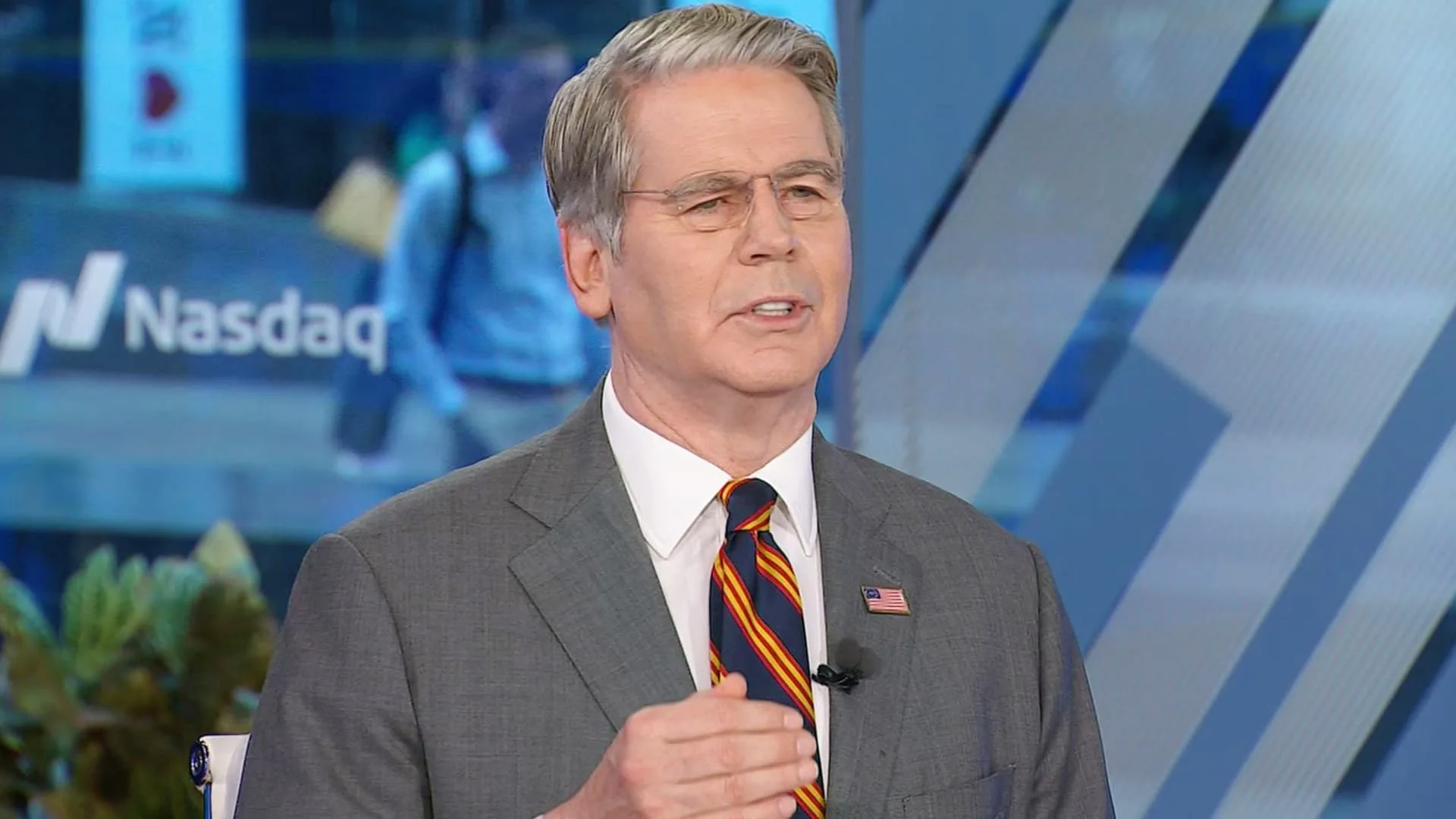
U.S. Treasury Secretary Scott Bessent said artificial intelligence developers should not expect a federal “liability shield,” arguing that responsibility for the technology ultimately rests with people, not the systems they build.
Speaking to CNBC, Bessent said, “It is humans who are responsible, not the AI,” when asked about President Donald Trump’s opposition to a tougher regulatory crackdown on the industry. He argued that growing concerns around advanced AI models do not remove accountability from companies and their executives.
Bessent also said he spent 12 hours on Sunday in talks with Chinese Vice Premier He Lifeng ahead of this week’s summit in Washington between Donald Trump and Xi Jinping. According to him, the two sides discussed AI and formalized a framework for further contacts that could lead to another meeting later this year in Shenzhen, where an Asia-Pacific Economic Cooperation summit is scheduled for November.
He said the two officials also discussed creating a communication channel for future AI-related incidents so that both sides can align on what they see as the main risks, including uncontrollable agents, nonstate actors in cyber activity and nonstate actors tied to biological weapons threats.
Bessent said a focal point of the meeting was the approaching expiration of the temporary U.S.-China trade truce. That agreement, which paused an escalating trade conflict between the two powers, is due to expire on Nov. 10. He also said Iran came up in the discussions, but did not provide details.
The Treasury secretary confirmed that Donald Trump plans to greet Xi Jinping on the tarmac at Maryland’s Joint Base Andrews. “I think we’re going to have a great visit,” Bessent said.
On interest rates, Bessent said last week’s Federal Reserve increase — the first since 2023 — could eventually be followed by lower rates once the war against Iran ends. In his view, oil markets would be better supplied after the conflict, which should help bring rates down.
The Federal Open Market Committee unanimously raised its benchmark rate target to 3.75% to 4% in an effort to curb “elevated inflation.” At the same time, Donald Trump, who appointed Fed Chair Kevin Warsh, has repeatedly pushed for lower rates.
Bessent also defended recent Treasury market intervention. He pointed to the Sept. 10 buyback of more than $5 billion in 10-year Treasury and 20-year Treasury notes, describing it as successful and suggesting yields would have risen even further without the move.
Since the war against Iran began in late February, the benchmark 10-year Treasury yield has climbed by about 100 basis points and moved above 5% last week for the first time since 2007. That yield influences long-term borrowing costs, including mortgage rates, which topped 7% this month for the first time in more than a year.
During the CNBC interview, Bessent also defended Donald Trump’s decision to bar three news outlets — MS NOW, CNN and Politico — from the White House. He initially said he knew little about the move, then argued that perceived bias in the “legacy media” had damaged those outlets’ standing. The three organizations later sued on First Amendment grounds.





