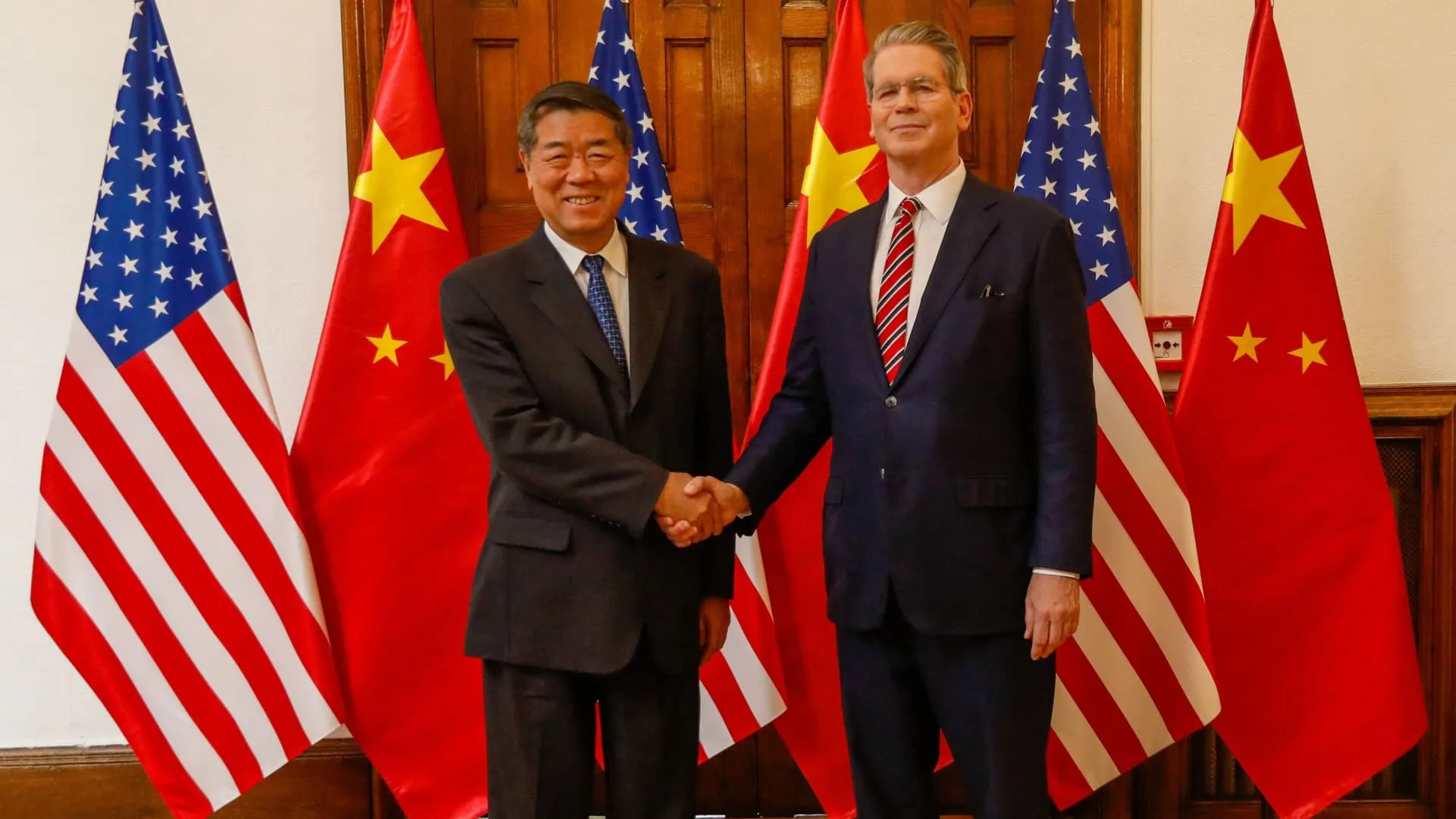
U.S. Treasury Secretary Scott Bessent and Chinese Vice Premier He Lifeng are due to hold talks in New York on Sunday aimed at preparing possible agreements on artificial intelligence, tariffs and critical mineral supplies. Reuters reported that the meeting is intended to lay the groundwork for this week’s high-stakes Washington summit between U.S. President Donald Trump and Chinese President Xi Jinping.
The discussions will take place at JP Morgan Chase’s headquarters in Manhattan and will also include U.S. Trade Representative Jamieson Greer. The session is scheduled to begin at about 10:30 a.m. local time and is expected to continue throughout the day.
One of the main issues will be the U.S.-China trade truce, which is due to expire on November 10. U.S. officials are also dissatisfied with the flow of Chinese rare-earth magnets and other critical minerals. Another key topic is the possibility of AI “guard rails” after reports of major security breaches involving AI models.
Analysts say the most likely outcome is not a major breakthrough but a limited package of steps designed to show that Washington and Beijing are still trying to prevent a fresh escalation in a trade relationship with broad consequences for the global economy. China trade analyst and Ashton Intelligence founder Anna Ashton said both sides would probably want to show some deliverables ahead of the presidential summit, but that there was little sign of a broader breakthrough and that the status quo remained the most realistic expectation.
Many of the issues on the agenda trace back to the May meeting between Donald Trump and Xi Jinping in Beijing. They include efforts to reduce tariffs on non-strategic goods, as well as Chinese pledges to increase purchases of U.S. agricultural goods by $17 billion a year and to buy more than 200 Boeing aircraft.
Over the past 16 months, Bessent, He and Greer have repeatedly met in cities across Europe and Asia to prepare potential agreements for the two leaders. One result of that process was the truce reached in November 2025 in Busan, South Korea, which capped U.S. tariffs on Chinese goods imposed during Donald Trump’s second term at about 20% after tit-for-tat escalation had pushed duties on both sides into triple digits.
The U.S. Supreme Court later struck down the Trump tariffs imposed under a national emergencies law, including duties linked to fentanyl trafficking. Even so, the administration has been rebuilding those restrictions under new legal authorities, including restoring a 12.5% tariff on Chinese goods over forced labor allegations. It is also finalizing a separate tariff investigation aimed at curbing what Washington says is excess industrial capacity in China.
Under the truce, China had promised to restore flows of critical minerals to U.S. and global users. But a senior U.S. official said on Friday that China’s performance on that commitment “has not been up to par,” making the issue one of the central topics ahead of the Trump-Xi summit.
New AI agenda
The Bessent-He talks on artificial intelligence are especially significant because the United States and China are the two main forces behind the development of advanced AI tools and the global spread of the technology. Rare earths are also essential for manufacturing advanced semiconductors that power AI systems.
Bessent said on Friday that the discussions would cover “both open- and closed-weight models.” Open-weight models are AI systems whose core elements are publicly accessible, allowing users to download and fine-tune them for specific tasks.
Chinese open-weight models are becoming more popular with U.S. companies in part because they can be cheaper than closed-weight tools developed by Anthropic, OpenAI and other U.S. firms. Bessent said the United States remains the leader in AI but is open to discussions on reducing shared risks and avoiding a split between the two systems.
He has also called for the United States and China to agree on AI “guard rails” to keep powerful models out of the hands of malign non-state actors.
Tariff cuts and investment
In May, Washington and Beijing also agreed to launch talks on reducing tariffs on non-strategic goods under a so-called “Board of Trade” mechanism, alongside a similar forum for addressing specific investment issues.
Although the Trump administration has tightened restrictions on U.S. company investment in some Chinese industries, Reuters reported that it is now working on rules that would likely allow U.S. pharmaceutical firms to invest in promising Chinese drugs and strike licensing deals around them.
China’s Ministry of Commerce said on Saturday that He Lifeng would also lead a delegation of Chinese companies to the United States for economic and trade consultations ahead of the summit. The announcement came as Donald Trump signaled openness to Chinese automakers building factories in the U.S. At the same time, U.S. auto industry groups on Friday urged the administration to maintain an effective ban on Chinese vehicle sales in the American market on national security grounds.





