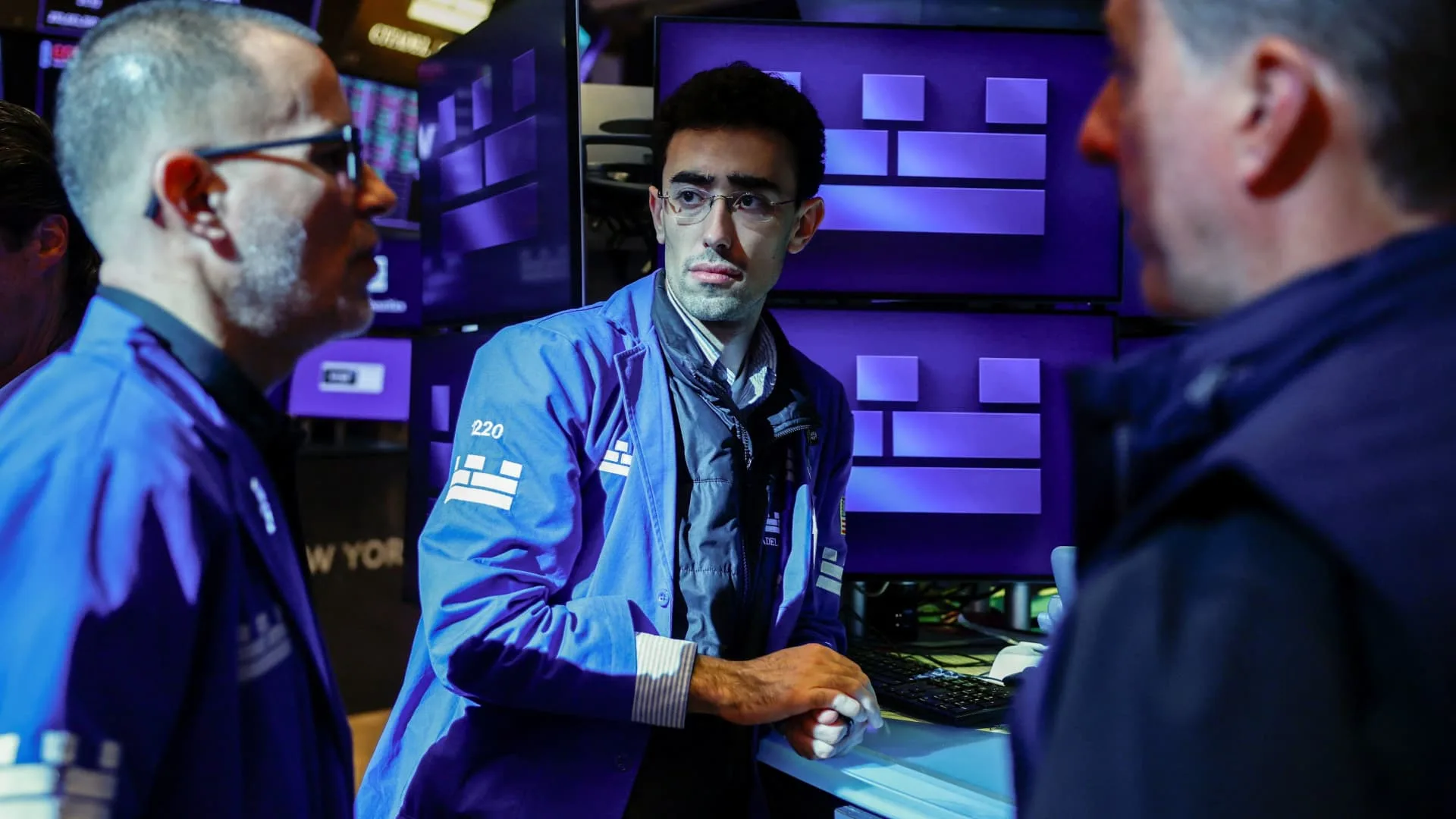


U.S. stocks closed lower on Tuesday as investors weighed a sharp rise in Treasury yields, higher oil prices and the Federal Reserve’s policy decision due later this week.
The Dow Jones Industrial Average fell 328.09 points, or 0.63%, to 52,093.11. The S&P 500 dropped 0.45% to finish at 7,585.73, while the Nasdaq Composite lost 0.78% to settle at 25,981.57.
Losses in the S&P 500 and Nasdaq were partly cushioned by gains in several artificial intelligence-linked names. Coherent added nearly 2%, Advanced Micro Devices rose 2%, and Qualcomm advanced more than 4%.
The yield on the benchmark 10-year U.S. Treasury note was also a key focus for markets. During the session, it climbed to 5.041%, its highest level since 2007. It later pulled back from that peak and was last up by more than 3 basis points at 5.00%.
Global bond yields have become a major driver for equity markets in recent weeks, as government debt has sold off amid concerns that the ongoing U.S.-Iran war could fuel inflation and push central banks toward a more hawkish stance.
Melissa Brown, global head of investment decision research at SimCorp, said investors are finally catching up with those risks. In her view, with U.S. government debt having surpassed $40 trillion and inflation still “stubbornly high,” oil above $100 a barrel is forcing the market to pay closer attention.
Oil prices moved higher after Saudi Arabia shut a key pipeline that bypasses the Strait of Hormuz. Brent had already closed above $105 a barrel on Monday, while West Texas Intermediate settled above $101. The rally extended on Tuesday, with November Brent crude futures rising almost 3% to end the session at $108.75 a barrel and WTI futures gaining more than 4% to $105.83.
Traders are also focused on the Federal Reserve’s rate decision expected on Wednesday. Fed funds futures imply a more than 94% chance that the central bank will raise rates by a quarter point, taking the target range from 3.5% to 3.75%.
Brown said markets want at least some guidance to help frame the policy outlook. In her view, if Kevin Warsh says the Federal Reserve remains concerned about inflation and will respond accordingly, that may be enough for investors; the bigger concern is the absence of a clear signal.
Barclays strategists said in a Tuesday note that higher rates have already weighed on valuations and are increasingly putting equity portfolios at risk. They argued that the approach to the 5% threshold in 10-year yields marks a historically important turning point, beyond which rates have typically become a more persistent headwind for equities.



