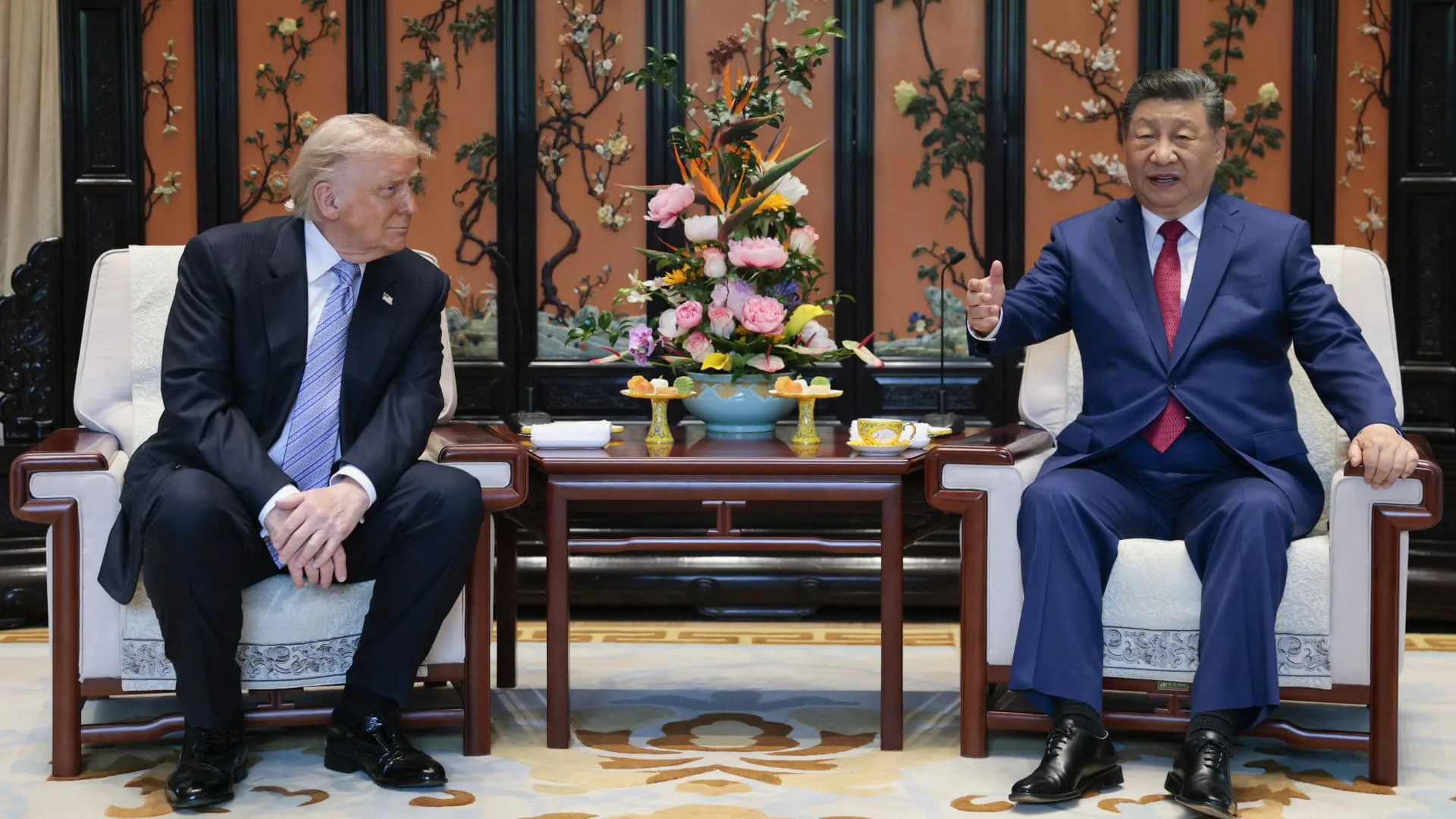
The temporary easing in U.S.-China trade tensions is still in place, but the core commitments supporting that truce are moving at very different speeds. Ahead of Thursday’s summit in Washington between Donald Trump and Xi Jinping, attention is focused on three areas: purchases of U.S. soybeans, the pledge to buy 200 Boeing aircraft, and the resumption of rare earth magnet shipments.
Analysts say the uneven pace suggests the truce is doing its minimum job — keeping trade flowing and discouraging a fresh escalation. At the same time, neither side appears willing to give up strategic leverage. Eric Xiao, head of sales for Asia at CMC Markets, told CNBC that the truce is advancing fastest where the cost of doing so is lowest.
At their May meeting, Beijing reaffirmed its commitment to increase soybean purchases from the U.S. and buy 200 Boeing aircraft. Chinese rare earth magnet shipments also resumed after export controls were suspended for a 12-month period starting last November. Even so, implementation across the three areas has been uneven, and in some cases difficult to verify.
Larry Hu, head of China economics at Macquarie Group, described the current U.S.-China relationship as a period of détente shaped by a “balance of vulnerability.” In his view, both sides are highly aware of each other’s choke points. Wendy Cutler, vice president of the Asia Society Policy Institute, has likewise argued that both countries are currently focused on stability rather than genuine rapprochement.
Soybeans: the clearest measurable signal
Soybeans provide the most visible numerical sign of progress. Reuters reported that China bought roughly 1 million tons from U.S. producers in a single week in September, bringing it to nearly half of its annual 25 million ton commitment.
Analysts say soybean purchases also serve as a political signal of cooperation. China strategist Andy Rothman told CNBC in July that buying activity tends to pick up before bilateral meetings between Trump and Xi and then fade again afterward. Xiao called soybean orders “political trophies,” but cautioned against reading them as a direct measure of Beijing’s broader trade stance, since China is also buying because it needs the crop.
Disputes over soybean trade are longstanding. China, the world’s biggest soybean importer, saw the U.S. share of its total soybean imports fall from 40% before Trump imposed tariffs in 2018 to 23% in the first five months of 2026.
Aircraft: slower and less transparent progress
Movement on the 200-aircraft Boeing pledge is far less transparent. According to Reuters, U.S. Trade Representative Jamieson Greer said this week that roughly 140 aircraft were in a “good state,” while orders for another 10 were being written. No details have been disclosed on customers, models, or delivery schedules.
Boeing CEO Kelly Ortberg has also played down expectations of a single headline announcement covering all 200 aircraft. He said individual Chinese airlines would place and announce orders on their own timelines.
The commitment also came with conditions. In Beijing’s official account, the May agreement linked the purchases to U.S. guarantees over supplies of aircraft engines and parts. That means implementation depends not only on political intent, but also on supply arrangements.


Rare earths: strategic leverage remains intact
China’s rare earths commitment is the hardest to assess because it concerns reliable access rather than a fixed export volume. Shipments of Chinese rare earth magnets to the U.S. recovered after earlier restrictions, but fell to 512 metric tons in August, down 20% from July and 13% from a year earlier, according to Chinese customs data cited by the Financial Times.
Uncertainty for U.S. buyers has not disappeared. Reuters reported that some Chinese suppliers declined U.S. orders because of geopolitical and compliance concerns, while some American companies waited more than six months for export licenses.
Experts say rare earths may be the clearest test of the broader relationship because the strategic cost of concessions is highest in this area. Hu identified rare earths as China’s main choke point, balanced against U.S. leverage in advanced semiconductors used in chipmaking.
Xiao likewise said rare earths are the best indicator of the overall U.S.-China relationship because of their importance to clean energy, advanced technology and defense. In his view, progress on this commitment could anchor a more durable relationship in a way soybean purchases and aircraft orders cannot. At the same time, he noted that this leverage has limits: a full export cutoff would push the U.S. and its allies to accelerate alternative supply chains, while also hurting Chinese producers that depend on global electric vehicle and technology markets.



